Near Future Laboratory Blog
Thoughts, Reflections, Updates & Week Notes
May 29, 2007 – Jul 18, 2007
w22/w23/w25/w26/w27/w28/w29/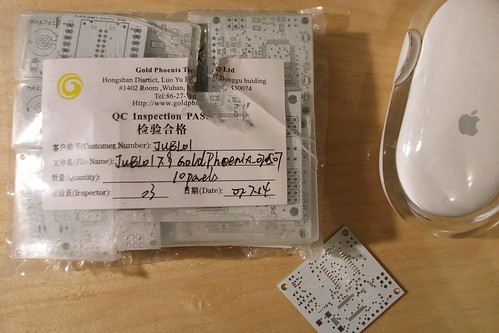
Jul 18, 2007
So, I’ve been pretty happy sending printed circuit boards off to this Gold Phoenix operation in China. It feels global to do my manufacturing offshore and its certainly a heck of a lot cheaper than doing it onshore. Frankly, my budget is my pocket money and every penny counts. I’ve been even happier that I can do th…
Book StuffGeneralHardwareHow ToPrinted Circuit BoardDIYPCB
Jul 18, 2007
Convergence: The International Journal of Research into New Media Technologies
GeneralProposal

Jul 08, 2007
The 2nd part of Don Norman’s two part essay on “The Next UI Breakthrough” appears in the July/August 2007 edition of ACM Interactions. In it, he describes how physicality is now being re-introduced into the user interface for computers. He describes physicality as more extensive than tangible computing and “embodime…
GeneralInteraction TermsMotionuser interface

Jul 01, 2007
The “Blubber Bot” series of DIY blimps has been a great success. Jed ran a workshop the other day at Machine Project. Sold out, in fact. Everyone was overjoyed. Mark broke out the cooler of ice cream and cones. I think they’re scheduling another one for the people who got locked out.
AtmelBook StuffDesign Art TechnologyGeneralHardwareProjects
Jun 25, 2007
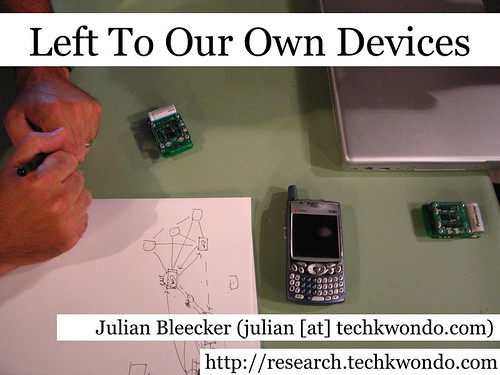
Making our own stuff — what does it mean, how do you do it? There is a sense that the ability to make our own electronic/digital/computational “stuff” is not just fun, but has some larger purpose that’s related to impulses of DIY sensibilities. Making your own devices has a implicit cultural and political message. T…
Book StuffGeneralSlow Messengerwriting

Jun 20, 2007
When one thinks of “mobile computing” I think the knee-jerk meanings are to consider it to be desktop computing only with a smaller screen and a jammed up smaller keyboard. Suppose though you could start with the mobile part and think first about movement or the kinds of activities that happen when you’re moving, as…
Book StuffInnovationInteraction TermsMobileMotionTheory Object

Jun 03, 2007
It is designed and manufactured by Leah Buechley in Boulder Colorado. This version is an old one she and Jean-Baptiste LaBrune used for a post-industrial workshop near switzerland.
ArduinoHardwareInnovation

Jun 03, 2007
Here are the slides from my Reboot presentation where I sketch a speculative pre-history of computer-human interfaces that includes bricklayers, Apollo guidance computers, Herman Miller Eames loungers and Aeron chairs. The trajectory is an argument for investigating how efficiency (time and motion) can be factored o…
reboot 9reboot 9.0GeneralMotionProjectsTime
May 29, 2007
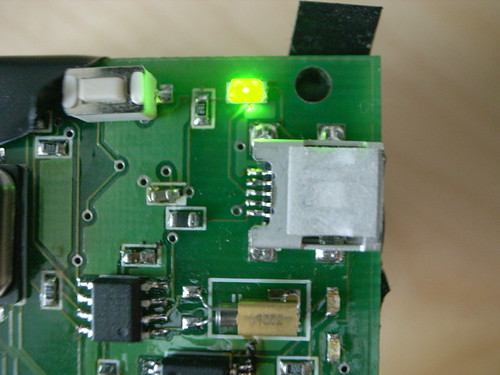
I dunno, I was staring at the Slow Messenger and the power LED — your typical grasshopper green — was so bright and just staring at me and kind of giving me a headache. And I thought..that’s not about slow. And I thought about the drowsy white “sleep” pulse of my PowerBook and I was, like..I need something like that…
Near Future Laboratoryslowest instant messengerAtmelDesign Art TechnologyHardwareHow ToProjectsTheory Object