Near Future Laboratory Blog
Thoughts, Reflections, Updates & Week Notes
Nov 6, 2025 – Dec 7, 2025
w45/w46/w47/w49/w50/
Near Future Laboratory Global HQ
Dec 07, 2025
Calling all generalists! Time to collaborate with specialists so we can all navigate into more habitable futures together! A decade and a half of identical headlines warning that “the university as we know it” is over tells you everything about the misalignment between specialized institutions and the futures they’re supposed to deliver. The failure of the university is a microcosm of the failure of any large, siloed organization. Over-specialization creates blind spots. Those blind spots make the organization brittle, unable to adapt, and ultimately unable to articulate a preferred future. The role of the generalist is to re-stitch the connective tissue the structure no longer allows.
futuresgeneralistspecializationuniversitymisalignment
Julian Bleecker at the symposium The Future of Being Human at MBZUAI in Abu Dhabi November 20-22 2025 hosted by Elizabeth Churchill
Dec 03, 2025 (ref Nov 20, 2025)
The Future of Being Human: An HCI Symposium at MBZUAI was a gathering of researchers, artists, designers, and academics exploring the intersection of technology and humanity. Wondering and wandering into futures together in order to actively build a more human future, considering themes of AI and agency, embodiment and identity, ethics and values, and the role of design in shaping what it means to be human in a world increasingly mediated by technology.
HCIAISymposiumMBZUAIFutureDesignTechnologyHumanity
Near Future Laboratory Global HQ
Dec 02, 2025
I’ve been wondering lately if we’ve let the word capitalist calcify into something too blunt to be useful. Somewhere along the way it became shorthand for extraction, exploitation, and the hollowing out of meaning. Fair enough — those systems exist, and they do real harm. But when I look at my own life, the word attaches itself in ways that feel quieter, more human, and frankly more honest.
workeconomicscreativityworkcreative capitalstudio lifecapitalism
Book cover of “The Anti-Aesthetic: Essays on Postmodern Culture” against a mountainous landscape.
Nov 16, 2025
A short sketch of an essay that came out of some workshops and discussion about the role of generative AI in image production, trying to collapse the theoretical into and onto the practice of making images today. What I am trying to get at is that Hal Foster's *The Anti-Aesthetic* (1983) feels newly relevant in a world where generative AI produces smooth, finished images at industrial scale. The anti-aesthetic then was about resisting spectacle and surface; today it might be about reclaiming the interval of thinking and intention that generation threatens to erase. Of course, I'm not referring to all generative AI art here, but rather the kind that is produced and consumed unthinkingly, as a kind of visual fast food — all the anime, the portraits, the endless style transfers, the goof-ball “slop”, and so on that floods social media feeds, and that risks numbing our capacity to see and think critically about images.
artaestheticsgenerative AIpostmodernismHal Fostervisual cultureimage productioncritical theory
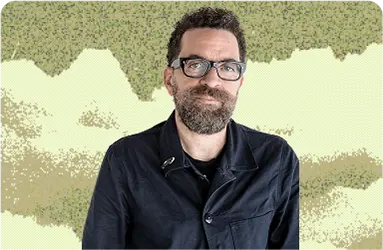
A headshot of Julian Bleecker PhD for the Dubai Future Forum event at which he is a featured speaker
Nov 15, 2025
I’ll be joining the Dubai Future Forum 2025 — the world’s largest gathering of futurists, policymakers, and creative thinkers — to speak on a panel titled “Relearning Imagination: Are We Actively Shaping Our Future?” In this session, we'll be discussing why imagination is not a luxury or a side activity, but a strategic capability we urgently need to develop. Drawing from my work here at Near Future Laboratory, I’ll mention how I help organizations and communities build their own imagination practices — using Design Fiction, storytelling, and tangible prototypes to make possibility feel real and actionable. This conversation brings together leaders from government, design, and culture to consider how we can reclaim agency, expand our sense of what’s possible, and shape futures worth wanting.
eventconferencepanelfuturismdesign fictionimaginationfutures
a kiosk capsule K67 designed by the Slovenian Architect Saša J. Mächtig as a neighborhood conversation kiosk designed to foster interaction and engagement in a world that has few ways of engaging with neighbors and strangers. It is sitting in front of a home on a suburban street in South Central Los Angeles
Nov 15, 2025
This is Metalabel's practical guide for creative people who love making work but struggle with promotion. It offers twelve principles such things as “do it *for* yourself” and “small is beautiful” to things like release windowing, hosting events, and making the next thing. All of this reframes marketing as care, context, and community rather than chasing metrics. It's got examples, anecdotes, and contributions from other creators (me too!), it argues for defining your own version of success, protecting your creative joy, and staying devoted to the long-term practice of making. It seems to still exist as a living/evolving Google doc. When I was promoting The Manual of Design Fiction, I found myself reflecting on the challenges creative people face when it comes to promoting their work. This was particularly acute when my co-authors simply could not do that kind of work. Creatives love to create (obs) and love making things but (strangely) dread the promotional side of things. This guide is...
creative practicepromotionmetalabelprinciples
Students and professor standing in a row in a studio space
Nov 15, 2025
My second annual visit to Chapman University for Jillian Warren's course in Chapman's graphic design program. This year, I gave a talk on speculative design and design fiction and we had a fun workshop with Q&A discussing the role of speculation in visual design and communication. One of the consistent questions that has been coming up in these talks is, not surprisingly, is something around “How do you make a living doing speculative design?” or “How do you get paid to do design fiction work?” It's come up so consistently — from the Harvard-Westlake panel on AI last week, to the four hours of fun one-on-one's with Liam Young's students at SCI-Arc yesterday — that I feel like I need to put something together on that point..at some point..
A speculative product toilet that uses AI and sensors to monitor your health
Nov 12, 2025
The value of Design Fiction isn’t prediction. It’s a method for making the abstract tangible—a way to embody trends, hopes, and anxieties so they can be discussed, debated, and designed with, not just around. A prototype like MeWee Monitor doesn’t forecast; it makes meaning felt. Using Design Fiction within organizations allows teams to experiment with the future in the present much like the way R&D once explored new technologies before quarterly metrics eclipsed curiosity. It gives companies a safe way to ask what if when the usual tools can only ask what’s next.
aidesign fictiontoiletsensorspurpose
Near Future Laboratory Design Fiction Imagine Harder
Nov 06, 2025 (ref Dec 11, 2025)
Last week I was invited to sit on a panel about AI — surprise — at of all places, a local high school here in Los Angeles called Harvard-Westlake. It was part of an event they called NextGen where they bring in people from various fields to talk about what the future might hold.
event