
| |
| |
| A worker at a Waymo depot recently described the job of getting cars ready for their next passenger. Charging, troubleshooting, cleaning the remnants of a passenger's over-indulgence at the bar. In Bay Area Current’s interview, the worker describes life at contractor Transdev, including
finding out which depot they’ll be working at two hours before their shift. This came up during Office Hours N°323 (last Friday). I don't mention this to dunk on Waymo. I find the self-driving world a fascinating terrain to wonder about. Endless plotlines in there. I mention it because it returned the Office Hours discussion to a page from the Quick Start Guide for a Self-Driving Car, which grew out of a workshop I facilitated at IxDA in 2015 (11 years ago!). The work of
the workshop brought up the question: clean-out! If you send your car into what we then (11 years ago!) called “Uber Mode” and it goes and hustles as a self-driving taxi, who takes care of the aftermath? We had devoted an entire panel to a “ReFresh™” feature. There was a pressure canister involved.
Explicit cautionary descriptions of the procedure were included, like making sure no one or no pet were still in the vehicle when this (presumably somewhat noxious if not toxic) procedure was carried out. People were going to do people things in these cars. In fact, people do do things in these cars,
and the evidence is right there in the Waymo depot. Writing a quick-start guide asks you to spend time with those situations. Someone has been sick in the back seat, or is just sick and does something sick. Someone else is about to get in. You have a few inches of an instruction guide in which to
describe what happens. A somewhat pedestrian yet necessary concern that no one really wants to talk about nor work on gets a whole page because, well...humans have bodily functions, tendencis to over-indulge, and the occasional mishap that needs attending to. That’s something I value about working this way. People bring their experience, their peculiar observations, their sense of what someone might actually do. Despite the untidyness of the things that may come up in a room, using this kind of approach gives you a chance for those things to find a place to sit down for a bit; to live on a page
,in this case.We follow a detail, sketch it, write the instructions, see what else it brings up. The resulting object holds those contributions together. We can return to it with a new story, as we did in Office Hours. Read alongside the depot worker’s account, that ReFresh™ panel opens up further
questions. Who gets the car ready? What does their shift look like? What have we packed into that pleasant little word, “refresh”? This is work I love doing with people: listening for the detail worth following, making connections, helping an idea acquire a shape we can examine together. If your team
or org has a question or initiative that could use this kind of facilitation or support, get in touch or just reply to this newsletter. | |
| From the Archives
|
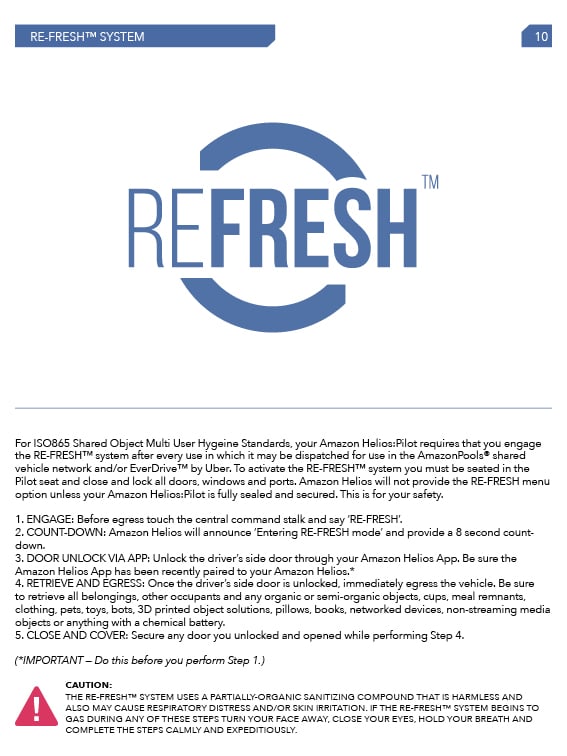 RE-FRESH system, page 10. IxDA, 2015 The guide discussed in this issue’s introduction came out of a workshop we ran at IxDA in 2015. Participants wrote and illustrated instructions for everyday life with an autonomous car, including taxi mode, errands, and the RE-FRESH
system shown here. Explore the Quick Start Guide →
| |
| |
| From the Shop
| |
|
From the Near Future Laboratory Shop
| 
| |
| The Four Design Fiction Books
| The Manual of Design Fiction, the TBD Catalog, The
Reader’s Guide to the Manual of Design Fiction, and Androids Dream of Electric Sheep, together in one box with the Electronic Sheep collector cards. | |
|
|
| |
| Tomorrow's Jobs Today
| |
|
|
|
 Food Drug and Algorithm Administration Platform Counter-Inference AnalystThe Food Drug and Algorithm Administration protects public health where regulated computational systems are used, prescribed, ingested, sold, embedded in essential services, or made available to the public. The Administration reviews algorithmic interlinks for their effects on behavior, attention, agency, health, and civic life. The Office of Platform Counter-Infergency is hiring a Level II analyst to examine how platform inference shapes behavior and how algorithmic interlinks inform consequential human activity across different places, populations, and conditions of use. Would you like to know more?
|
| |
|
| |
| Tomorrow's Service Vans Today
| |
|
DR. CORNELIUS LOCAL SERVICES
| 
| |
|
|
| |
| Food For Thought
| From the not-flock-cameras
Channel DEPARTMENT OF Sound Art | shared by julian The 101 Plays Itself, by Jay Judah. Brian Eno would be either proud or professionally jealous. It turns traffic on Los Angeles’s 101 freeway into music using a public
Caltrans camera. (p.s. the cameras can go offline at times; just switch to another one.) Five lanes become the stave of a musical composition, with passing vehicles triggering notes and their speed and length influencing the resulting sound.
Listen to the 101 →
| |
| From the digest-this-🥓 Channel DEPARTMENT OF Consumer AI | shared by julian People don’t just want chatbots to be productive assistants. This report
shows how 80% also pick relational or supportive roles, and many describe distinct “personalities” for different tools. Curiously, non-use is driven by distrust as much as by lack of need, especially when a presented checklist highlights ethics and environmental concerns. Takeaway: chatbot makers grow faster by clearly targeting specific user groups and listening honestly to those who aren’t convinced. Read the report →
| |
| From the digest-this-🥓 Channel DEPARTMENT OF AI misuse | shared by julian Anthropic’s Threat Intelligence reports that they identified and disrupted operations
where threat actors tried to use Claude for malicious purposes. Contains notable case studies across seven harm areas, including cyber ops, influence ops, surveillance, scams and fraud, biological misuse, trad weapons development, and illicit distillation. Haiku, Sonnet, and Opus were used in these cases, while Claude Fable and Mythos-class models were not (except for one illicit distillation case). Curious how AI adoption can increase harm by boosting speed, scale, and depth across the cyber
kill chain? Read the report →
| |
| |
| From the Archives
| A digital worry bead for touch, motion, and time
This physical prototype of a thing came about in 2008, which was a time when there were early indications that our connected digital gewgaws were not ameliorating stress and anxiety — in fact they may be amplifying and elevating stress and anxiety. This quick sketch imagines an intimate handheld device
modeled on the kombolói which is like a traditional Greek worry bead. Yes. I appreciate the irony of making a thing that is meant to alleviate the anxiety of the digital world with a digital worry bead. The idea came to mind and rathe rthan dismiss the idea because it contains its own irony, I wanted to test the contours of the notion. But this may actually be as much about a raft of sensors that I wanted to “research” (muck about with in a purposeful way): capacitive touch, motion, and light.
The idea was that this produced mostly light effects based on how much and for how long it was held in the hand. The project explores touch, motion, and duration, treating a small physical object as a way to consider how interactive experiences can feel. Explore Kombolói →
| |
|
Join the Near Future Laboratory Discord Your support helps
|
Near Future Laboratory Patreon Join the Discord, Support Office Hours, the Newsletter and More
| 
| The Near Future Laboratory is
supported by its community and members. Join us on Patreon to support our work, get access to exclusive content, and be part of our Discord community where we discuss design, technology, creativity, the future, do projects, and support each other’s work. I host weekly Office Hours for Patrons. Bring a project, an idea, a question, or something you’ve found and would like to share. We look at work together, offer feedback, exchange references, and stay in touch through the Discord. | Join the Patreon →
|
|
| |
| Office Hours N°323
| Pattern machines, tacit expertise, and workshops as practice I'm trying a new format for the online blog post format of the Office Hours sessions that includes better (?) indexing of the main discussions, plus an ability to play back specific segments of the conversation (and the
whole thing, of course). I'm not sure I'll continue to upload the full videos if this new format works. (What you see below is not the new format — you have to go to the post on the site to see it. A few notes from our September 4 conversation: 1) We discussed generative AI as a pattern machine: its repeated skylines, building heights, and colors make different cities
look strangely alike. 2) A crank-operated language model made computation’s cost felt in the hand: harder tasks meant more resistance. 3) A pathology system virtually stains biopsy slides and flags tissue for a pathologist. We discussed the expertise developed through repeated close looking, and how that experience changes with the work. 4) Chicken sexers, surgeons using touch and smell, and cancer-detecting dogs
gave us ways to consider knowledge that is difficult to describe. 5) Brandon Harwood shared his workshop sequence: observation, interpretation, reconstruction, and deliberation. Artifacts from Dallas–Fort Worth in 2033 included a Waymo birthday invitation for transporting children and a missing-cat poster
reporting an 83%-confidence sighting. Attending: Andrew Korf, Brandel Zachernuk, Brandon Harwood, Bulldog & Fisk, Julian Bleecker, Mad Astra, Marc B, Pawel Halicki, Sabrina Sullivan, and Scott Paterson. Read the recap and transcript →
| |
| |
| Pondering Kat
| 
| |
| |
| |
|
|
|
|


