| |
|
Is The Problem The Problem?
|
| |
| This started as a short one that got longer..I was reading Ken
Anderson's Substack and had some revelations; Tim O'Brien had a LI post about the measure of humanity in the era of AI writing; and Car had a thing about the messiness at Black Mountain College; Academia.edu keeps emailing me a trove of Design Fiction papers, which is humbling to see how the practice has resonated over the years; Sascha Pohflepp's work is still alive and he may have found the Solarpunk origin story; a dispatch from a plausible future I need help building — another episode of
“Tomorrow's Jobs Today”; and I guess its SXSW panel picker season, so I have a pick for you to vote on!
| So..Ken Anderson's recent Substack post “A Better Noun”, right? It got me thinking about the way I remember problems
getting framed in organizations. Ken's post is about the way things get named in those contexts (he spent a career there at Intel), and how that naming can shape our understanding of the things around which one circles attention. In particular, Ken talks about the way problems get a name, and how that naming can subsequently shape understanding of these things. And it got me wondering about prototypes and prototyping. You know, you have an idea and the best way to get it from some vague feeling in your head to something someone who lives outside of your head is to make a thing. You make the thing to help you explain as much to yourself as to others what this idea is — it's a conversation piece; it's there for discovery and exploration. Except often it isn't there for exploration. It's there to get closer to a solution because, you know — it's a problem we're attending to. The intent isn't to expand the terrain of opportunity or bring a different kind of attention to the space. The canonical prototype assumes there's a problem to solve and we're on our way to solving it because — look!..we're making a thing and if that thing doesn't solve a problem then, like..what's the point? And this to me seems to be one of the struggles of doing what I do — applying speculation to help explore possibilities, which is not the same as solving a problem, which is the thing that most organizations think they should be doing (near as I can tell.) So how does one convey the value of doing work that doesn't solve problems but increases the surface area (expands the terrain) for unexpected/unknown opportunities? That's the question. If you figure that out, let me know. I'm
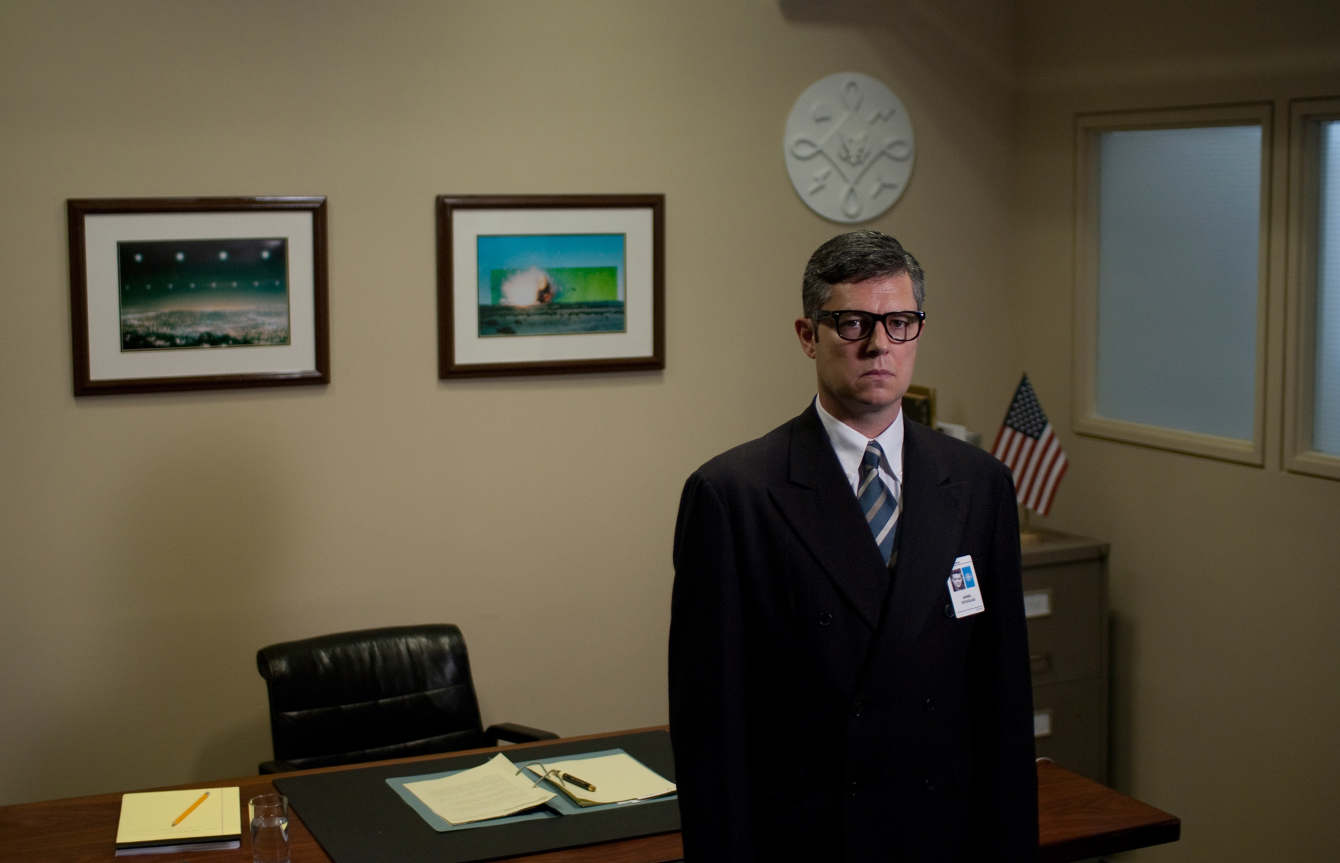
still working on that. It might just be in the name. Applied Speculation? Maybe? | |
| Design Fiction Product Design Work Kit
| |
|
Design Fiction Product Design Work Kit
| 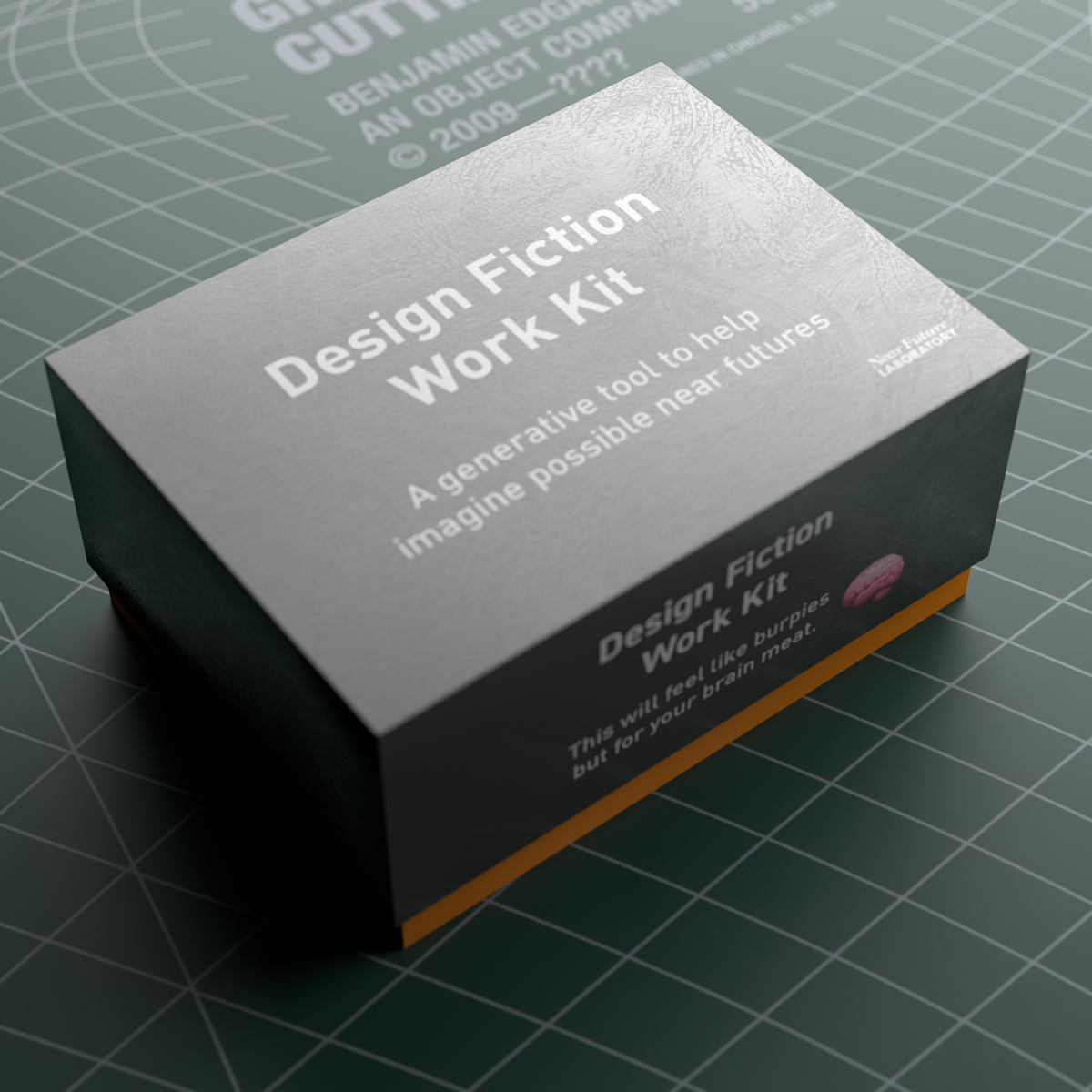
| Last few remaining. A card-driven tool for
imagining near futures: combine archetype, tone, object, attribute, action, and a 70/20/10 Joker to create unexpected Design Fiction product proposals. | |
|
|
| |
| Past & Future
| Sascha Pohflepp · The Golden Institute Sascha Pohflepp's The Golden Institute (2009) imagines an alternate history in which Jimmy Carter wins a second
term and renewable energy receives the scale and ambition of the Apollo program. In the interest of keeping Pohflepp's pathbreaking corpus alive, watch the film and revisit the project through his archive and
this account of the work. I'm curious to build on this work and develop
further a world in which energy policy evolved from the moment of the pivot that is central to this work. Suppose we got Solarpunk instead of Cyberpunk?
See The Golden Institute →
| |
| |
| In Conversation
| Dubai Future Horizons · Julian Bleecker & John Katsos Dubai Future Horizons brought together more than 350 people, joining from around the world, for a conversation with John Katsos and me about the kinds of people we might become alongside AI.
John speaks to the moral muscle of keeping one’s own judgment under pressure; I talk about imagination as a human practice—the ability to see other ways of being and knowing. We also spend time with a risk that feels close at hand: ceding the difficult, uncertain part of thinking to a chatbot. It’s a
generous, wide-ranging hour, and a useful indication of the creative R&D work I bring to organizations: using research, storytelling, and artifacts to make consequential possibilities available for examination.
Watch the full session →
| |
| |
| Books & Accessories
| Volume I: Classes, Monsters, and Anti-Patterns in AI Coding Author:
Tim O'Brien ISBN: 9798995259749 The AI Developer's Field Guide gives developers, engineering managers, and technical leaders a role-playing-game-inspired vocabulary for recurring failures in AI-assisted coding. O'Brien organizes developer archetypes, artifacts, and project-scale monsters to examine overconfident merging, ornamental architecture, fragile fixes, and unwarranted trust in automation.
Read the library entry →
| |
| |
| News from an Adjacent Future
Doing these “Tomorrow’s News Today” pieces over on The Adjacency has become a way to make plausible futures tangible and relatable. Representing “the future of work” as a formal,
somewhat terse, and super recognizable job description archetype does two things: it makes one name things like role, responsibilities, and activities directly and specifically in an active voice; and it helps me describe the work I do, including how that work might live within a more-or-less traditional organization. I think organizations will change in ways that may eventually make today’s rectilinear right-angled
org chart look rather odd. (cf that org chart down there; like most things we take granted it has not always been what it is today) For now, read these as one side of a conversation. I am looking for creative R&D work: consulting, fractional, or full-time roles where research, design, prototyping, writing, systems thinking, and cultural translation can be brought to bear on a new technology, product, service, or
capability. If your organization is working through a consequential question and needs an experienced outside collaborator to give it form, make it visible, and develop useful possibilities, I’d like to hear from you. | |
| |
| Tomorrow's
Jobs Today
| Another in a series of explorations to try and describe the kind of work I would enjoy doing. These are an exercise as much as a bit of design fiction. The exercise is for me, not so much you (although I appreciate the emails and formal applications): they are the things I point to when someone asks “so..what do you do?” |

| IMAGINE THIS AT OpenAI
|
Applied Speculative Design, Generative Brand Experiences, Consumer Products OpenAI’s Brand Experiences team is building a small applied speculative design capability across Brand Experience and Consumer Products. The role moves between concept development, prototyping, and product collaboration, building high-fidelity generative experience prototypes that explore how generative AI might feel in consumer products, media, entertainment, and culture. It
is based in Venice Beach, Santa Cruz, and San Francisco with a hybrid three-days-in-office model. Here to help →
| |
| Food For Thought
| From the digest-this Channel DEPARTMENT OF pedagogy | shared by julian
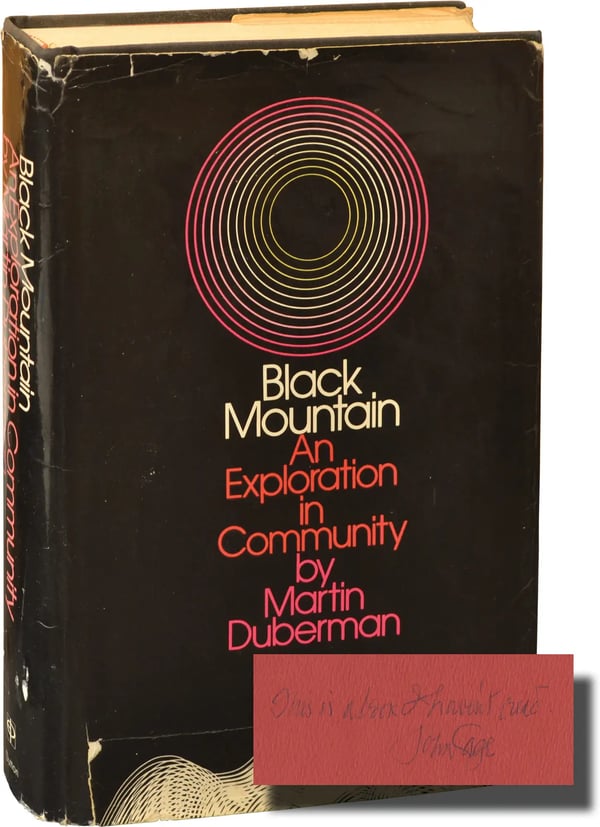 I had some peripheral insights on Black Mountain College over the years, but it wasn't until I started actively
collaborating with Carl DiSalvo that I got a chance to be taken deeper into the whole vibe of the joint. Check out this recent post from Carl on that Substack just around the corner. Black Mountain College ran from 1933 to 1957 in the Blue Ridge Mountains near Black Mountain, North Carolina, built around
inquiry-led learning and a liberal arts education where the arts were central. Founded by John Andrew Rice after he was dismissed over academic freedom disputes, it drew major figures like Josef and Anni Albers, composer John Evarts, philosopher Theodore Dreier, and visiting faculty such as John Cage and Buckminster Fuller, along with students including Robert Rauschenberg, Cy Twombly, and Ruth Asawa. The school’s learning model was unusual: students moved between divisions by taking an
open-note, multi-day exam followed by an oral test, with questions designed to probe how students think and investigate, not just what they memorized. Sounds fun — but Carl makes the point that it's was a mess, which almost sounds like a joint like that should be. One little aspect of the set up that I can relate to is the way the studies at any particular moment were based on who was there at the time. So..no generic History 101 or whatever. Reminds me of my time at History of Consciousness there at UC Santa Cruz, which wasn't the same kind of mess, but had a dynamic and fluid
curriculum based on he faculty there at the moment/era. Read Carl's Post →
| |
| From the Intelligence Analytics Channel
DEPARTMENT OF meaning-making | shared by Tim O’Brien Friend of the Blog and Patreon supporter Tim O’Brien shares Human Quotient, a self-declared
0–10 scale for naming how AI was involved in a piece of work. Tim rates his post HQ(10). Human Quotient distinguishes process from quality and gives the maker a way to describe how the work was made. Curious to see things like this crop up — and of course wondering about what they become. Text and images
are one thing, but what happens when we apply it to fine dining, music, pet DNA? And is there a near future in which the integration of AI into life is just like..hygiene? Wasn't there a time when photography was painting's cheating cousin? (I seem to recall that from Prof. Berger's History of the Camera
Image seminar back there at UW.. Explore Human Quotient →
| |
| |
| Research & Academia Here are a couple of papers more on the research and academic side of things related to the practices of forecasting, futures, and how these things can become “applied” in various more traditional contexts like corporate decision-making.
| |
| |
| Research
| In a corporate setting, design fiction can help teams think critically about future products—yet it’s hard to keep the work genuinely speculative once business requirements kick in. Over more than a year, Mercedes-Benz collaborated on a near-future self-driving car scenario, generating stories and 24 artifacts like city maps and quick-start guides. The project revealed what made the process work,
where it stalled, and how product-centric goals shaped the final direction. Instead of mainly provoking questions, the output leaned toward confirming and justifying innovation through specific, market-friendly implications. Read more →
| |
| Security and privacy problems keep showing up after products ship, often because teams can’t reliably predict threats and social-context risks ahead of time—especially with a shortage of security experts. The authors suggest a workaround: use “design fiction” grounded in science-fiction storytelling to help developers visualize future use, contexts, and failure modes. They point to a pilot effort that used
simplified threat modeling plus story samples drawn from existing science fiction to support threat assessment for Health Internet-of-Things devices, with encouraging early results. The goal is a practical method that can be adapted beyond healthcare and IoT to other software domains. Read more →
| |
| Joseph Lindley and Paul Coulton argue that “imaginary abstracts” (fictional problem frames, prototypes, user studies, and
findings included inside otherwise real research papers) can be extended into fully fictional papers. They compare this approach to “Game of Drones,” a paper that stays fictional from start to finish, revealing its fictional nature only at the end, and they weigh the merits and weaknesses of both tactics. The core claim is that fictional research—used tactfully and carefully—can strengthen HCI’s design discourse by offering compelling new methods for thinking about technology’s real-world
implications.
Read more →
| |
| |
|
SPECULATION IS STRATEGY
| 
| |
|
|
| |
| What an org chart once was
|
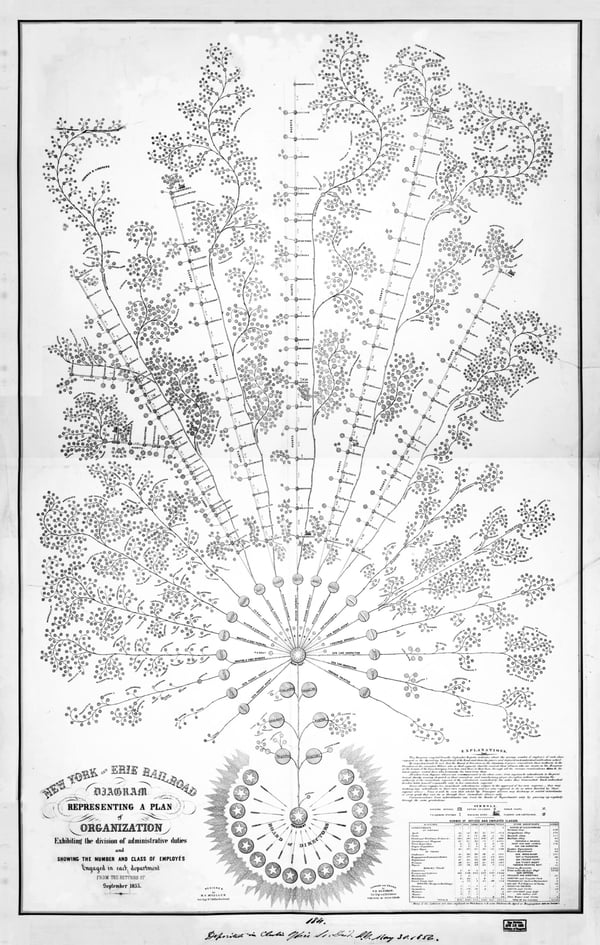 Org Chart General
McCallum's org chart for operational clarity of the railroad network. Described as the first organizational chart (bit of a stretch to make that claim), but no matter..the point here is that this looks futuristic in contrast to all the usual right angles one typically sees. | |
| SXSW Panel Picker
| A Workshop on Learning with AI The Office
Hours had the good fortune to do a run of the workshop that Shreya Thakkar and Sneha Arvind are proposing for SXSW 2026 — and it was a fun structure and a great way to explore the implications of AI in learning. (cf Office Hours N°317) The workshop is designed to help participants think through the implications of AI in learning and to create speculative artifacts that challenge what learning with AI should look like. Over-reliance on frictionless AI can lead to cognitive downsides like overconfidence and weaker independent performance, even if it feels helpful. This SXSW EDU workshop time-travels to a 2045 classroom to create speculative artifacts that challenge what learning with AI should look like. Through debate and hands-on facilitation, participants reverse-engineer today’s critical product choices and leave with a facilitation toolkit and frameworks to anticipate
unintended consequences—grounded in productive struggle pedagogy and emerging AI learning research.
Read & Vote →
| |
| |
| |
|
|
|
|