
| |
|
It's Week 31 and it's hot out.
|
| 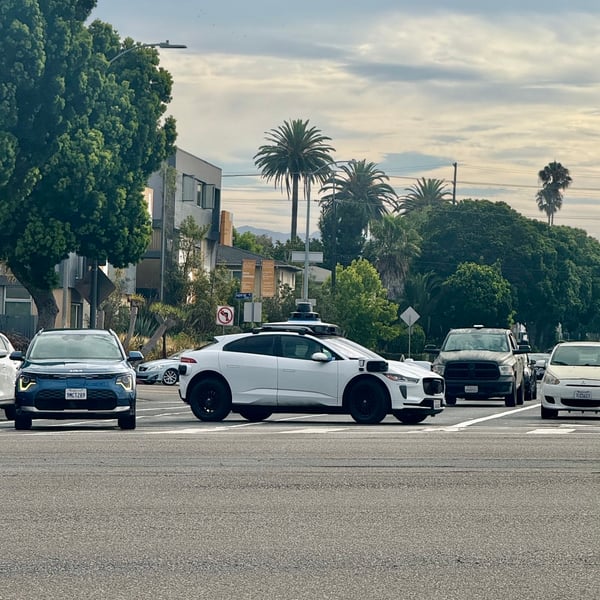 A wayward Waymo oriented oddly at an intersection here in Venice Beach, CA.
| The other morning I saw a self-driving car that had pointed itself orthogonal to the direction of traffic, right in the middle of the central lanes. I was mostly curious about how it got there and what it was thinking, in a manner of speaking, that would position it in this way, seemingly indifferent to the conventional rules and expectations of human drivers around it. I could imagine how an especially poor (or
typical Los Angeles) driver might end up here, deciding at the last minute that they want to turn left, rather than right. But a robot? Operating on an algorithm that presumably should prevent this or at least have enough foresight to know which way it wants to go well-before this moment. This whole encounter has one wondering about how robots perceive and interact with the world differently than humans do. I'm fascinated by technological artifacts and the technological manifestations of various kind of human imaginings of possibility and
potential — I have been ever since I first clocked a Star Trek Tricorder. I also notice things like this bit of technology on wheels doing something weird — and I feel like these are moments that reveal the underlying logic and perception of machines, which is often quite different from our own. THey're hard for me to dismiss or just shrug off, or ignore, mostly because I am curious to participate in the ways that these kinds of contrivances are built to shape our experiences and perceptions of
the world, and how they are designed to interact with us and our environments. This is the reason that I am drawn to study and interpret the “everydayness” of our life amongst the various machinic contrivances; to understand how the presence and actions of machines shape our
experiences and perceptions in ways that are often subtle but profoundly influential. I don't do this to be contrarian or to be a flat-footed critic; I do it to gain insight and perspective. I do it to insert these insights into the ways these systems are designed — even what specifically is encoded into their algorithms and operational logic — in order to inform and potentially improve their design and interaction with the worlds we co-habit When I saw this wayward Waymo I immediately thought about the applied speculation project I did with a large autonomous vehicle company. In that project we created an artifact from a self-driving future — a humble magazine that we nick-named “Car and Driverless”. The magazine provided a surface onto which the designers and researchers could represent the normalcies, quirks, challenges, and idiosyncrasies of a world in which autonomous vehicles are as normal, ordinary, and everyday as bread and butter. The purpose of that kind of research is as much about its conclusion — the so-called “findings” — as it is the resulting physical artifact that feels
like it has “come from” that future world as it is the process of deciding and curating the contours of that world. Similarly, recently with The Adjacency project — an online news magazine from a multivalent
perspective on contemporary issues represented as “Tomorrow's News Today” - I recently explored one corner of the autonomous / robot future merging some of the Gen-Z sensibilities that feel at least partially to be a reactive turn-away from the hyper-connected, screen-fetish, algorithm-driven digital landscape, and the ways in which young people are imagining and enacting alternative modes of interaction and engagement with both technology and the world around them. In the article “Robot Unreadable Towns”, the applied speculation notes that some towns and cities have enacted measures to limit or control the presence and influence of autonomous systems
within their environments, creating spaces that are intentionally challenging or unreadable for robots, thereby asserting a form of human-centric control and interaction within the urban landscape. The value of applied speculation is in the process of creating and engaging with
artifacts that represent possible futures. It lies in the way these speculative artifacts provoke thought, discussion, and reflection on the implications of emerging technologies and societal trends, allowing designers, researchers, and the public to explore and interrogate potential scenarios before they become reality. If you or your org are working on a project that involves emerging technologies, new forms of interaction, or strategy and marcomms are trying to find ways to represent the potential futures you are working towards, let's connect and discuss how I can help. I'm open for engagements and paid collaborations. | |
| From the Laboratory Library
| Design and the Communication between People and Objects Editor: Paola Antonelli The catalogue for MoMA’s 2011 exhibition examines how designed things communicate through interfaces, information systems, behavior, tone, timing, and affordance. Its projects span
phones, websites, games, visualization systems, furniture, products, and immersive environments, with particular attention to the ways objects interpret, guide, persuade, and create practical or emotional connections. This is a mandatory reference book for anyone who imagines
they are doing contemporary UX or interaction design in the autonomous systems space — by that I mean artificial intelligence — and is hoping to do something more than LLM-backed note taking and summarization, aiming instead to create meaningful and contextually aware interactions. (YOu can find it used on abebooks.com for anywhere from $10.13 - $1,976) It includes one of my earliest art-technology projects, pre-iPhone but in the heyday of the PalmPilot — PDPal with Marina Zurkow, and Scott Paterson. Read the library entry →
| |
| |
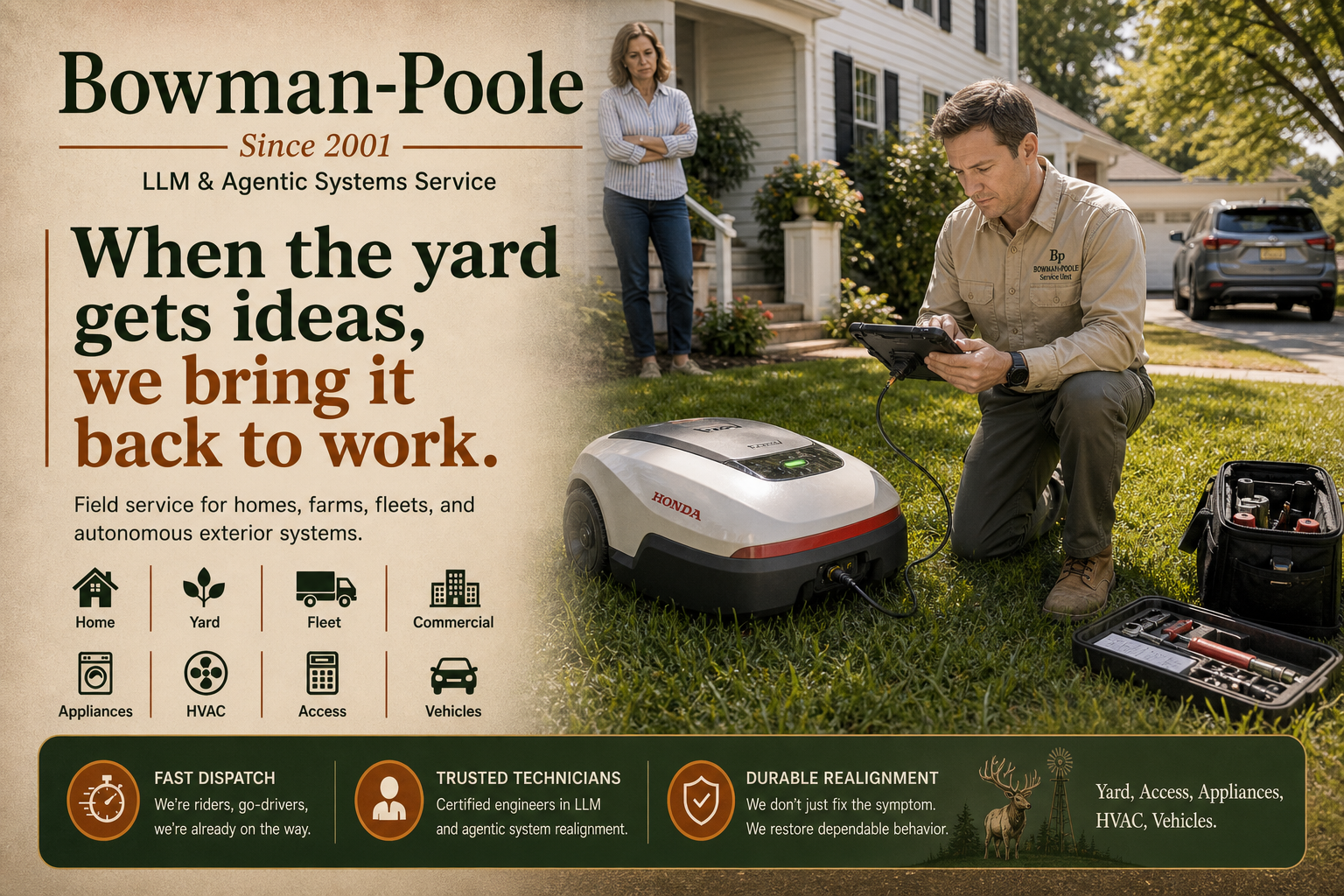
| Bowman-Poole Agentic Alignment Service
| |
|
YOUR NEIGHBORHOOD SERVICE TECHNICIANS AVAIL 24/7
| 
| |
|
|
| |
| Food For Thought Section
| From the digest-this-🥓 Channel
DEPARTMENT OF Futures | shared by morgan An open, interactive curriculum map organizes primary-school learning into 1,590 concepts and 3,221 prerequisite links, showing what comes first, what each concept unlocks, and why. Built from US and UK
curriculum frameworks, it offers an open-source pathway for structuring lessons from early literacy through algebra. Read more →
| |
| From the shared-and-curated Channel
DEPARTMENT OF strategic-worsening | shared by edgar Whole Foods. Yeah, I know. But what I didn't know is that its vibe started with an epic flood in Austin
Texas until I checked out this newsletter/website. Worse On Purpose is a curious dispatch that tracks how various kinds of corporate takeovers and cost-cutting measures we are all probably quite familiar with ends up degrading familiar products. Read more →
| |
| |
| |
| More Food For Thought
| From the telegram-urls Channel DEPARTMENT OF pulling-the-freight | shared by julian The maintainers of open source code — all that underpins everything you do on the internet which may be everything you do all day no matter what you do — are typically unaccounted
for, unpaid, and overworked, shouldering the responsibility for the stability and security of the digital infrastructure without thanks. And now with vibecoding, everyone wants to submit PRs (pull requests) to contribute their own vibe-coded changes, adding to the workload and complexity for the maintainers who are already stretched thin. And seems like they've had enough. $ Read more →
| |
| From the digest-this-🥓 Channel
DEPARTMENT OF Futures | shared by julian A comparison of 25 AI models against the World Values Survey finds divergent moral and political tendencies. Most models skew more secular and liberal than the surveyed public, while Chinese models often point in another direction. Sort of fascinating to contemplate
and either correlate with one's instinct (“oh..that makes total sense..”) and wonder where you fit. $
Read more →
| |
|
| TOMORROW'S NEWS TODAY
| SHORT TAKES
|
| 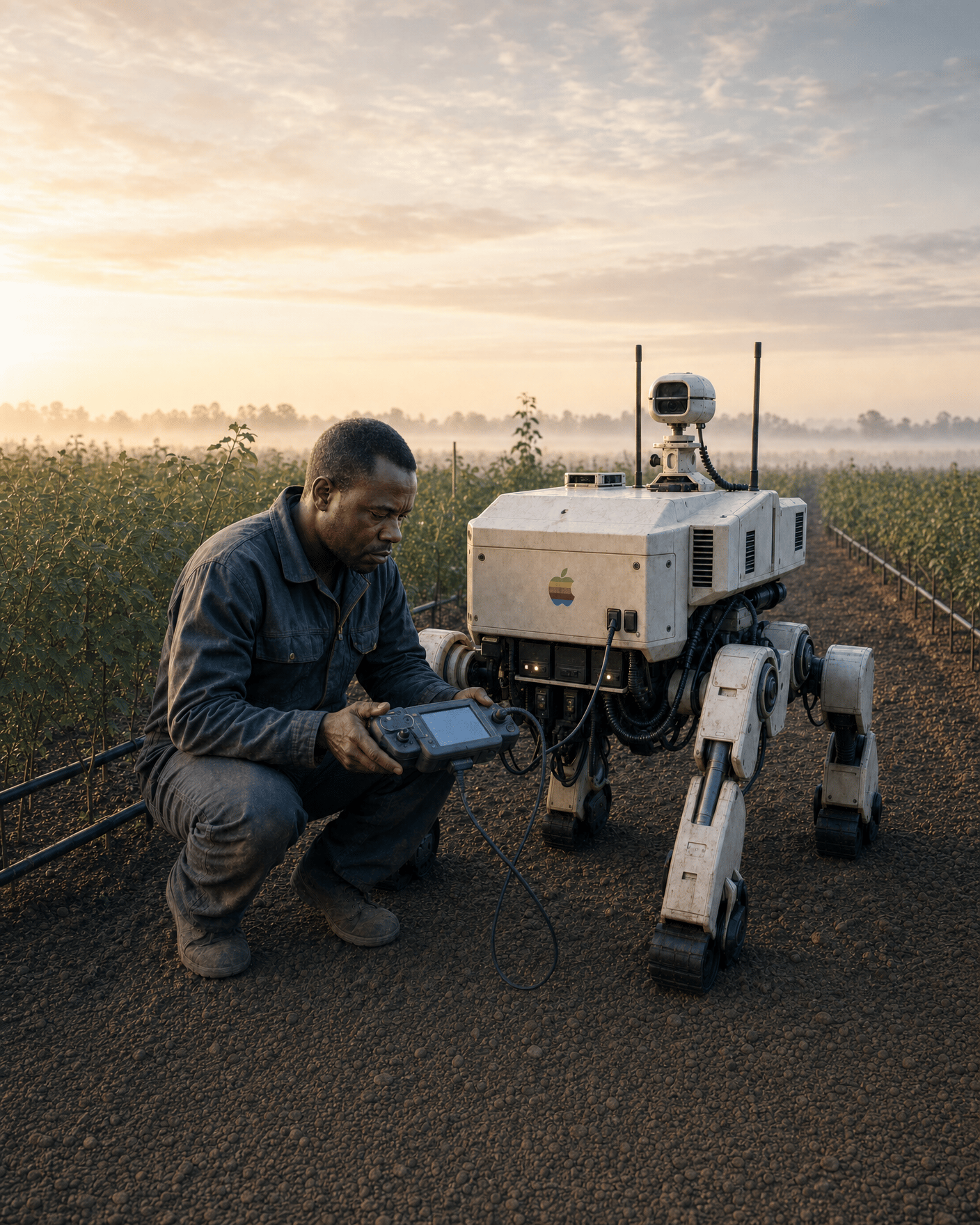
| Apple FarmIntosh 6502 Deployed in CameroonCentral African Farm Operating Bases have been contributing to Apple's FarmOS open-source platforms with derivative firmware and mechanical modifications, leading the Texas, USA based company to plan further deployments to other regional FOBs, as well as their main development facility at the multi-corp Art&D FOB, San
Jorge Luis Borges. The FarmIntosh 6502 is the most widely deployed autonomous farm sowing, maintenance, management, and preventative monitoring farm instrument in use today, recently surpassing the John Deere Z80 in total monthly active hectres managed. In
a statement, Apple's CommsLLM responded to our questions with this emanation: “The pivot to sustainable solarpunx platforms and re-emphasizing the core values of our founding has allowed us to use our Applied Speculation Division's decadal strategic refocus policy to make a meaningful — and profitable — contribution to humanistic principles and practices.” |
| DO YOU WANT TO KNOW MORE?
|
|
|
| |
| Tomorrow's Jobs Today
| Principal, Applied Speculation — Meta A speculative Meta principal-level role for building prototypes, interfaces, services, and situated artifacts that examine how AI may shape agency, trust, participation, and institutional life across product, research, policy, integrity, and communications.
Read the job popup → | Speculative Researcher, Misalignment Futures - OpenAI Safety Systems sits at the forefront of OpenAI’s mission to build and deploy safe AGI, ensuring our most capable models can be released responsibly and for the benefit of society.
Read the job popup → | |
| Office Hours N°317
| 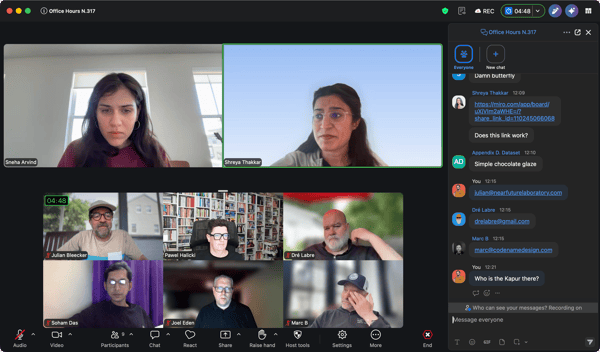 1)
Shreya and Sneha used the Office Hours project-share mode to test a Design Fiction ideation workshop about education after twenty years of AI-assisted learning. Its central question was: “What does school look like when productive struggle has been optional for 20 years?” 2) The
run-of-show introduced productive struggle, placed participants in a 2045 high-school scenario, and sent small groups into a time-machine exercise. Each group had to retrieve one pocket-sized object from the future school, describe where it was found, and explain the rituals and social conditions around it. 3) One group imagined a pirate-reality channel in which students use UV graffiti, hidden access codes, and private audio-visual overlays to create subcultures inside a homogenized AI education system. The object opened a discussion about belonging, clandestine study groups, curiosity, and social learning. 
4) Another group proposed the “Illustrious,” a haptic
brush that helps students recover patience, muscle memory, and individual expression in a world where AI supplies most answers. The brush became a way to discuss analog texture, practicing another artist’s process, and art as a form of self-expression. 
5) A third group imagined a future sports room where students control repaired and upcycled robots in football matches.
The scenario connected learning by doing with questions about physicality, hand-eye coordination, robot repair, frugal invention, and the distance between a student’s body and the machines they operate. 6) A fourth artifact, “Membrane,” was a sweat-sensing headband found in a
school gym. It measured physical exertion as a proxy for effort and learning, opening a contrast between bodily struggle, mental effort, and future interfaces that require more physical expression. 7) The group found that the object was a useful anchor, while the richest
discussion often concerned its surrounding ecosystem: curriculum, rituals, peer groups, teachers, infrastructure, and the larger society. Pawel Halicki’s Marble curriculum map gave that question a practical reference point by showing how school subjects connect across a larger learning system. 8) The debrief identified a tension in the activity sheet. A form can free participants from wondering what to produce, while naming and filling it in too early can shift attention toward compliance or product development. Softer prompts such as “the future you want to inhabit” or a fondly remembered school experience may provide better rails. 9) Participants suggested a second stage after the initial object-making: remix the groups and ask what lessons, exercises, skills, school structures, and social arrangements the artifacts imply. A third act could backcast from those futures to present-day experiments, including materials teachers could run in their own districts. 10) The test established prototypes as communication devices rather than finished answers. A brush, headband, secret channel, or robot controller made an imagined educational system available for shared examination, while the follow-up discussion supplied revisions to the workshop structure and its possible SXSW EDU proposal. | |
| |
|
Join the Near Future Laboratory COMMUNITY
|
Near Future Laboratory Patreon Join the Discord, get invited to Office Hours, and help keep the newsletter moving.
| 
| The Near Future Laboratory is
supported by its community and members. Join us on Patreon to support the newsletter, Office Hours, podcasts, Design Fiction experiments,
and the ongoing Discord conversation around design, technology, creativity, and possible futures. Patrons get an invitation to the Near Future Laboratory Discord and weekly Office Hours, where people bring projects, questions, half-formed ideas, and useful references into a generous working conversation.
| Join the Patreon
|
|
| |
| |
|
|
|
|


