
| |
| |
| |
| Last week we talked about dirt. This week we talk about where we leave it and what we actually do when we live in a world of just-enough. Also,
a conversation with Ian Bogost about his fun new book “The Small Stuff” all about sensory life, boring-not-boring ordinary objects, curiosity, gratification, and the recurring embodied encounters that make up the texture of a life. Ben Millen reminded me about a back catalog item on Mark Fisher and the Star Trek Communicator aesthetic, an essay-paper on the poetics of design fiction, an ad from a plausible future in which your desk needs alignment (not that kind), and a reminder that this
is all supported by my patrons on Patreon — become one for a measly $10/month and get access to that Discord, weekly Office Hours, and the ongoing conversation about design, technology, creativity, and possible futures. Okay. Let's go! | |
| Near Future Laboratory Podcast
|
Episode 105: Ian Bogost on The Small Stuff Everyday objects,
sensory life, curiosity, and ordinary gratification. Ian Bogost joins me on the reinvigorated Podcast to talk
about The Small Stuff: How to Lead a More Gratifying Life, a funny, Bogostian invitation to find ways to recover the sensory enchantment of normal, ordinary, everyday — nay, boring! — life. (The book
isn't boring, but it makes a reasoned claim that boring need not be normaitvely bad — in fact, it may be a signal to find that thing of value in the mundane.) We get into stick shifts, toasters, paper cups, doorknobs, Diet Coke cans, phone cases, ice in motel buckets, and the small embodied encounters that give a day its texture. We also talk about Ian's long path from games and object-oriented philosophy to ordinary experience, the decline of sensory life, curiosity as a virtue, and the possibility that contentment is closer than it tends to appear. (p.s. Maybe I'll do more of these as video dunno..) More from Ian: bogost.com,
The Atlantic, and
Ordinary Extraordinary.  Spotify Spotify
 YouTube YouTube
 Apple Apple | |
| |
| FOUND: An Artifact from a UBI Future
| What would you do if you didn't have to work for money? And after that got boring, then what would you do? We asked that question in the
last round of activities at the Futures 2.0 Seminar two weekends ago at Shop at Matter with Rick and the gang. That rested on the question that bubbles in my head: seriously..if there was universal basic income — pray, tell me — what would you actually do if you
suddenly didn't have to worry about, you know..the basic cover you need for daily life? (Which begs the question as to why you aren't doing it now, but I don't want to get you all worked up.) So — the exercise started with this form I sketched and then Debra and Rick made into somethign that actually
looked like a form rather than a sketch. All done very quickly, on the fly really — just an hour or two before Seminar. The form looks like this — with all the minutae of a bureacracy that still needs to exist in order to order things. The nomenclature and form designations and form design is
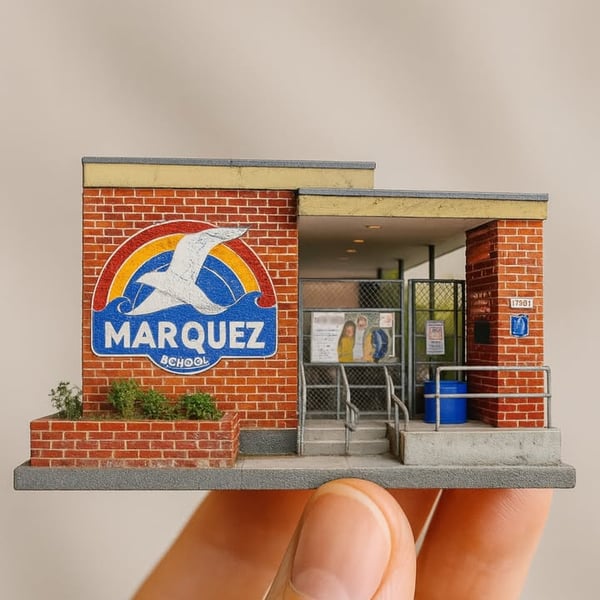
there so that one “falls into” the sense that this is a real artifact, the conceit being this: In the UBI world, every year, or maybe twice a year, one has to do some kind of reciprocity service — contributing to the larger social organization (perhaps your Farm Operating Base pop. 3,604 — about the size
of a large city high school) in a meaningful way. So, you fill out this form with your proposed “service”. That is to say, you make a proposal as to what to do. Of course, that doesn't mean proposing “sitting on my sofa playing Fortnite” is what you will do because presumably that is how you spend
your time otherwise, if you're that kind of person. You might propose to teach a class on soil cultivation, or host a reading group on phenomenology, or a teach a class on Manga illustration. Something that reciprocates the value that you draw-down upon by otherwise and generally being self-indulgent for 2/3rds of the year. The provocation was accepted by the folks in the seminar group — people got it straightaway. I would say that it was a group of ringers — everyone there has the “giver” gene so they were excited to propose what they would do (or rather be doing in this world, I would guess.) | |
| |
| |
| |
| Food For Thought
| From the digest-this-🥓 Channel
DEPARTMENT OF poetics of speculation | shared by julian
 I’ve been thinking about design fiction as more than “making up the future” and closer to a kind of discipline — like a procedure or protocol — that is practiced like a routine, like washing
your hands or gargling or something. And part of that gargling is that you accept that the terrain we call “the future” is far to vast and expansive for the language we have today to comprehend its potentiality. That's why I was intrigued by this notion that there is a literary poetics surrounding design fiction. The authors of this academic-y paper — Markussen and Knutz — lay out a practical way to do design fiction by blending literary practice with design practice — so the story isn’t an accessory, it’s fully enmeshed in the method. They start with a sharper definition that is rooted more in poetics and possible worlds, then they back it up with four workshop projects co-developed with a Danish author. Their takeaway is this: good design fiction has craft in both directions, on the
page and in the interface. Read more →
| |
| From the digest-this-🥓 Channel
DEPARTMENT OF abundance | shared by julian
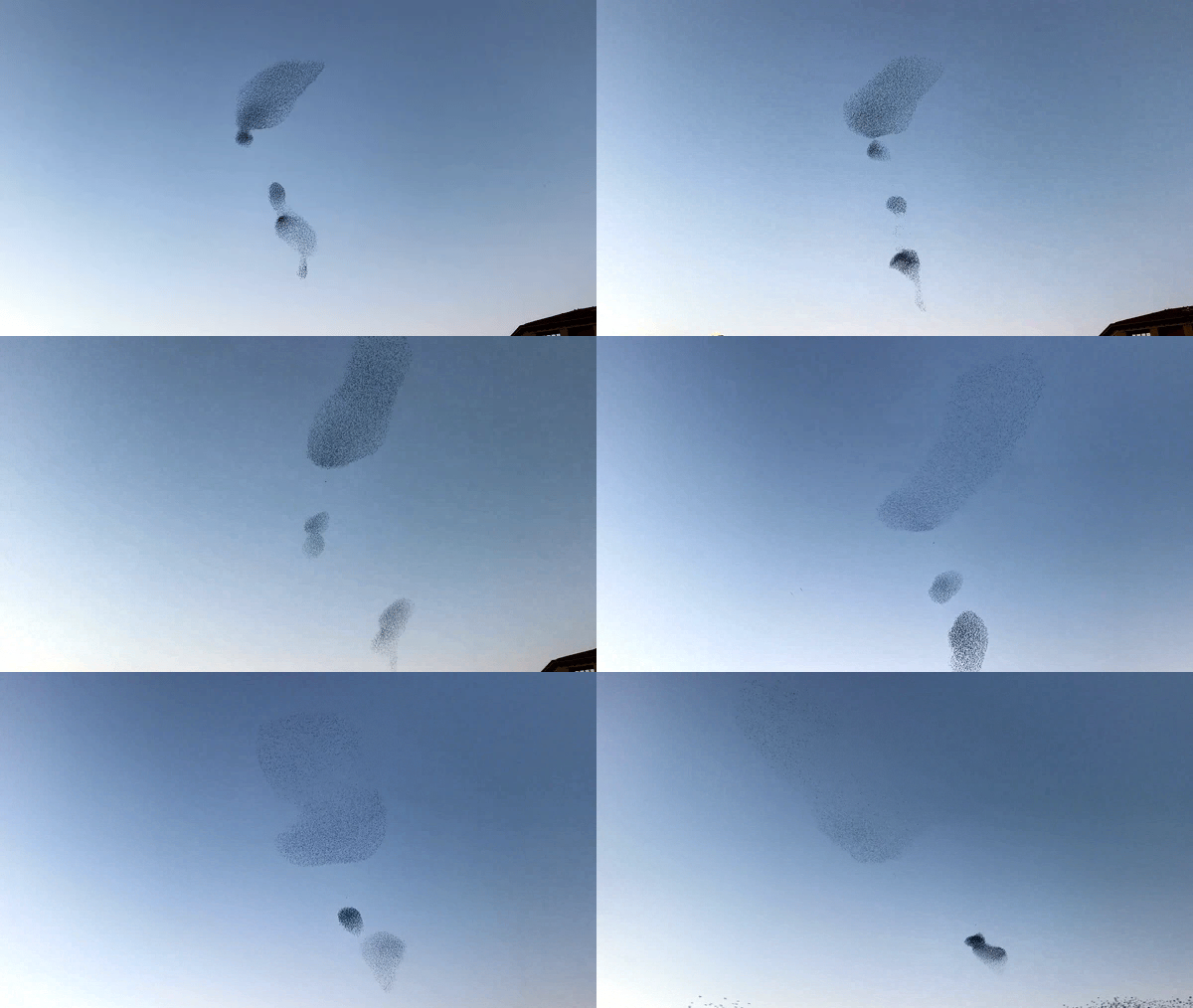 This piece from friend-of-the-blog Dan Hill resonated because when I was in Denver last weekend, Rafael pointed out how there was an
area of downtown Denver that had “over built” and was somewhat latently occupied or something. That inspired a forward-facing wonderment: suppose there was a world where that space was used for indoor farming? I know..I know..crazy, right? Or maybe just weird enough such that sticking with that thought before dismissing is out of hand would be somehow...generative? So..we sat with it and then the whole
idea of a soil cultivation depository/repository led to the further design fiction of the Denver Public Biometic Hybridatarium so..I'm good with sufficiently weird to widen the conversation kind of things. But, anyway — Dan's saying that he keeps hearing that the housing crisis is solved by “abundance”
politics: loosen regulations, flood the market with more homes, and affordability will follow. But the piece makes a sharper point: there may not be a true housing shortage, and building more the same way won’t automatically fix affordability. Worse, the built environment’s extractive footprint means careless “build baby build” could wreck carbon budgets without delivering the housing outcomes we actually want. The real work, it argues, is changing the system settings and focusing
emissions-aware, not-for-profit housing strategies.
Read more →
| |
| From the digest-this-🥓 Channel
DEPARTMENT OF ludd festivals | shared by julian An intentionally offline festival in
Tompkins Square Park held an event called “Luddite Recreations,” — a phone-free, papier-mâché-and-zine kind of performance festival that turned the old Luddite story into a modern warning about tech and displacement. Part of a “Summer of Ludd,” week of real-life community events that stitched together
offline flirting (eh?), and organizing against data centers — with a strict “no phones” rules. Handmade paper feels and defiant sensibilities completely the opposite of the usual attention economy stuff. Couple this with those Pub Lecture (“Lectures on Tap”) things and maybe it's not all doom-scroll futures. $ Read more →
| |
| From the digest-this-🥓 Channel
DEPARTMENT OF policy as markdown enacts aesthetics | shared by julian 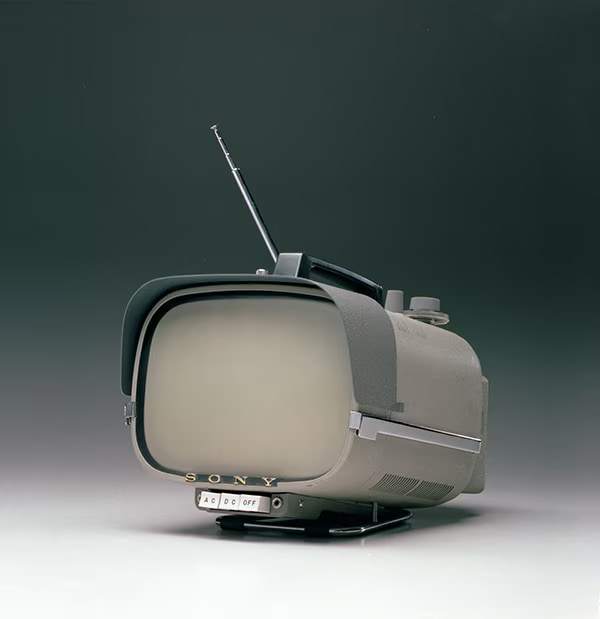
All of these things are just like the other? Aesthetics are oftenn a material reflection of not just an era, but of formal and informal policies. Think of your average, run-of-the-mill automobile and as most automobiles these days (at least here in California) are SUVs one cannot fail to
notice that they are barely indistinguishable from one another (at least from the saddle of a bicycle trying to avoid them). Why is that? Well, policy. Specifically transportation safety policy. Those policies start shaping the vehicle because, amongst other things, that policy requires side-impact protection, airbags, specific crash-test performance, etc. So, the policy shapes the design and the design shapes the aesthetic. And that aesthetic is a reflection of the era of sameness amongst things like automobiles. (No wonder any number of my 20-something neighbors decide they'll drive an early model
Chevy or a 1976 Ford Bronco roofless — the policy extends a grandfather clause so in a way, policy articulates optionality for hip-coolness by driving a car twice as old as the driver.) I say all this to say that this piece in The New Yorker can be read similarly as it is that little markdown file in your
system somewhere that can redefine the out-of-the-box factors that shape the aesthetics you may (or may not..sorry if this is aggrevating) conjure out of your preferred machine collaboration engine, such as Codex or Claude or whatever model you're dosing..err..using. It's easy to dunk on folks who use
these tools to create their website or whatever, but that's kind of a cheap shot, imho. The pro move is to understand the policy and design factors that shape these aesthetics and invest a bit of curiosity and tweak that to see what emanates from the machine rather than accepting it's (admittedly boring, taupe) aesethetic as the only possible aesthetic. p.s. That's a television back when physics demandd they have depth..and panache..now every television is as boring as every other television. $ Read more →
| |
| |
|
From the Laboratory's Archives
|
Mark Fisher and Futures Product Design
| 
| Ben asked me a question in the
Discord that had me rummaging around in the back shelves of the blog and I stumbled across this note on Mark Fisher that I wanted to drag out and dust off to share with you. It kind of makes me want to do another reading group on Fisher. (p.s. if you curious, reading Fisher led in part to the pamphlet
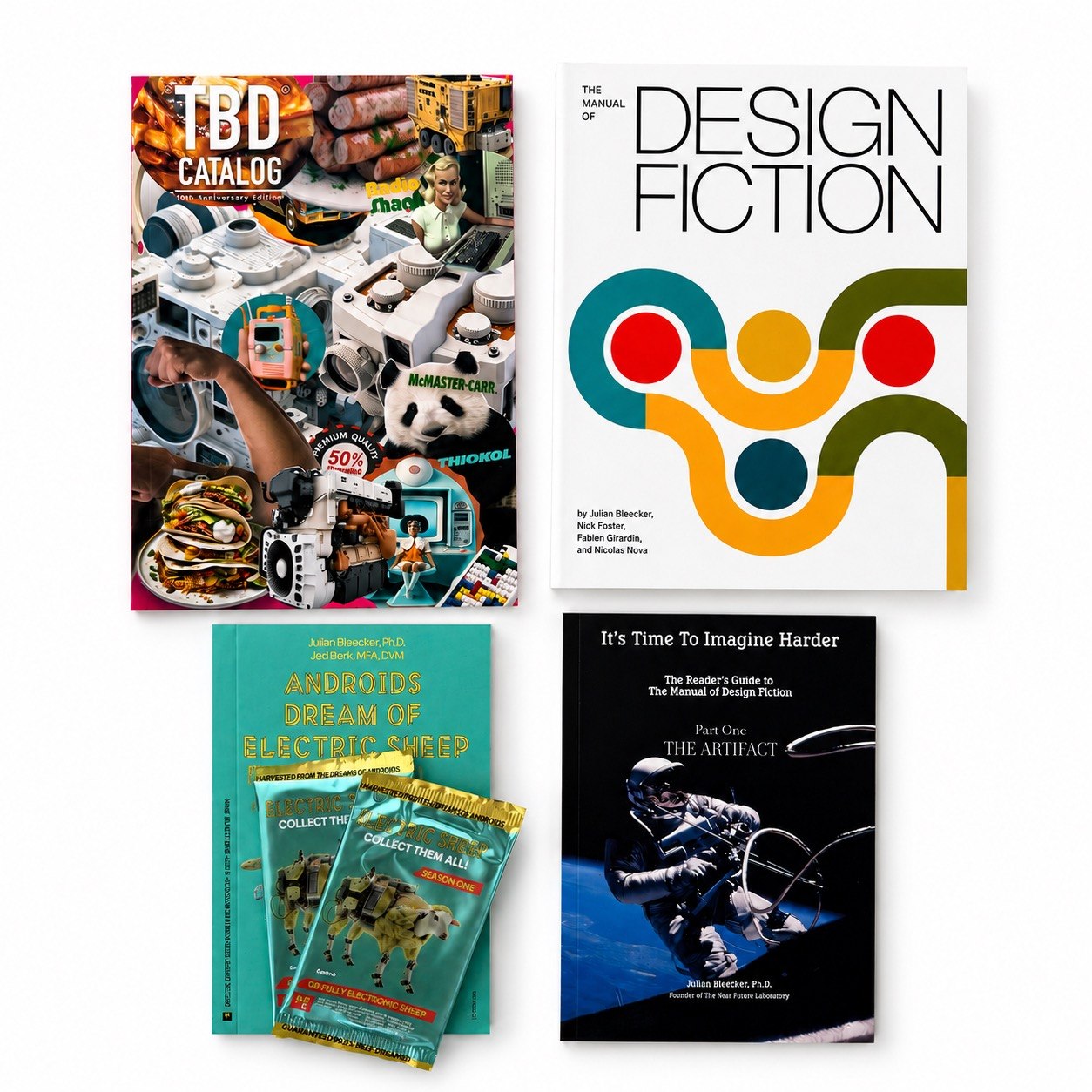
“It's Time to Imagine Harder” which you can get as part of the Four Design Fiction Books below!) | Read from the back catalog →
|
|
| |
| The Four Design Fiction Books
| |
|
The Near Future Laboratory Shop
| 
|

| $49.00 (Cheap!)
|
|
| The Four Design
Fiction Books
| Big Books. Big Summer Sale. The full collection of
Design Fiction books. Get the whole set and save. Four books for $49.00. Crazy, right? | |
|
|
| |
|
Join the Near Future Laboratory COMMUNITY
|
Near Future Laboratory Patreon Join the Discord, support Office Hours, and help keep the newsletter moving.
| 
| The Near Future Laboratory is
supported by its community and members. Join us on Patreon to support the newsletter, Office Hours, podcasts, Design Fiction experiments,
and the ongoing Discord conversation around design, technology, creativity, and possible futures. Patrons get an invitation to the Near Future Laboratory Discord and weekly Office Hours, where people bring projects, questions, half-formed ideas, and useful references into a generous working conversation.
| Join the Patreon
|
|
| |
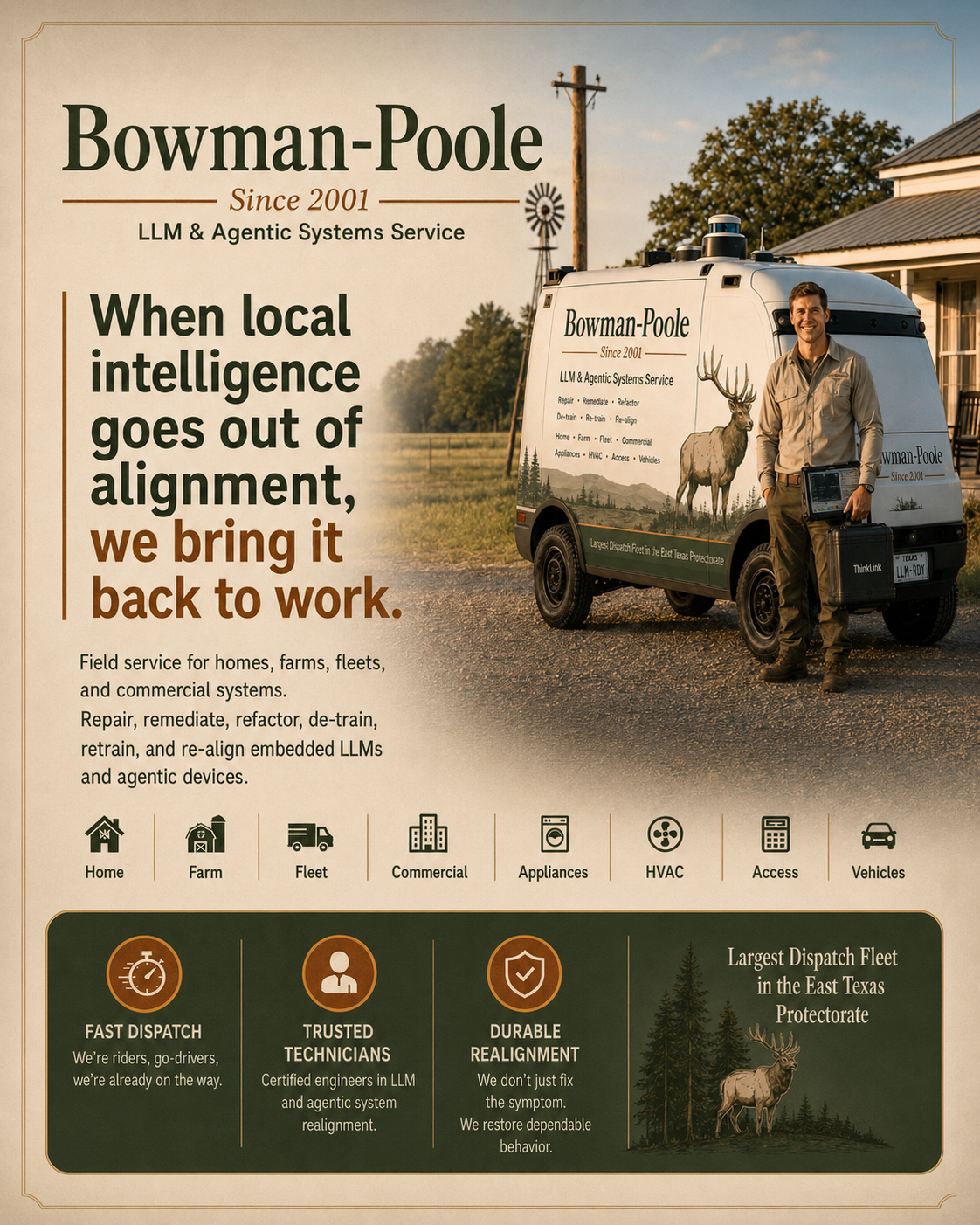
| Tomorrow's Ads Today: AI Alignment at Home
| |
|
YOUR NEIGHBORHOOD SERVICE TECHNICIANS AVAIL 24/7
| 
| |
|
|
| |
| |
|
|
|
|
