| |
| |
| A Studies & Observations issue: a place for short notes, links from outside the studio, projects underway, and material from the Near Future Laboratory archive that deserves to come back into
circulation. | |
| Quote of the Week
| "People have always found ways to live
alongside systems that don’t quite fit. Rewriting forms. Ignoring rules selectively. Carrying unofficial practices next to official ones"
Ken Anderson
| |
| Newsletters To Check Out
| There's
no shortage of newsletters out there, what with the Substack and Medium and all the rest. Less is more, but here are a couple that I think are worth checking out if you're looking for something new to subscribe to. | Futures & Foresight as Speculative Fiction An entanglement from an adjacent now: The Adjacency is news from several plausible near futures, imagining what work, culture, sports, and other parts of life might look like in the next few years. The newsletter is a place to encounter possible worlds through stories, interviews, and speculative articles that treat the future as something to experience rather than just predict. If you want to get a regular dose of near-future news, you can
subscribe to The Adjacency. Subscribe
→
| |
| Chicken Shed is a weekly newsletter for founders and creators who want the clarity, courage, and tools to build a better business, and
life. I've been following DO Lectures for a while and their newsletter is a great extension of the ethos of the DO: practical, inspiring, and focused on making things that matter. If you're interested in entrepreneurship, creativity, or just want some good stories and advice in your inbox, Chicken Shed is worth checking out. Subscribe →
| |
| |
| A resume of methods used in forecasting, long-range planning and Future Studies Author: Janice J. Tait From the Near Future Laboratory library, a 1975 Environment Canada occasional paper that surveys forecasting, long-range planning, and Future Studies. It frames futures work as a public and organizational practice of goal formulation alongside forecasting methods and planning
tools.
Check It Out →
| |
| |
| Seminars and Workshops
| Futuring in Print In collaboration with The Shop at MATTER, I'll be running a
workshop and seminar on futuring on June 27th in Denver with Becky Vartabedian, PhD. The seminar will cover the history of futuring, methods and tools, and a look at how the practice is evolving in the context of AI and other emerging technologies. The workshop will be a hands-on session where participants can apply futuring techniques to their own projects and challenges. If you're in the Denver area, I hope you can join us! RSVP →
| |
| |
| From the Project Archives
| Navigating the contingencies of autonomous vehicles in urban space From the project archives: the Geneva
Street Map, published as Geneva Map for an Autonomous Vehicle Future, was a foldable tourist map from an autonomous-vehicle future, made with the Canton of Geneva to give citizens and public institutions something ordinary to hold while debating automated driving. The map turned streets into a policy surface: pickup zones, urban canyons, traffic permissions, signage, energy infrastructure, and the ways an old city might have to redraw itself around new forms of automated movement. The recent speculative article in The Adjacency, Delivery Stewards Help Mitigate the Curbside Chaos of Autonomous Delivery, picks up that thread at the curb. Where the Geneva map asked how automated mobility might reconfigure the street, the delivery-steward piece follows the question into the last fifty feet: who mediates between a vehicle, a package, a pedestrian, an insurer, a labor rule, and a blocked curb
ramp? Together they point to the same civic problem at two scales. Autonomous vehicles will bring sensors and software into negotiation with street geometry, local policy, labor rules, liability, weather, signal shadows, etiquette, and public tolerance. That was the thing we could already see when the
Geneva map was done: a moment where policy and geometry would come together to negotiate the contingent factors that shape how autonomous vehicles co-habit amongst us. Project archive / Design Fiction, 2019. Related Adjacency artifact,
2026. Visit Geneva Map
| |
| |
| Studio Tools
| Yet Another Color Palette Tool I nerd out on color palette generators. They're fun to generatively..you know...generate palettes. They seem to me more like a run finger-flick-toy than like..a utility. Although this one is a palette studio for designers, creatives, artists or whatever who need something to help explore, generate,
name, critique, and refine palettes — and maybe with a soft use of human-language AI if you want, or pull colors from images (hygiene these days), check accessibility, and export production-ready tokens for CSS, Tailwind (yes!), shadcn, JSON, and even shareable social assets for gumming up the gram with colors. $ Free to
Try →
| |
| |
| Food For Thought
| From the digest-this-🥓 Channel
DEPARTMENT OF What would de Certeau do? | shared by julian 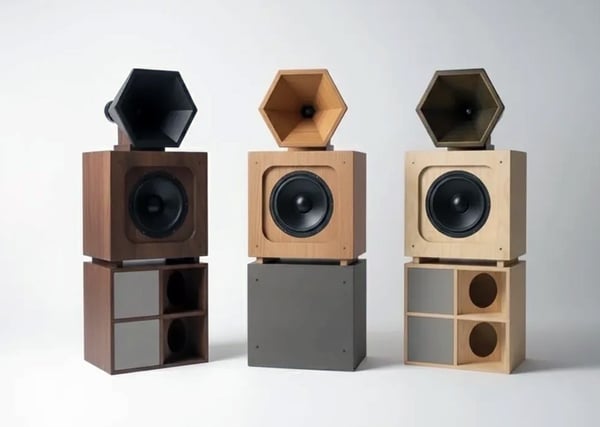 Friend of the studio Ken Anderson got a list of a friend's small irritations that he salved with a series of miniature “vibe-coded” contrivances. Let's call
it “personal tooling” e.g. Ken's guy wanted to watch the Mariners but it's blacked out in his area so, like..“I want to watch the Mariners but I can't because well — don't worry about it. Build me a contrivance that lets me watch the Mariners anyway.” I find this musing of Ken's super curious because I don't know if we have a solid name for what's going on. I know we can say that we have a name — but its meaning I guess is what is wonderfully elusive because it is an emergent category of things that are built to solve a problem
but also to have a certain vibe, a certain personality, a certain way of being in the world that is not just about the problem but about the experience of living with the solution. It's like a personal artifact that embodies a specific relationship between a person and their environment, and it's designed to fit into their life in a way that is both functional and expressive. Read and Subscribe →
| |
| |
| From the Archives
| A Newspaper from an AI Future From the archives: Applied Intelligence
Issue 001 is the studio newspaper from an AI future, a Design Fiction artifact made as stimulus material for a workshop on AI policy, governance, and ordinary life. It treats AI as something woven into everyday routines, letting readers encounter a possible world through headlines, ads, classifieds, and cultural fragments instead of a forecast. Worth resurfacing now because it gives the current AI conversation a more graspable object to argue with: a printed world where spiritual services, companion intelligences, sports simulations, household products, and policy questions all sit together on the page. From the archives / Studio project, 2024.
Visit the archive entry
| |
| |
| Dioramas from The Pacific Palisades
| Stumbled across this around the corner while walking Chewy the Dog. Had a nice chat with the founder of this project, 17 year old Luca dal Bello created in response to the 2025 Los Angeles wildfires, Pali-Altadena Collective is a community-driven
project.
Through hand-crafted miniature models, oral histories, photographs, and community storytelling, the project preserves the places, memories, and everyday experiences connected to life beginning with Pacific Palisades and expanding to Altadena. Visit
the project
| |
| |
| Office Hours N°312
|  1. Accessibility, color, and interface defaults The session opened with a discussion about color-coded systems, colorblindness, screen readers, phone interfaces, and the ways accessibility is often treated as an add-on rather than part of the first-use experience. 2. Personal agents and adaptive interfaces The conversation moved into the possibility of personal software agents that know a person’s perceptual needs and automatically adapt interfaces, visual systems, and data displays across tools and devices. 3. Typography as future
worldbuilding Kristian Bjornard shared an early
type-design inquiry: science fiction has recognizable typographic tropes — Eurostile, Microgramma, pixel fonts, rounded futuristic sans serifs — but what typography belongs to futures that are not cyberpunk, militarized, dystopian, or corporate? 4. What does a solarpunk typeface
need to do? The group considered whether the right question is not “what should this future look like?” but “what does this future need?” A typeface for a regenerative world might belong on handmade signage, community newspapers, trail markers, robot-readable landscapes, stamps, or other everyday artifacts. 5. Future language beyond letterforms The discussion widened from fonts to semiotics: icons, hobo marks, rock formations, emojis, ideograms, hybrid languages, and other systems that may communicate faster, more locally, or more meaningfully than alphabetic text. 6. Typography, vernacular, and power The group explored how language and type carry power: whose forms become standard, whose vernaculars are treated as marginal, and how future-facing visual systems might break from inherited assumptions about Latin alphabets, corporate legibility, and dominant cultural codes. 7. Inside languages and coded communication The conversation turned toward languages and visual systems made for insiders: forms of communication that do not need to be universally legible, but instead build recognition, trust, and shared meaning among the people who know how to read them. 8. Temporal language and broken time The group moved into time as a design material, referencing Arrival, Slaughterhouse-Five, Station Eleven, Outer Wilds, and the possibility of languages or artifacts organized around non-linear, atemporal, or non-human experiences of time. 9. Trust, belief, and power Rick Griffith introduced a set of provocations around belief as a force that gives power to gods, institutions, politics, race, and social reality. The conversation explored how belief, touch, sense-making, and power might be connected. 10. Reparative justice as practice The group discussed what it means to believe in reparative justice, and whether belief becomes meaningful only when it is grounded in action. The question was not “what do you perform?” but “how do your beliefs show up in what you actually do?” 11. Systems, legibility, and small interventions The conversation turned toward how designers work inside complex systems: finding small points of intervention, making hidden systems more legible, and using whatever agency is available to create openings that might not otherwise exist. 12. The Hustle Economy The session ended with a sharp discussion of hustle: the person asking for cash on the street, the designer asking for thousands inside an institution, the freelancer, the worker, the founder, the artist. Everyone is hustling at some scale. 13. Abundance and generosity The closing thought: people are generous with what they feel they have in abundance. That might be money, time, imagination, care, attention, access, or something else. The invitation is to notice what you have enough of, and spend from there toward the futures you want to help make real. The Artist’s Eyes: Vision and the History of Art The Fundamentals of
Achieving Accessible Content Typeset in the Future Black Panther: Wakanda Forever Make It So Sci-Fi Interfaces Sentient Design Planet City Arrival Logograms and the Wolfram Language Book of Evil Dator’s Four Futures Warchalking Water of the Sky Station Eleven Vonnegut’s Conception of Time in Slaughterhouse-Five The Big Payback —
Atlanta Watch the session
| |
| |
| The Four Design Fiction Books
| |
|
The Near Future Laboratory Shop
| 
|
| $49.99 (Cheap!)
|
|
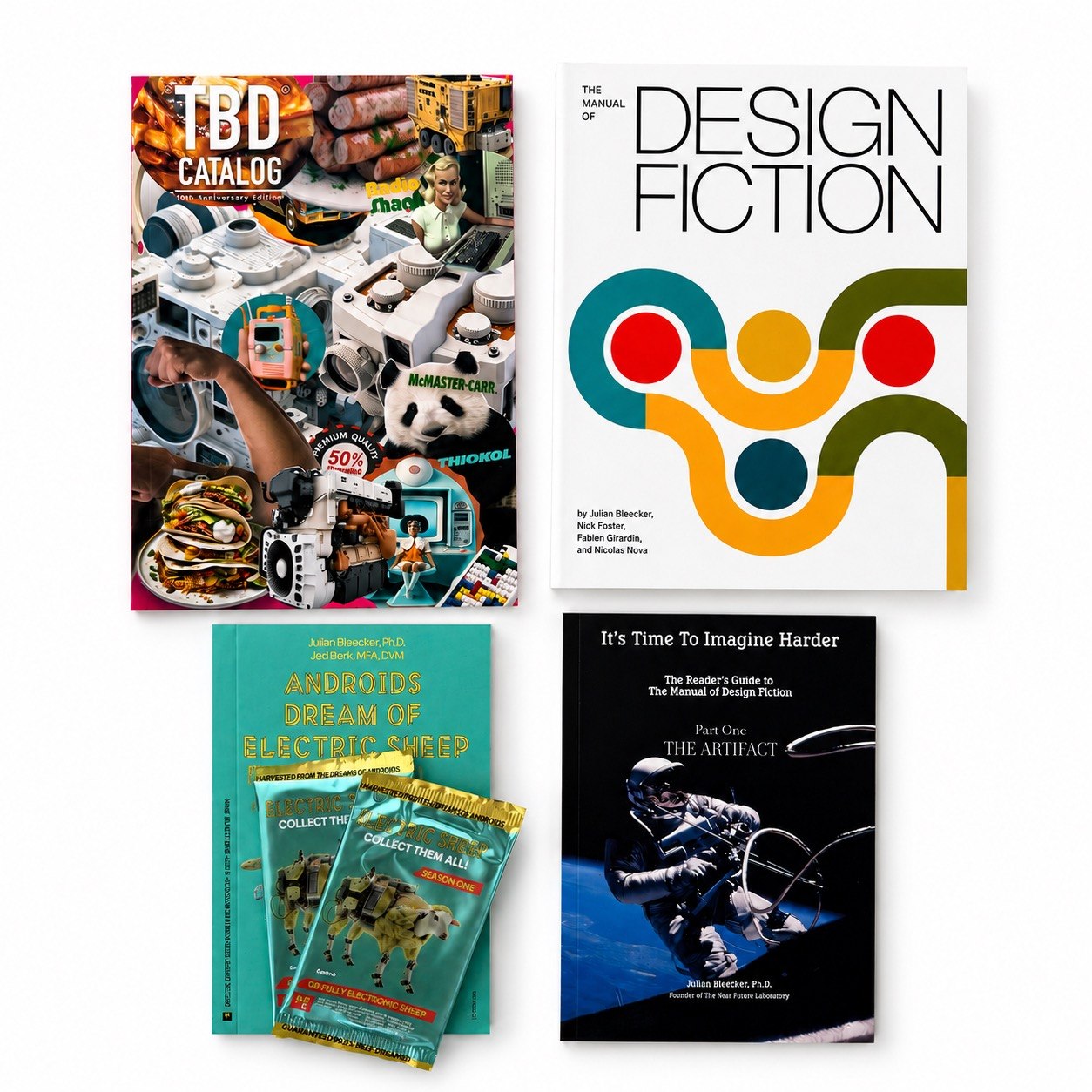
| Big Books. Big Summer Sale. The full collection of
Design Fiction books. Get the whole set and save. Four books for $49.99. Crazy, right? | |
|
|
| |
| |
|
|
|
|