
| |
|
Past, Present, and Future of Art+Tech
|
| |
| Hand-cranked futures, art+tech has a history to be paid attention to, a new citizens’ assembly on the future in Italy, my brother made a feature film, and a new role at OpenAI for a Team Leader to lead a new unit focused on speculative impacts and plausible implications. Plus more. | I've got a small obsession with books that catalog the history of art+tech. I think it started when I realized that the students I was once teaching expected that their earnest projects were breaking
new ground when in fact they were more-or-less rhyming with work that had been done for decades. I started collecting these books as a way to show them the lineage of their work and to help them find inspiration in the past. One of my favorites is MoMA's Talk to Me: Design and the Communication between People and Objects, which came out in 2011. It's a catalog from what I would say was an important exhibition of work that represented a moment when artists were wandering into a realm of
possibilities that was anticipating the way people and technology could co-habitate. The work was mostly curated around this theme of “objects” were interfaces to other things — data, systems, people, environments. It was a moment when the idea of “interaction” was starting to feel a little stale and the work was pushing into something more complex and poetic. The experiments are still out there, but the valence and meaning of contemporary
art+tech is, of course, different as the contingent surface of social, political, economic conditions are different. That's totally normal, of course — even as there is nothing about the world at the moment that feels normal. Take Matt Webb's Poem/1, for example. In very early 2024 — two years ago — when the Kickstarter launched, it was a curious and poetic experiment at the point where LLMs were just becoming exposed via an API surface so you could..you
know..do stuff like come up with the idea of a poetry clock and propose that that be made. Now, in 2026, it's a little harder to see the poetry clock as a poetic experiment and more like a glimpse into a future where machines can generate “art” on demand and how conflicting that can be as a point of debate. The idea of a clock that tells you the time through poetry is still charming, but the fact that it relies on an LLM that is trained on all the
poetry in the world and is generating new poetry in real-time based on the current time feels a little more unsettling when you consider the implications of having a machine that can generate poetry on demand and how that might affect our relationship with poetry and time. That's not Matt's fault — or even his worry — just to be clear. It's my own question as I watch the clock poem the minutes by. I backed it eager to show my belief in Matt as much as —
if not more than — the idea or the object itself. I have it on the shelf here. I admire it because I admire Matt and the object is inciting some good questions — and sometimes that is the more important thing to admire. You know — objects that to think with and all that — the artifact from a plausible “adjacent now.” It's the spirit and gumption and perserverance from a fellow product designer (who made an actual product..the kind if you drop it it might
break..not a product designer who makes a web page — yes..I'm making a distinction..) it takes to have an idea and make a thing — an actual manufactured thing. That is a kind of poetry in itself. But it does feel like the world has changed in ways that make the same work feel different. It’s a reminder that the meaning of art+tech is not just in the work itself, but in the context in which it exists and how that context can shift over time. | |
| Tomorrow's Ads Today
| |
|
When GPT becomes GLP and inference enhancement goes biological. | |
|
SPONSORED BY COGENTIC BY BAYER™
| 
| 2x your token maxxing for long orchestration sessions
with unprecedented rates and efficiency. Twice daily. Use only as directed by your SKILLS.md file. | |
|
|
| |
| Poetry + AI
| Matt Webb's poetic AI clock Matt Webb's Poem/1 is an AI-powered e-paper clock from Acts Not Facts: a physical object that tells the time by writing a fresh poem every minute. It is charming, strange, and a
useful reminder that embedded AI will often arrive through small objects that feel playful before they feel consequential. Created with industrial design help from Approach, the clock uses a central server and ChatGPT 3.5 to keep minute-by-minute generation affordable. The digest frames it as a shift from
connected everything to small, embedded intelligence everywhere. Digest: 05162026_125906_digest-this. Signal: 950e1da57381. Read the story from 2024 →
| |
| A Study in the Entanglements of Poetry, Python, Prototyping and Play PoemOS is a 2024 Near Future Laboratory project to
study and explore AI-generated poems as a small software contrivance: Python builds the daily poem, ElevenLabs gives it a voice, and the system packages the result as an audio/animation sketch. It makes a useful companion to Poem/1 because both ask what happens when machine poetry leaves the chat window
and becomes a thing you encounter as an object, interface, or daily ritual. But, it became somewhat more interesting to me as a way to explore the entanglements of poetry, Python, prototyping, and play. It’s a reminder that the future isn’t just built with tech — it’s built through speculation, experiment,
study, and play. View project →
| |
| |
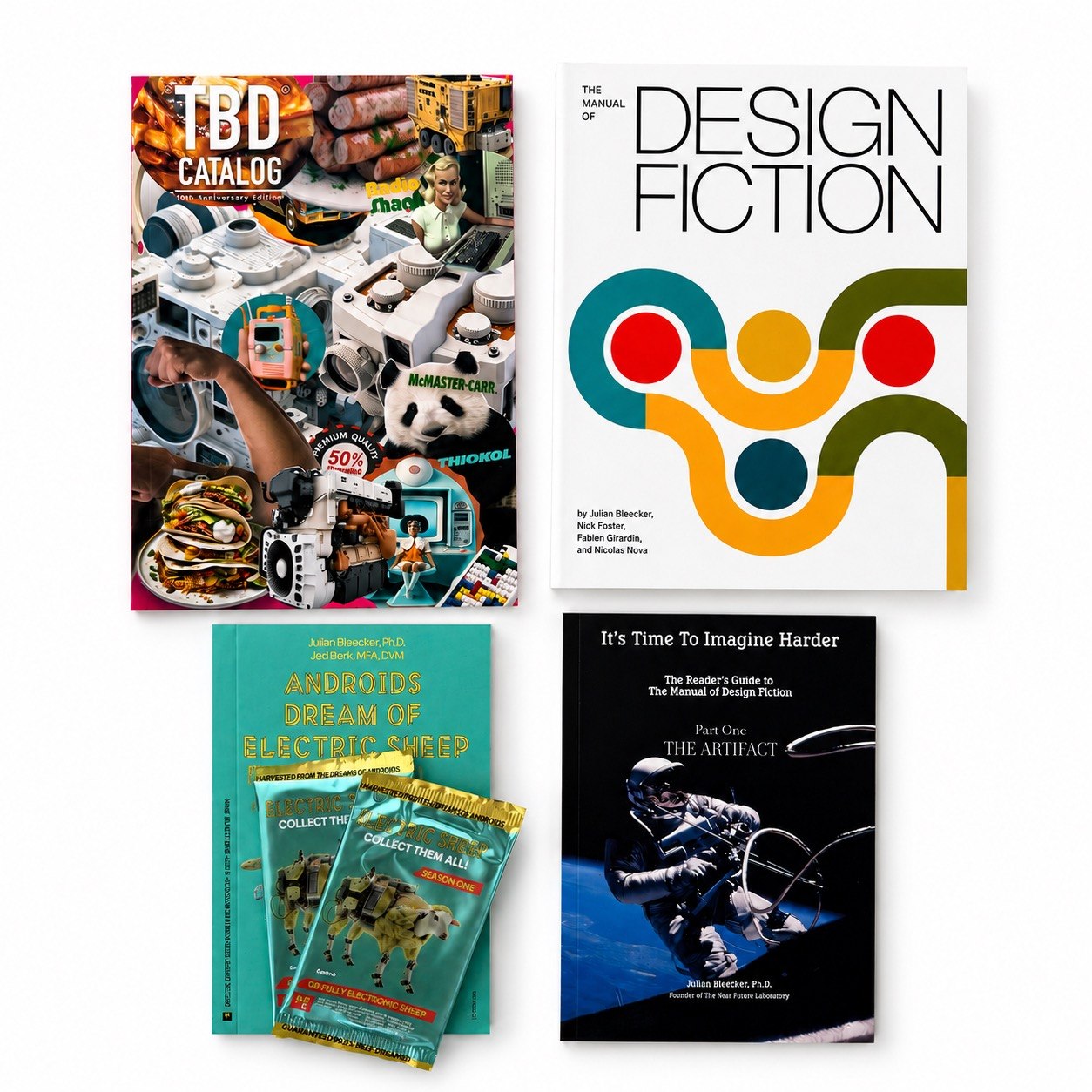
| The Four Design Fiction Books
| |
|
The Near Future Laboratory Shop
| 
|

| $49.99
|
|
| Big Books Big Pre-Summer Sale. Available now, the
full collection of Design Fiction books. Get the whole set and save. Four books for $49.99. Crazy, right? | |
|
|
| |
| Fraternal Feature Films
| My
brother Marcus Bleecker's first feature film, Mississippi Scholar, is now available to stream and rent. It’s a powerful drama about a gifted student in the south trying to break out of a brutal cycle through education, while tragedy and pressure from the people closest to him threaten everything. I highly recommend it. Not just because he's my brother, but also because he's my brother and because it's a really good film. | Prime Video drama A
gifted student, James Wilson, tries to break out of a brutal cycle through education, until tragedy and pressure from the people closest to him threaten everything.
Watch Now ->
| |
| Books & Such
| |
MoMA exhibition catalogue, 2011 Edited by: Paola Antonelli ISBN: 9780870707964 MoMA's Talk to Me catalogue gathers design work around the communication between people and objects: interfaces, tools, environments, games, websites, and systems that talk back. You’ll find classic Dunne & Raby, early Stamen Design, and Timo Arnall’s “Making Visible” thesis work (see below) and tons more. It is also
part of Near Future Laboratory's own studio archive because PDPal, by Julian Bleecker, Marina Zurkow, and Scott Paterson, appears in the exhibition's object set.
Check the book in the library ->
| |
| |
| Food For Thought
| From the digest-this-🥓 Channel
DEPARTMENT OF Legibility & Visibility | shared by julian Back in the day, Timo Arnall wrote a design-research thesis that treats RFID less like a black-box technology and more like a material you can work with, particularly through visibility. He focused on how
interfaces stay invisible even when they feel seamless, and how design can make the mediating stuff legible using visual communication, semiotics, and remediated media like photography and film. His goal was simple: turn hidden technical behavior into something people can see, interpret, and talk about.
(Hey, psst..Timo? If you're out there give me a shout 🤙🏽)
Read more →
| |
| From the digest-this-🥓 Channel
DEPARTMENT OF Physical Computing Lives | shared by julian Suppose..just suppose you wanted AI that doesn’t phone home, doesn’t rely on an internet connection, doesn’t mess with one of the foundation model companies harvesting your innermost thoughts..and you wanted to get some crosstraining in
at the same time? You might go ahead and get your CrankGPT on. Friend of the blog Alex Kauffmannn instigated this contrivance — CrankGPT is a fully local, private assistant you can run without relying on the cloud. It’s powered by you cranking a, you know..crank. Use the hand-and-arm crank for everyday inferencing, or pedal power for heavier workout workloads. It flips the “tokens” conversation into something you
control instead of something you rent from mega-corp infrastructure. No Wi‑Fi, no Claude outage, no rolling blackouts ruining your day. Just get cranking and keep your data yours. Imagine how yoked those tokenmaxxing bro’s would be if they had to pedal for their next 100k tokens! Read more →
| |
| From the digest-this-🥓 Channel
DEPARTMENT OF Future Generations Futuring | shared by julian Italy’s got a new citizens’ assembly on the future evidently. Seems like it’s not just another task force with the usual voices, but who knows. The have a plan to seat 100–150 residents (mostly young’ns) in a parliament-style process that will produce proposals by late 2027 for what Italy should look like in 2050: education, work and free time, climate adaptation, housing, and even how we use AI for the common good. What makes it feel different is the explicit goal of pushing
back against short-term politics and giving young people who are the future generation yet can’t vote some say and influence. Worth keeping an eye on this! Read more →
| |
| From the digest-this-🥓 Channel
DEPARTMENT OF Local AI | shared by julian I'm super fascinated by the prospect of running inferencing locally — on your own owned
hardware, off the grid..off the network. I've been experimenting with this certainly — mostly on the image generation side of things with a beefy workstation. So I was intrigued to hear that Nvidia was making this move from data centers to your desk. I guess they're paying attention to the shift from assistants to agents that actually operate your computer which, if you've ever tried, is somewhat unsettling/uncanny. $ Read more →
| |
| From the digest-this-🥓 Channel
DEPARTMENT OF Design Research | shared by julian Joe Lindley is now co-director there at Imagination Lancaster, which is something you'll want to keep on your
radar because he's good people but also because they treat design research like something you can actually use in the world and not just something you study. If you haven't watched their documentary “Permission to Muck About” you'll want to — it’s built from years of workshops and interviews, and it does the good work of making the value of design research legible to people outside the community. There are also some very cool hands-on projects like geography games and coastal-futures toolkits,
plus practical resources like their “Little Book of” series and Leapfrog tools. It’s all a reminder that the future isn’t only built with tech — it’s built with imagination and method. Read more →
| |
| |
| Tomorrow's
Jobs Today
| Help Wanted! ((From an adjacent now)) | Speculative Impacts & Plausible Implications, Team Leader OpenAI is looking for a senior Team Leader to establish a compact, high-leverage unit that turns weak signals, plausible
implications, and future failure modes into decision-grade artifacts. The role sits across research, product, engineering, policy, legal, and operations, with a mandate to make alignment risks, opportunity pathways, and roadmap tradeoffs legible before drift becomes default behavior. Read the posting → | |
| |
|
|
|
|


