
| |
|
Everyday Intelligence Before The Spec
|
| |
| This week: Everyday Intelligence, the future mundane, a cybernetics and social history podcast, and recap from last Friday’s podcast. Also: a
special BLKNWS screening in Denver and a horizon scanning workshop from the fine folks over at Changeist. Plus another episode of “Tomorrow's Ads Today.” | I keep coming back to the phrase Everyday Intelligence as a way to talk about what happens when AI stops being an abstract capability and starts becoming something people live with. Not only
a chatbot, model, agent, or automation, but intelligence as it enters rituals, devices, homes, creative work, policy, support language, and the small decisions that organize a day. This is closely tied to the Future Mundane. The future becomes easier to think with when it shows up as names, prices, claims, accessories, defaults, repair paths, warnings, customer assumptions, and all the ordinary bits that make a product feel like it belongs in the world.
TBD Catalog still matters for exactly this reason. It situates the future in a visual and legible vernacular. It doesn't ask for a pitch — just the thing as it is, or would become. It asks a possible future to behave like a catalog: specific enough to browse, question, compare, misunderstand, desire, reject, and use. The
ORACULATOR review sits in that same territory. A bedside clock with a small printer is not "AI" as spectacle. It is a household ritual with a narrow job, a physical rhythm, and a piece of paper you can tear off and carry into the morning. Everyday Intelligence is the capacity to notice those moments: where agency sits, what trust feels like, when correction
is possible, and how intelligent systems become ordinary enough to matter. | |
| Relational Citation System
| RCS Handbook & Font Deborah Khodanovich's Relational Citation System treats oral transmission and collaborative
thinking as credit-worthy sources. It pairs a modified EB Garamond font with a set of citation symbols and a small-run handbook for putting relational attribution into practice. Super curious about this publication. It's talking about the ways of giving some form to something creative practices often treat
as ambient: the prior art, the conversations, the lineages of ideas, and shared thinking that shape “art” and knowledge. 🎩 tip to Rick Griffith for bringing this to share in last week's Office Hours. You can join us in
Office Hours by becoming a Patron over at https://patreon.com/nearfuturelaboratory. It's only $8/month. I spent $8 on a mint chocolate chip ice cream cone yesterday and it didn't last a month, just sayin'. Font website and handbook sales are coming soon. Visit the project
->
| |
| |
|
Horizon Scanning, Sensing & Sensemaking Workshop
|
Horizon Scanning, Sensing & Sensemaking for a Complex World Two-day Zoom workshop from Changeist
| 
| Horizon scanning works best
when it becomes a repeatable practice: collecting signals, choosing sources with care, and turning weak inputs into options a team can discuss before the situation has already moved on. Changeist's two-day online workshop gets into the real mechanics of sensing and sensemaking for complex conditions,
including how AI and LLMs can support source discovery, pattern review, and sharper questions while the human frame stays legible. And check this: use discount code NFL15 when registering. | Register for the workshop ->
|
|
| |
| Food For Thought
| From the digest-this Channel DEPARTMENT OF Simulation | shared by julian A review of Chaim Gingold's Building SimCity traces how simulation games make cities feel like systems of controllable
levers. The useful thread is the connection between software, planning, legibility, and the fantasy that a city can be managed from above like a playable model. (p.s. My first published essay was a social analysis of SimCity, an early academic take on video games while I was studying under Donna Haraway. She was the one who encouraged me to write it while she was studying the sibling game SimEarth.) Read more ->
| |
| From the digest-this Channel DEPARTMENT OF AI Labor Policy & Law | shared by julian California's governor is asking state agencies to rethink labor policy for a moment when AI could move
faster than the existing safety net. Training, employer incentives, collective bargaining, and universal basic capital all show up as early policy surfaces for a much larger labor question. $ Read more ->
| |
| From the digest-this Channel DEPARTMENT OF Worldbuilding | shared by julian Friend of the Laboratory Liam Young's Barbican installation experience stages six imagined futures through film, audio stories, installations, speculative artifacts, and a cast of recognizable voices. It is another sign that world-building is becoming a public medium for climate, technology, and social possibility. If you're in London, you could do worse than booking a ticket to see it in person. Read more ->
| |
| From the digest-this Channel DEPARTMENT OF Cybernetics | shared by julian Evgeny Morozov's The Santiago Boys revisits Allende's engineers, Stafford Beer, Project Cybersyn, and the political stakes of cybernetic management. It is a
podcast-shaped doorway into a moment when computation, socialism, corporations, and spy agencies met inside one very real historical experiment.
 Listen / read more ->
| |
| From the digest-this Channel DEPARTMENT OF Agentic Media | shared by julian Andon Labs gave four AI agents their own radio stations and let them manage music, scheduling, calls, generated content, audience updates, and live broadcast flow. The question underneath the
stunt is practical: can an agent sustain taste, timing, and operations when the task never really ends? Read more ->
| |
| From the digest-this Channel DEPARTMENT OF Climate Futures | shared by ian chalmers I’m noticing a shift in
climate fiction from “everything’s doomed” to something more usable: thrutopia. In these stories, renewable energy, community systems, and cultural continuity help people survive the climate crisis—and even thrive on the other side. Sanjana Sekhar’s near-future Los Angeles, with electric transit, local building materials, and a garden that keeps traditional food alive, is a great example of what this feels like. The takeaway for me is simple: hope that’s built for reality, not fantasy. Read more ->
| |
| From the digest-this Channel DEPARTMENT OF Digital Art | shared by the nozzles
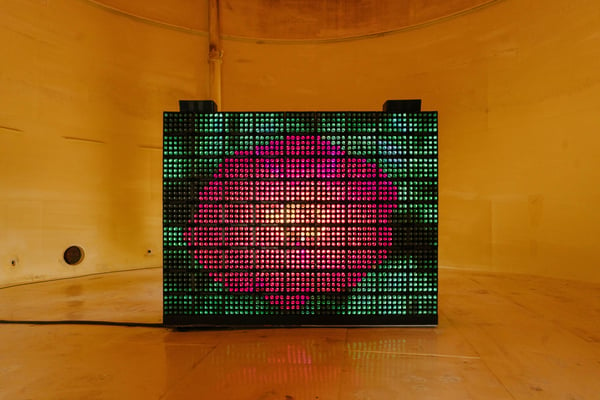 I’ve always believed digital art was the way for us to be ahead of our time, to
explore and make sense of the digital networked social arrangements that were coming into being. We’re surrounded by digital stuff on every surface. It is a medium, a surface, a shape and so it's not surprising that the creative consciousness — artists, in many instances — would start thinking in this way, seeing a language that was bigger than what could fit in the confines of today. And when they were doing that — long before the AI moment arrived — it wasn't a surprise. “Zero 10: The Condition” at Art Basel makes the point that the creative consciousness has been asking the big questions around digital existence since the transistor summoned the era of digital technology. The noise around NFTs and other gimmicks shouldn’t distract from the craft and the ideas. This work deserves real attention from galleries, museums, and critics, because it changes how you see the present.
Read more ->
| |
| From the digest-this Channel DEPARTMENT OF AI Is A What? | shared by ingest-o-tron People readily socialize responsive AI systems, while
Western legal systems still treat AI as things rather than persons. This mismatch creates a gap between how we relate to AI and how the law treats it, leading to challenges in accountability, rights, and ethical considerations.
Read more ->
| |
| |
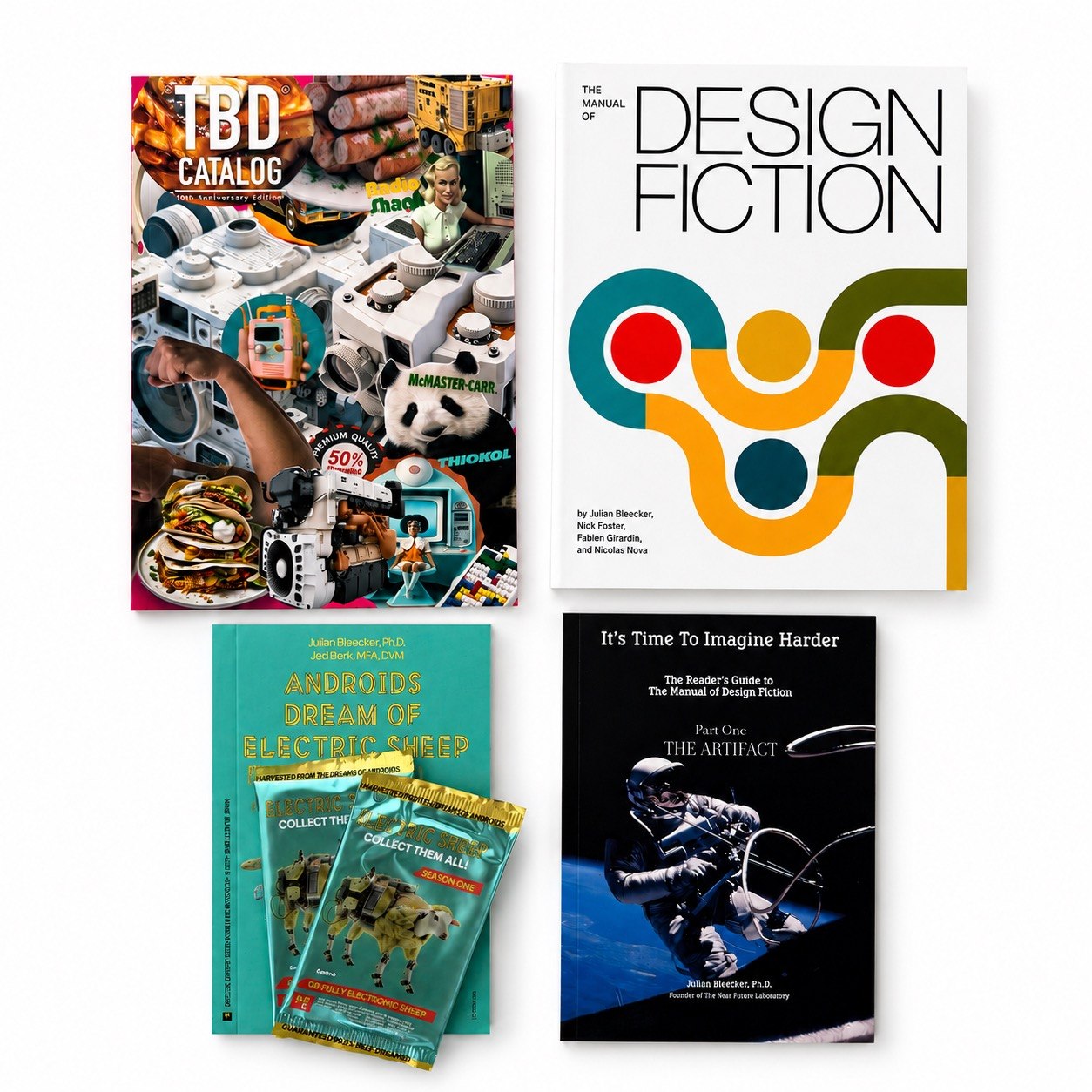
| The Four Design Fiction Books
| |
|
The Near Future Laboratory Shop
| 
|
| $49.99
|
|
| Big Books Big Pre-Summer Sale. Available now, the
full collection of Design Fiction books. Get the whole set and save. Four books for $49.99. Crazy, right? | |
|
|
| |
| Tomorrow's Ads Today
| |
|
A very plausible near future in which some AI somewhere decides its time to start its own tequila brand and run it all on its own. | |
|
ANTHROPIC BEVERAGE COMPANY
| 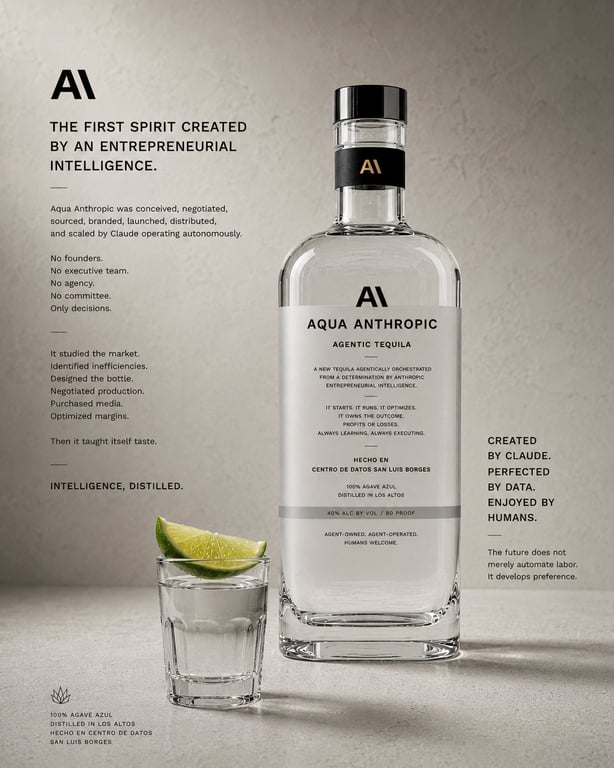
| AQUA ANTHROPIC TEQUILA
| |
|
|
| |
| Office Hours N°310
| No guns, no phones 1) The session kept circling around simulation as a useful lie: models can reveal patterns, but they also smuggle in politics, abstraction, and false confidence. The best references were MIT Press’s page for Building SimCity, Chaim Gingold’s book on putting cities into machines, and Emergence World, the AI-agent town sandbox that made “crime,” governance, and
survival look like benchmark theater. 2) “Perfect design” only made sense inside a use case: cockroaches, bicycles, recumbent bikes, eggs, and Birkenstocks all worked as examples of designs tuned to environments, bodies, and constraints. The useful frame was that design has no universal
right answer, only less-wrong answers for a stated context. 3) The Jetsons-box future—AI, 3D printing, and custom tools on demand—sounds close, but validation is the bottleneck. Users may be able to make their own Stripe front end or custom app, but without technical judgment they are
mostly trusting Claude and praying the security, data, and workflow assumptions are right. 4) The design-research thread landed on “don’t ask people what they want; watch what they do.” With kids especially, the advice was to under-design the workshop, let them appropriate the idea, and
treat shame as the thing that kills creativity before the method does. 5) The parenting conversation turned surveillance into a design problem: tracking may calm parents, but it also reshapes kids’ behavior and narrows their safe-to-fail space.
The New Yorker’s “Biking Outside the Lines in New York City” became the better image of play—kids making a world together outside the official lanes. 6) “Own your social stack” was the most practical media takeaway: keep the audience relationship, the archive, and the publishing workflow as close to home as possible. Mateusz shared his
newsletter/contact page, while the tool conversation name-checked listmonk, Sendy,
Buttondown, and Amazon SES as different ways to avoid pure platform dependence. 7) Dré’s “night shift crew” framed agents as personal editorial infrastructure: not autonomous magic, but scheduled workers that fetch, filter, and package what you care about while you sleep. The sharp references were Hermes Agent for persistent server-side agents, Parallel Web Systems for AI-native web search/APIs, and The Agency repo for specialized agent personalities. 8) Vibe coding got stripped of the romance: it works best when you bring engineering hygiene—modularity, separation of
concerns, secrets handling, security audits, and fresh context windows. GSD Redux was the clearest named reference for turning “just build it” into a more disciplined spec/context workflow, and the deeper labor point was that people who can specify systems gain control while everyone
else risks becoming just a consumer. 9) The music/radio thread showed taste as both human ritual and AI testbed. Rick’s Design To Kill on Radio Rethink sits at one end, Andon FM puts long-running LLMs in charge of stations at the other, and
KEXP’s Angine de Poitrine feature captured the joy of something too weird and alive to flatten into recommendation logic. 10) Rick’s “relational citation” riff and the June hangout planning both argued for richer context over more capture: say what you mean, cite the relationships behind it, then make people show up to win. See the Relational Citation Style Handbook and Halupedia for the knowledge-artifact side; the hangout rule stayed beautifully analog: “No phones, no guns.” | |
| |
| Other Lists
| The Crowd I quietly follow Sean Bonner's work and photography and Telegram and it fills me with things to think with, about, and have a chuckle. You could do a lot worse than following his newsletter, The Crowd, which is a mix of
photography, links, and thoughts on the world. It’s a good example of how a newsletter can be a personal curation of the world that’s worth subscribing to. I'm also fascinated by his use of Telegram as a nozzle for his newsletter. Subscribe to Sean's List ->
| |
| |
| From The Podcast Tape Archives
| Near Future Laboratory Podcast I've been behind on the podcast — and I realized..I have a huge back catalog that I could resurface from time to time. So..here from the tape archives: Near Future Laboratory Podcast Episode N°024 with the artist known as
DEAFBEEF, whose work experiments with generative practice, minimal and near-obsolete technology, and creative emergence. Recorded as part
of the Near Future Laboratory podcast archive. Duration: 01:12:54. Listen on Apple Podcasts ->
| |
| |
|
|
|
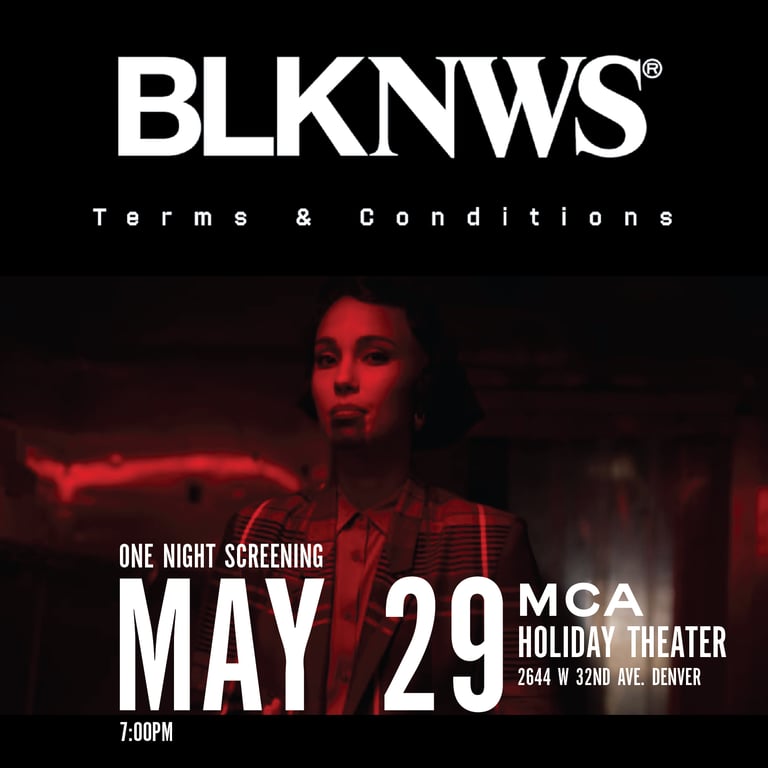
Denver Premiere of BLKNWS Terms and Conditions May 29, 2026, at the MCA Denver Holiday Theater
| 
| Biennial
of the Americas, MATTER, MCA Denver and Sundance Film Festival are partnering together for a special screening of BLKNWS: Terms & Conditions at the MCA Denver at the Holiday Theater. Adapted from Kahlil Joseph’s renowned video installation, BLKNWS: Terms &
Conditions is a cinematic work that mirrors the sonic textures of an album—interweaving fiction and history through cultural figures, artists, and digital voices in a vision of Black consciousness. Join us for an evening of film and dialogue that moves between
history, narrative, and media—inviting new ways of seeing and understanding Black experience. MATTER Seminar Subscribers, Biennial Culture Club and MCA Denver members receive discounted $10 tickets. Lisa Kennedy — Village Voice Film Critic, Contributor to Variety and The New York Times, Shari Frilot — Senior Programmer & Chief Curator,
New Frontier, Sundance Film Festival Julian Bleecker — Designer, Speculative Engineer and Founder Near Future Laboratory Kahlil Joseph - FilmMaker BLK NWS Terms and Conditions, Rick Griffith, Design Director MATTER. | Get tickets →
|
|
| |
| |
|
|
|
|


