I was listening to the Rhizome 7x7 livestream last Saturday.
Rhizome 7x7 pairs artists with technologists, researchers, theorists, philosophers,
and other people whose work arrives with a different kind of evidentiary weight.
In the crudest cartoon version of the pairing, it is “creative consciousness” X “rational consciousness,” which is exactly why the format is interesting, and also slightly revealing.
What we see are presentations from these sprint-like collaborations to “make something new.” In past years, if memory serves, the teams have
had only a handful of days to make something together. So the talks often have this particular charge: young, earnest collaborators at a dais, still reaching for the language to explain what they made and why it matters. The artist is making aesthetic sense of a scientific insight or finding; the technologist, or the research itself, is there as a kind of warrant. An arXiv PDF appears on the screen, and suddenly the experiment has a scholarly shadow behind it.
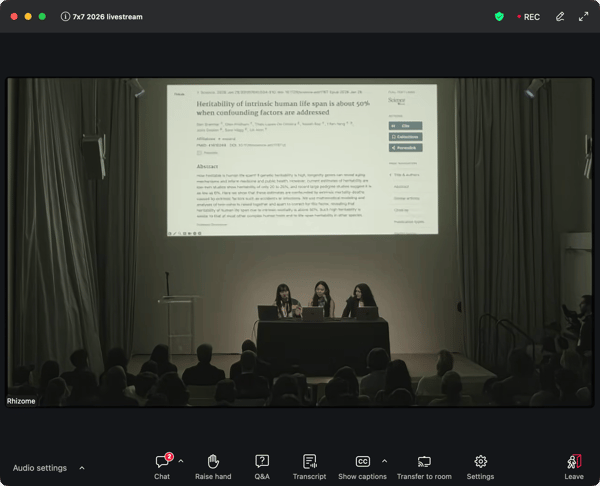
What I noticed was that the excitement usually precedes knowing what to be excited about and why. The audience was already there to see the work so
they didn't need a ton of explanation or justification. They were just excited to see what might happen. The permission to do the work to “make something new” had already been granted, so no one was going to say..“I don't get it..” or ”What's this good for?” or ”How are we going to make money off of this, anyway?”
You could hear the fascination in the room before anyone needed to prove their “new thing” had any kind of value other than to be the
product of the alchemy of the collaboration. Everyone was right at home. They're happy to be there together and not in a room with some PMs or SVPs scratching their heads and rolling their eyeballs.
There was one of the 2 or 3 that I saw that was framed around a repository of open source code for a kind of music/sound software (references were made to max/msp, ableton, etc) that did something different through some lamination of AI on the surface of the
code. You get it. AI + music.
I couldn’t follow entirely watching illegible PowerPoint slides on a Zoom window the size of a postage stamp but it was what I heard one of the presenter's say that caught my attention. At one point my attention perked up when I heard the recitation of a simple phrase that was something like this:
“Agents creating agents creating agents...creating agents...creating
agents...”
Their voice trailed off and left a hole in the air as if to imply that this recursion could go on indefinitely.
The implication was to ask us to wonder with curiosity this notion: What happens when one system begins making another system that can make another system?
What kind of music, image, interface, creature, tool, intelligence or procedure comes out of that recursion? What does it feel like when the making starts to move one step away
from the hand, then another step, then another? What happens when we create a thing that creates another thing independent of our intentions?
That is a genuinely interesting question.
It is worth letting lay there on the ontological kitchen table for a while before deciding what it is for, what it is shaping, what kind of dish might be made by that layer cake of agents. What world, or
experience it might create.
This is one of the strange tensions around AI and creative practice right now.
In the creative studio, a weird capability can begin as a hunch, a pressure, or a small oddity. Someone sees a pattern forming and does not yet have good language to make it stick as “a thing.” So, the creative consciousness makes something with it to make it tangible. A demo. A track. A little toy. A
sketch. It's the tiny ritual of making that lets other people encounter the question that is percolating and for which the best language has yet to be found - so often when asked what it is, the answer is “I dunno..it’s cool I guess?”.
And then “deployment” enters the room — the PM or whatever. A bit like a studio visit. Or a presentation from an earnest dais at an event to see what happens when artist and theorist/scientists/grounded folk come together
to “collaborate”.
This deployment character has a different temperament. It asks how the thing scales, what labor it it can or might displace, what market it opens — or creates. What workflow it can absorb, what cost it can remove, what “efficiencies” it provides.
That same experiment that helped people wonder about agency, authorship, and expression can be taken up as evidence that there is no longer much need
for a person to compose music, or write poetry, or read the full text, or listen to the whole lecture, or bother to choose..or care.
Just to be clear — I’m not making an argument against experiments. Far from it. I live in this zone, at the edge of possibility.
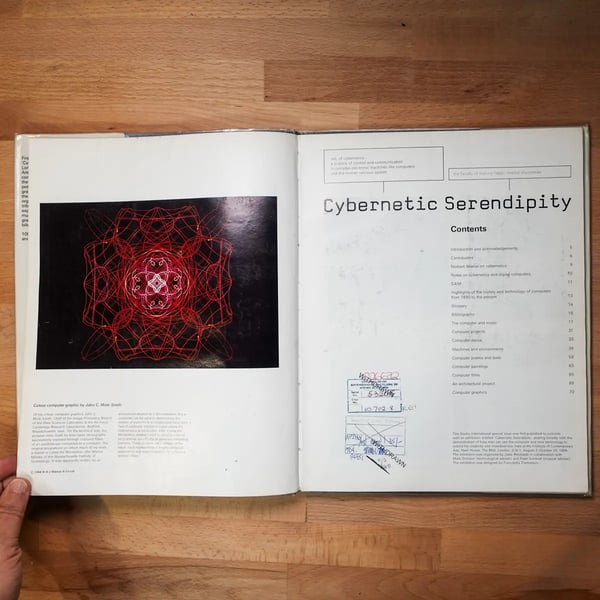
What I am doing here is almost the opposite. We need more small artifacts that let us think with these changes while we are still at the “I dunno...” stage. This has long been recognized as having immense value,
particularly in the present context.
When things are still hard to name is the moment where creativity is most vital to have in the room. But we need ways to feel the difference between a system that expands creative attention and a system that treats creative attention as the inefficiency to be eliminated.
Speculative prototyping is useful here because it gives the question a surface to walk and wander
around. Instead of jumping from that exploratory sense of wonder to inevitability, it lets us pause in the middle and ask better questions.
In this case of the agents begetting agents, we get to ask what ordinary thing changes first? Is it a contract signing an agent to a record deal? A music credit? A label on a generated song that no one knows how to attribute or who/what to credit? If a music publishing agents creates a music making agent
that creates a music streaming agent, what do human musicians do?
So, why all of this? Well, in this week's newsletter I am thinking about the gap between fascination and exploitation, between the artist's question and the deployment logic that comes into the room to ask, “what’s this for?”
Wonder asks what a thing might mean while deployment wants to ask, “what can be extracted from it.” The work, at least the
work I care about, is to recognize that there is immense value in having a wee bit of patience so as to keep the question alive long enough that people can notice what may be at stake before the answer is sold back to them as inevitability.
_Julian_