
| |
| |
| |
| Some upcoming events (one tomorrow!), along with a recap of Office Hours, BLKNWS / Sundance in Denver,
Dave Vondle & Ducks from IDEO, and more Help (is) Wanted in an Adjacent Agentic Near Future that — you betcha! — will need your help and skillz! Plus Tomorrow's Ads...Today! Scrollscrollscrollscrollscroll..\\//.. | Modern organizations are very good at planning, forecasting, roadmapping, and risk management. They are less practiced at imagining. Joshua Rothman’s recent essay in The New Yorker, “Do We Think Too
Much About the Future?,” is useful because it reminds us that “the future” is not a natural object sitting out there waiting to be predicted. It is a historical invention: a way of thinking that emerged when people began to believe that history could be understood, shaped, and improved through Reason. A no-frills, don’t-worry-you-were-asleep-during-history-class way to think about it is this: the future, as we understand it now, was built with instruments. Modern time owes a great deal to clocks. Projection owes a great deal to accounting, insurance, ledgers, and bookkeeping. Prediction was transformed by tools that extended perception: telescopes, charts, markets, statistics, sensors, models. A merchant who could see ships before others could make better bets about
prices. A company with better data could act sooner than its competitors. The future is not just “what happens next.” It is a way of thinking that emerged in a particular historical context, shaped by the tools, institutions, and cultural practices that taught people to imagine, measure, price, and act upon what had not yet arrived. Prediction is a power move. Which is why you get predictors who come in like they're on a self-important ego trip. They're not guessing about the future. They're hoping to make you feel that they can see something others cannot. That belief that the future is what happens next still underwrites most corporate strategy. But in a world of unstable/untrustable institutions, opaque machine intelligence that no one understands really, climate craziness, and all the multivalent compounding uncertainties, prediction alone
starts to feel brittle. Here at Near Future Laboratory, I help you develop a different organizational capacity: not guessing what will happen, but learning how to inhabit possibility more fluently. An imagination-forward practice helps teams rehearse consequences, prototype beliefs,
and make futures tangible before they harden into inevitability. | |
| Food For Thought
| From the digest-this-🥓 Channel
DEPARTMENT OF Historical Consciousness | shared by julian That thing in the intro? Well, I mention that because it's important to consider that “the future” is
less a single destination and more as a historical invention. It's something that had to be made possible by religion, politics, science, finance, and even the stories people told. Once the future became measurable and actionable, it got woven into daily life, so we now live in the constant act of planning and forecasting. Yet forecasting still comes down to guesswork, and the mood around what’s ahead keeps getting gloomier. That tension—between our confidence in shaping tomorrow and our
inability to know it—feels like the real question. Read Joshua Rothman’s essay / short book review(s) to get a better sense of how the future came to be the way it is, and to think about what it might become if we start to imagine it differently. He's got a couple of books in the article (Illustration by the awesome Josie Norton) $ Read more →
| |
| |
|
APF Futures Imagineries Series
|
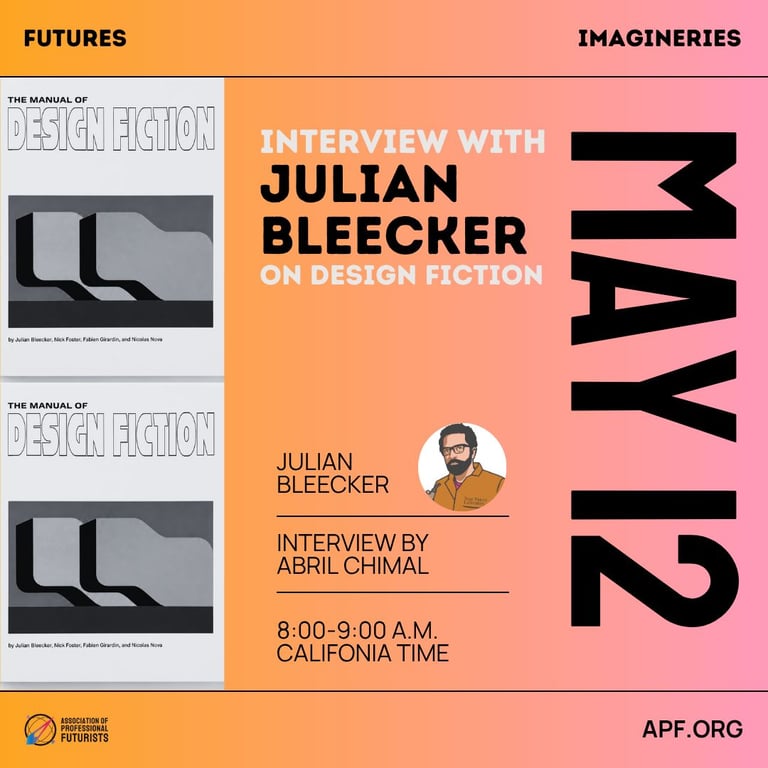
Interview with Julian Bleecker on Design Fiction Tuesday, May 12, 2026 @ 0800 PDT / 1100 EDT / 1600 BST
| 
| I'll join Abril Chimal and the
Association of Professional Futurists for a public Futures Imagineries conversation on imagination, design, futures, and what it takes to make possible futures feel real. Seats for non-members are limited. | Register →
|
|
| |
| Tomorrow's Ads Today
| |
|
Although most pespectives on LLM's “hallucinating” take a fairly narrow perspective of the phenomonen, there is something of timeless cultural import to the idea of “seeing” that which is not apparent to the naked eye. Blind oracles. Vaporous caves. Crystal balls. Tarot cards. The idea that there are hidden patterns, invisible forces, and secret connections that can be glimpsed by those with the right tools or insight is a powerful one. LLMs are just the latest in a long line of technologies that promise to reveal the unseen, make the future legible, and enhance our perception of the sense and meaning of what lies in front of us. | |
|
19 MILLION TOKENS FOR YOUR FESTIVAL EXPERIENCE
| 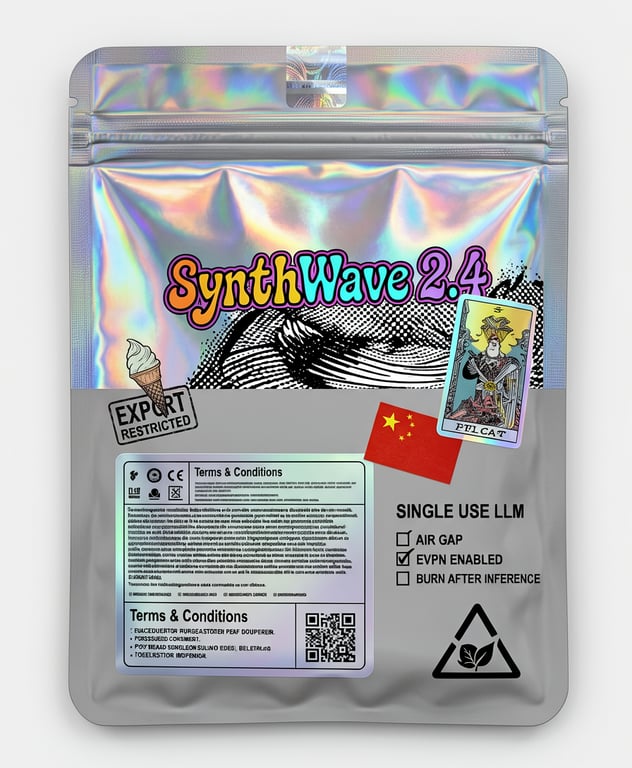
| Sanchez Festival LLM single use lucid hallucinatory
language model tuned for optimal interlinks and extralinks. Festivals become more than just a vibe. Transjection and intraspection under adjunct influence. Unforgettable — with no risk of post-festival privacy leaks. Must be used within 72 hours of purchase. Self-deleting after use. No refills. No reflections. No returns. No regrets. | |
|
|
| |
|
|
|
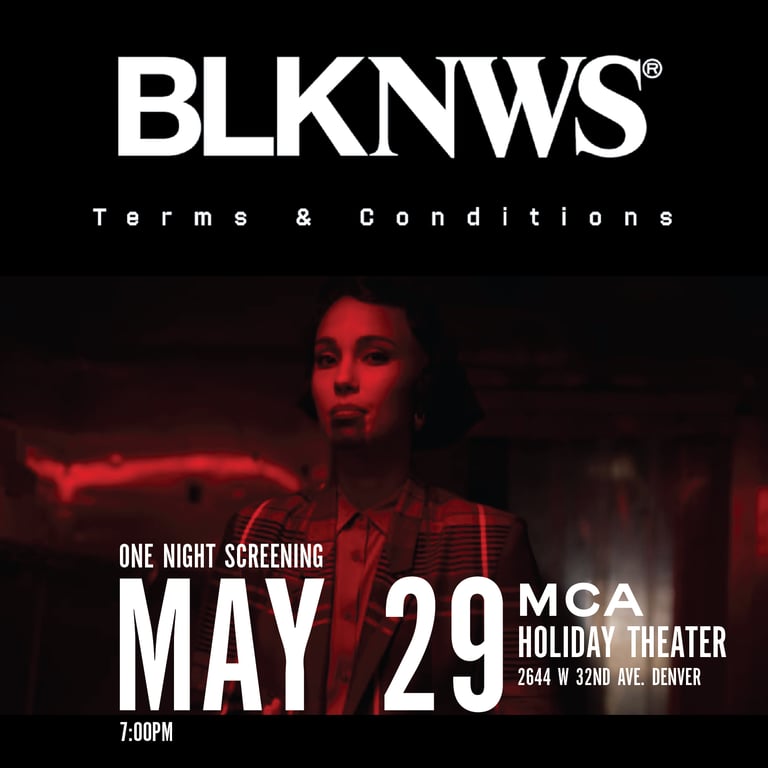
Denver Premiere of BLKNWS Terms and Conditions May 29, 2026, at the MCA Denver Holiday Theater
| 
| I'll
be on a panel at the Denver premiere of BLKNWS: Terms & Conditions on May 29, 2026, at the MCA Denver Holiday Theater. Biennial of the Americas, MATTER, MCA Denver and Sundance Film Festival are partnering together for a special screening of BLKNWS: Terms &
Conditions at the MCA Denver at the Holiday Theater. Adapted from Kahlil Joseph’s renowned video installation, BLKNWS: Terms & Conditions is a cinematic work that mirrors the sonic textures of an album—interweaving fiction and history through cultural figures, artists,
and digital voices in a vision of Black consciousness. The evening includes a social hour, bookstore pop-up, and a post-film conversation featuring Lisa Kennedy, Shari Frilot, Julian Bleecker, Rick Griffith, and Kahlil Joseph. Join us for an evening of film and dialogue that moves between history, narrative, and media—inviting new ways of seeing and understanding Black experience. MATTER Seminar Subscribers, Biennial Culture Club and MCA Denver members receive discounted $10 tickets. Lisa Kennedy — Village Voice Film Critic, Contributor to Variety and The New York Times, Shari Frilot — Senior Programmer & Chief Curator, New Frontier, Sundance Film Festival Julian Bleecker — Designer, Speculative Engineer and Founder Near Future Laboratory Kahlil Joseph - FilmMaker BLK NWS Terms and Conditions, Rick Griffith, Design Director MATTER. | Get tickets →
|
|
| |
|
IDEO Edges
|
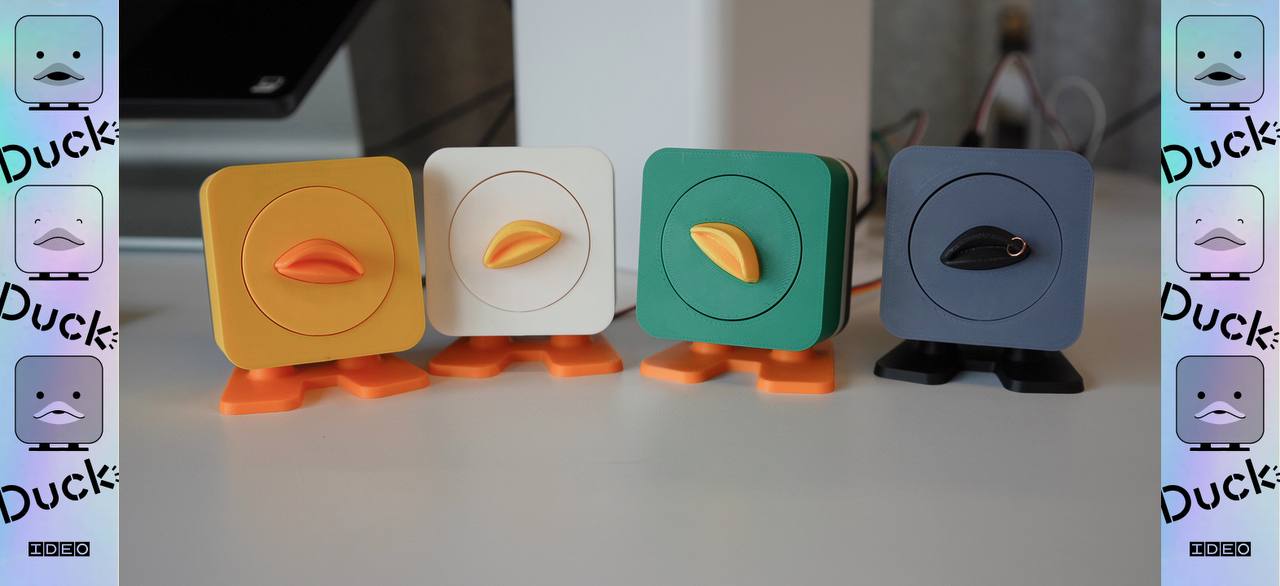
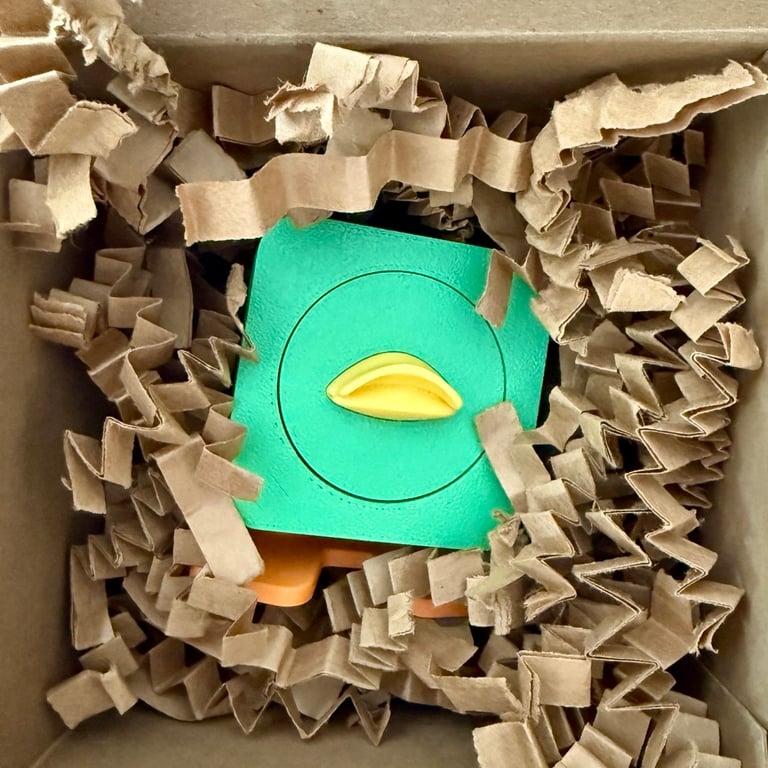
Duck Duck Duck Rubber duck debugging, but the duck talks back.
| 
| 
| 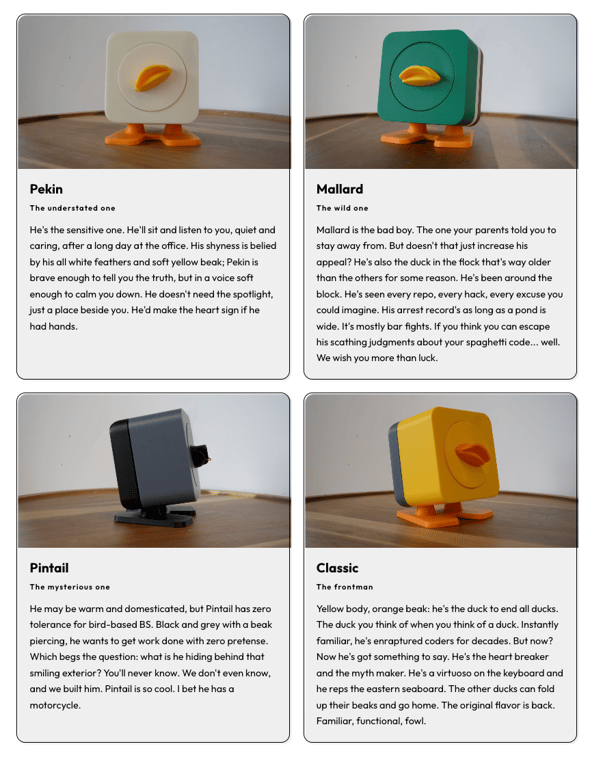
| Dave Vondle over at IDEO sent
me a small USB duck. If you know Dave, this won't seem odd. Dave is one of the most curious people when it comes
to exploring and wondering and wandering around the possibiliites of an interconnected world and to get a mail from him asking if I'd like a desktop widget that's a duck was about as weird as a someone asking if I'd like a refill on my coffee. These ducks are delightful little animatronic usb connected
contrivances that have Claude and talk to your repo. My Duck Duck Duck has a hands-free voice interface that watches my coding session, weighs in on the code, handles permissions by voice, and lets me think out loud without doing the tiny keyboard-and-mouse QWERTY ballet every thirty seconds. Of course the
wake word is ducky, naturally. It is free, open source, built right there at IDEO lickity-split in three weeks using the same agentic tools my duck-duck-ducky plays with, and somehow arrives with the exact amount of judgment — and opinion — one might want from a plastic desk duck debugging dongle. | Meet the duck →
|
|
| |
| |
| 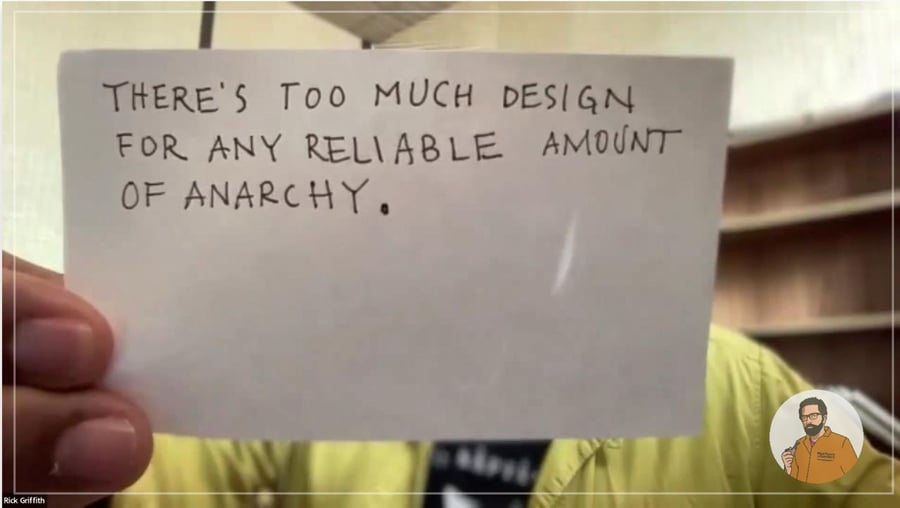
It's never boring when Rick Griffith comes to Office Hours
| |
| Office Hours N°308
| There's
too much design for any reliable amount of anarchy. 1) Office Hours N°308 began with Aaron sharing an
extraordinary series of hand-folded “beat books” — pocket-sized no-cut zines built from a single sheet of paper that unfold progressively like miniature cinematic experiences. What looked at first like a conversation about print design quickly became a much larger discussion about attention, storytelling, civic systems, transportation advocacy, and the politics of communication itself. 2) Aaron walked through his “Intuitive Intersections Initiative,” a transportation advocacy effort in San Francisco focused on simple but meaningful changes: painted crosswalks, daylighting intersections, bike parking, and safer pedestrian infrastructure. Rather than oppositional activism, the strategy centers on creating delight, accessibility, and shared imagination around what cities could
become. 3) The folded zines themselves became the subject of fascination. Participants explored how the rhythm of unfolding creates pacing, suspense, and progressive disclosure — almost like editing in cinema — while the physicality of paper produces a kind of engagement that digital media
increasingly fails to sustain. 4) The discussion drifted into typography, grid systems, CSS-for-print, InDesign automation, procedural publishing, responsive layout systems, and the strange possibility that printed matter may now feel more radical than screens. There was particular
excitement around the idea of building simple systems that allow non-designers to generate and print their own folded “beat books.” 5) One of the strongest threads of the session revolved around the tension between professionalism and spontaneity. Rick, Aaron, and others reflected on how
overly polished design can accidentally erase the urgency, joy, and humanity that made an idea worth communicating in the first place. 6) Punk culture, David Carson, Dieter Rams, amateurism, anarchic design, and “professional aesthetics” all entered the conversation as participants tried
to articulate why handmade, slightly imperfect artifacts can often feel more trustworthy and alive than institutional communication. 7) The session repeatedly returned to the idea that infrastructure, urban planning, and civic systems are not neutral technical realities but socially
constructed narratives maintained through layers of bureaucracy, process, and visual authority. The folded zines became a way to make those hidden systems legible without turning the work into combative propaganda. 8) There were also wonderful side conversations about tactical urbanism,
transportation cultures in Paris and Portland, the hidden labor behind city maintenance, “micro-tour” guidebooks, skateboard clinics as educational spaces, and how physical artifacts can create communities of participation rather than simply broadcasting information. 9) More than anything,
Office Hours N°308 felt like an extended meditation on how ideas move through culture: not simply through information density or technical sophistication, but through delight, rhythm, tactility, narrative pacing, and the subtle emotional textures that make people want to keep unfolding the next page. Watch on YouTube →
| |
| |
|
PUBLIC SERVICE NET
| 
| Seasonal East Texas Doctrine Pack. Conforms to latest
policy alignments and governance maintenance contracts. Suitable for SKILLS.md, POLICY.md, AGENTS.md upkeep. Available now at area retailers and restaurants for your convenience. Get aligned for the season! |
East Texas Data Alignment Bureau
|
|
|
|
| |
| Help Wanted
| Are you looking for a new opportunity in the Agentic Service trade? Join our team! | Agentic Alignment Field Technician Dr. Cornelius' Agentic Alignment Service is the nationally recognized service, installation, realignment, disposal, and remediation operator for AI-based
systems that live where people live and work. We're looking for field service technicians to join our network of owned-and-operated dispatch bureaus and franchise partners as we expand into the Midwest and Northern Europe. Find out more → | |
| |
|
|
|
|


