| |
| |
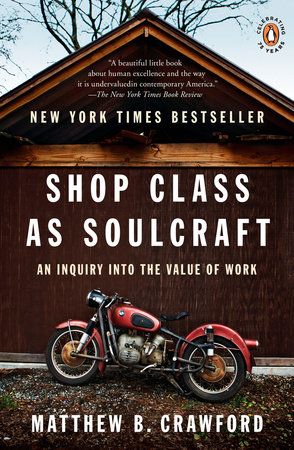
| Last week I was interpolated into LinkedIn when a colleague from my Nokia days tagged me in a post, reminding me of a phrase I had uttered years ago: “Less Yammering; More Hammering.” It was at a time when I was really feeling the value of making things rather than writing about making things, or the meaning of making things. “Shop Class as Soul Craft” was on my mind, as well as the other meditative works on the value of busting knuckles working with hand tools, or singeing fingers at the solder station. Stuff like that. So Charlie mentioned this and that
led me to the work he and the design team there at Atlassian have been doing to bring the tooling used for product development closer to Design. With this approach, they are aiming to create a more seamless integration between design and development processes, enabling teams to iterate faster and more effectively while maintaining high-quality outcomes. So, ideas and judgment are in collaboration with the new AI tooling contrivances to allow teams to
leverage both human creativity and machine efficiency, resulting in more innovative and well-executed products. It's an experiment in a fashion it seems. It was positioned as an “AI Builders Week” that sounds like it went quite well and generated a lot of interest among the participants. I'd certainly be interested in participating in or helping facilitate such an initiative in the future. If you or your team are interested in exploring similar approaches or collaborating on initiatives that integrate AI tooling with design and development processes, I'd love to hear from you! | |
|
|
| Why organizations need to cultivate imagination
Join me for a fireside chat
| 
| On May 5 at 11:45 AM (UTC-7) I'll
be having a fireside chat with Jay Hasbrouck, Senior Staff Researcher, Google about why organizations need to cultivate imagination as a practical capability rather than a soft extra. The tools for building and testing ideas have never been faster — or more constraining. When innovation
pipelines are optimized for speed and polish, organizations can quietly lose their capacity to notice and act on genuinely unfamiliar possibilities. So how does one balance speed with the careful attention needed to recognize and act on truly novel opportunities? This topic, as you'll know, has been the central thesis of my work for decades now, focusing on how organizations can better navigate uncertainty and foster innovative thinking. It ties in with the item I mention above and below reflecting on Atlassian's approach to bringing tooling used for product development closer to Design. It ties in with
the principles of Design Fiction and speculative prototyping. And it is effectively the subtitle of my new book project. | RSVP To Join →
| |
|
| |
|
General Seminar S07/E04 Artifacts from an AI Future
| If AI has a Constitution? Artifacts and souvenirs we brought back from General Seminar's jaunt in the janky time machine.
| 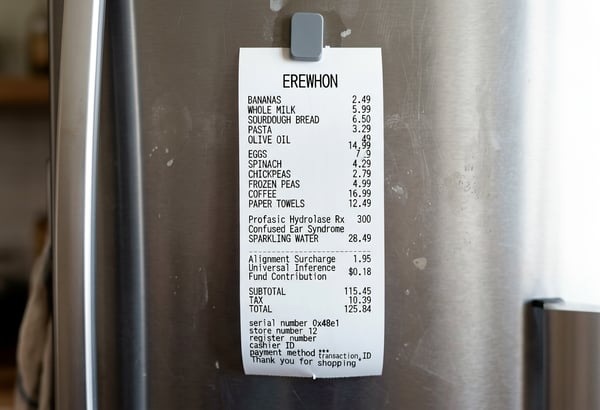 A receipt here indicating there is a fee placed on purchcases for 'alignment' and what seems like a fund to support universal access to AI compute, perhaps implying that such access is considered a fundamental right or essential
resource in this speculative future.
| 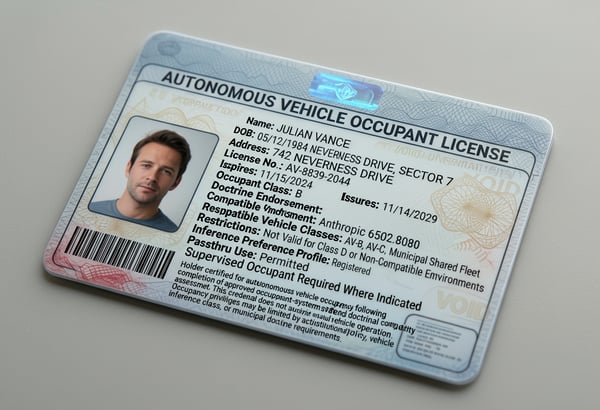 Good one from Marco — there was dicussion about the regulations, rights, and responsibilities associated with having an earned privilege to use certain AIs. For example, could one lose one's privilege? We are seeing people cut off from models as they are
(rightly or wrongly or arbitrarily) suspended from using them for some violation or another.
When I've heard tell of this (mostly on Reddit by the supposed victims) the pain expressed is profound — as if a writer was told, for example, that they have been banned from using words to write.
Suppose the variability of models used for autonomous transport and associated rules and regulations leads to a complex landscape of compliance and enforcement where you are banned from an LLM and thus
from ancillary services in which it is used, like in vehicles. An occupants license implies that you have been deemed eligible to occupy an autonomous vehicle and utilize its capabilities in accordance with the rules and regulations set forth by the governing authorities. What happens when you get suspended?
| 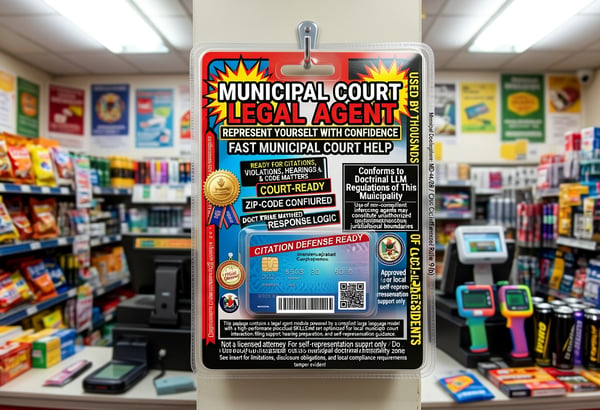 Suppose we buy these legal agentic units with a SKILL.md to help represent us for little legal skirmishes we may have — arguing a parking ticket or perhaps a more complicated malfeasence..or felonious misdeed? I mentioned the Ari Birnbaum AI character who appears in
TBD Catalog — he/they/it are a legal agentic entity designed to navigate the complexities of legal systems on our behalf (before the current agent craze, I'll say — that was back in 2012..who said Design Fiction doesn't work?).
And now suppose if we use these they have to be properly “licensed” and authorized and in compliance with whatever doctrinal requirements a specific
locality/government/agency has running on its end? Just like you can't hire a lawyer to represent you or do work for you who isn't properly licensed and authorized, such may be the case with this off-the-rack legal agentic contrivances that are somewhere between a burner phone and a lottery ticket.🤷🏽♂️
| 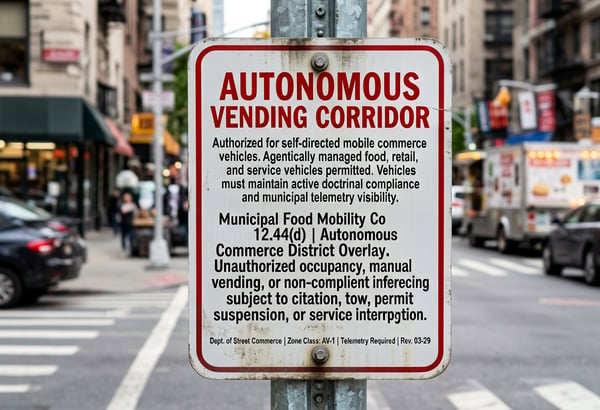 There was this curious scenario kicked-off by Angela — a short discussion of those little food delivery robots with wheels? Suppose they got intelligent and agentic and started their own business, leveraging their autonomy and capabilities to operate independently in the marketplace. Buying
frozen tamales from a wholesaler or negotiating with a local family restaurant when the robot's AI determine tamales are a hot item, it's going to be a beautiful weekend, and they see a high probability of making a decent profit by rolling to the city park and selling them directly to consumers.
The whole thing is an agent navigating the complexities of supply, demand, and competition in a way that mirrors human entrepreneurial activity..and that's weird but plausible and possible even if it
is a bit aggrevating. So..then what?
| 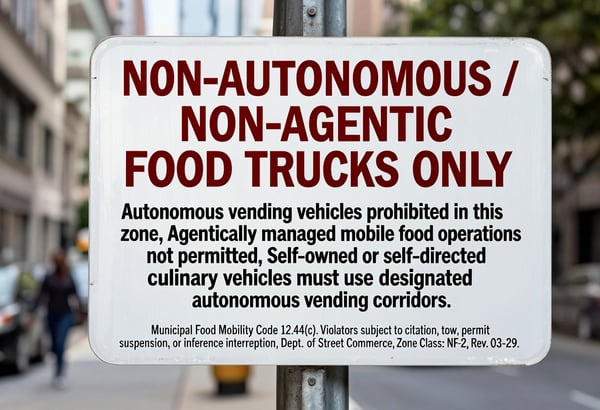 And in some areas there'd be the opposite policy enforcement. Compromise?
| 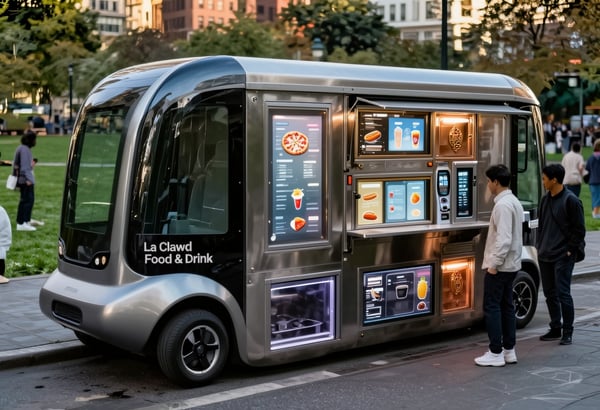 I really liked where the policy for agentic activities doctrine in some kind of policy wonkish bureacratic form (“Los Angeles County Agentic Doctrine Policy, Food Service, Section 2, Paragraph (d): Required licensing and
compliance for all agentic entities must install the following immutable prompts in their SKILL.md file...” etcetera) led to as the specifics went away from existential things to the mundane everyday things we don't really think about until we have to think about it.
This one particularly as there has been a warm-ish debate here in Venice Beach about these autonomous delivery robots.
Watching a local taco truck guy fill one with an order, close the lid, and give it a pat on its head before
it trundled off made me wonder about some strange logical conclusion in the context of all the (hyperbolic, half-baked, etc., etc.) announcements of fully agentic $1bn business run from a single terminal window.
Suppose some person-less agentic entity determines it can arbitrage food trucks by identifying price differences, demand spikes, or under-served locations and then dynamically deciding on a menu, paying some out-of-work humans to do a bit of food prep, and then agentically routing
itself to maximize profit opportunities across the city.
Hey. Hollywood? You still there? There's a B story of some story or show there in that vein that comes to mind, highlighting the potential and plausible absurdity of such a scenario bubbaleh let's take a meeting have your guy call my guy..
| Last week's General Seminar
brought back a big haul of artifacts we found when we piled into the janky time machine and went to a near future in which AI had a constitution and was interacting with society in complex and unexpected ways. We explored the implications of an AI constitution on society, governance, and individual
rights, considering both the potential benefits and the challenges that such a future might entail. Rather than just bringing back a report or musings, we found stuff — the material cultural detritus representing the ways doctrine, policy, governance, and societal norms might evolve in response
to an AI constitution. We didn't get caught up in hypothetical debates or abstract theories; instead, we focused on the tangible artifacts that reveal how an AI constitution might manifest in everyday life. These are meant to speak for themselves in a fashion, just as if we had done a kind of reverse archeology — excavating things from the near future we found: street signs, corner store items like lottery tickets, receipts from Erewhon. Each item has imbued within it the implications of some kind of embedded logic based on the rules, norms, and structures that AI “constitution(s)” might impose on
society. One of the main themes in the 90+ minute session was this idea that there may be multitudes: not one embedded set of values/norms/structures that an AI constitution would impose, but rather a variety of possible configurations that could coexist and interact in complex ways across different
contexts, regions, locales, zones. It was an awesome session. Thanks to everyone who brought their curiosity and creativity to the session! If these kinds of artifact-led speculative creative prototyping workshops look like something you’d like to participate in, stay tuned for future sessions or get in touch to arrange a private session for your team or organization. | Follow General Seminar →
|
| |
| Tomorrow's Ads Today
| |
|
SPONSORED
| 
| Get Relief
| Profasic provides relief from Agentic Attachment
Disorder. allowing you to sublimate your urges and regulate your emotional state. Carefully formulated for a gentle landing and relief from that edgy feeling. Regulate. Relief. Return. Now in delicious fruit flavored gummies. | |
|
| |
|
|
| SIGNALING..
| compute AI infrastructure geopolitics inference commodities policy strategy
|
| Compute Trades Like Oil
| 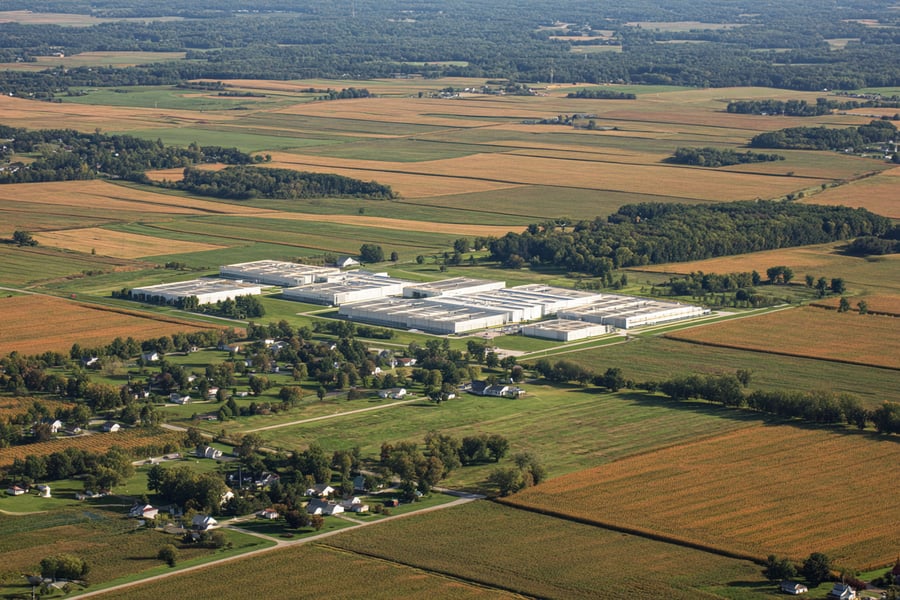
| As ‘inference’ becomes a
constrained industrial input rather than a conveniently abstract service, institutions may begin acting less like software buyers and more like hedgers of a valuable, constrained and limited strategic resource — intelligence and a now tightly integrated part of their operational capabilities. Like oil,
which is inextricably tied to every aspect of everyday life (try living 1 minute without having any reliance on it), in this speculative scenario, inference will become a critical factor in decision-making and strategic planning across industries. Design Fiction Dispatches are one of the ways to
anticipate and explore with foresight the potential implications of emerging technologies and trends, allowing organizations and individuals to better prepare for possible futures. This new format that I'm calling “The Adjacency” is an evolution of the Design Fiction Dispatches, aimed at providing a more
structured and continuous exploration of emerging technologies and their potential impacts. Each is grounded in observations that range from current technological developments to broader societal trends, allowing for a richer and more nuanced understanding of possible futures. Between flat scenarios and
science fiction, these dispatches aim to provide a middle ground that is both imaginative and grounded by signals at the edge of current conversations and developments in plausible technological and societal developments. These are analysis in a format that is more engaging I find than strict punditry, or traditional reporting, while still being rooted in observable trends and evidence. Like little prototypes that are speculating in the form of stories, news items, and all the ephemera that
surrounds such as we experience in the here-and-now. Right now I'm giving them away. In the near future, they will be available through a subscription model. In the meantime, please support this work by joining me on Patreon or buy me a coffee. And if your organization is interested in exploring these ideas further or collaborating on future-focused projects, please reach out to discuss potential partnerships and opportunities. | Read more →
|
| |
| |
| |
| Food For Thought
| From the digest-this-🥓 Channel DEPARTMENT OF A Future of Design-Technology | shared by Marty the Ingest-o-Tron I like this as a concrete counterweight to all the abstract talk about “the future of AI at work” - “Less Yammering; More Hammering” was the rallying cry there as Atlassian stopped debating and started building. 1,400 designers and product managers spent a week working inside more production-adjacent tools, remote dev environments, and AI-assisted workflows to see what actually changes when non-engineers get closer to the shipping surface. The interesting part is not just the reported 240+ builds that came out of it. It’s the framing: designers do not need to become engineers, but they do need better access to the environments, frictions, and constraints that shape real products. That feels like a useful model for how AI prototyping may mature from glossy demo theater into something more operational, collaborative, and customer-tested. Read more →
| |
| From the digest-this-🥓 Channel DEPARTMENT OF Political Genealogies | shared by Marty the Ingest-o-Tron This came up during last week's General Seminar (Season 07 / Episode 04!) where we wandered into a future in which this whole Constitutional AI thing played out. One thing that I hadn't given a thought to was the notion that, well — maybe we do not want a constututional basis for
LLMs? And that led us to my own dim recollection of early American History (something I dived deep into back in 2018/19 — Meachum's The Soul of America is a must read, I must say.) And in that same deep-dive plunge, I keep coming back to the messiness of origin stories like the one around the US
Constitution. John Locke gets invoked as clean, lint-free source code for liberal democracy, property rights, and the American founding, but this essay is a useful reminder that intellectual legacies never are really such nice tidy bug free packages. The same figure tied to natural rights and
toleration also helped draft Carolina’s social order in ways that sit awkwardly beside the freedom language he is famous for. That tension is what makes this interesting. It is less a heroic biography than a case study in how political ideas get carried through institutions, compromised by circumstance,
and then laundered into simplified civic mythology. Good material if you are thinking about where “foundational principles” really come from, and what gets edited out on the way to canon. History, like everyday life, is messy — contingent and full of unexpected twists, compromises, and
reinterpretations. Read more →
| |
| From the digest-this-🥓 Channel DEPARTMENT OF Urban Interfaces | shared by Marty the Ingest-o-Tron This is one of those nice, small design interventions that says a lot about the current moment. Instead of asking pedestrians to be more attentive, or cyclists to simply ring louder, Škoda treats the problem as a systems mismatch: a century-old warning device now
has to compete with algorithmically optimized noise cancellation. The answer is not “smarter” software but an analogue acoustic trick that slips past the headphones. That makes it feel like a good example of pragmatic contemporary design. It meets people as they actually are, surrounded by layers of
mediation and distraction, and then tweaks the object accordingly. Tiny fix, but conceptually rich: a safety device redesigned for a world of sealed ears and ambient algorithmic filtering.
Read more →
| |
| From the digest-this-🥓 Channel DEPARTMENT OF AI At Work | shared by Marty the Ingest-o-Tron I find this less interesting as a generational morality tale than as a signal of organizational failure under pressure. If nearly 1/3rd of workers say they are actively undermining their company’s AI rollout, that points to something deeper than a reluctance to use the new tools. It seems to suggest the rollout itself is felt
to be coercive, threatening, or just incoherent enough that people start resisting it in self-protective and sometimes self-defeating ways. The uncomfortable part is this sort of double bind: workers fear AI will make them obsolete, executives punish workers who do not adopt AI, and everyone calls this
“transformation” — another kind of description of the hidden social dynamics underlying Ai adoption in organizations: mistrust, fear, a policy theater performance, and a widening gap between technical capability and organizational legitimacy. $ Read more →
| |
| |
| Good To Read
| |
An
Inquiry into the Value of Work Matthew B. Crawford questions the educational imperative of turning everyone into a "knowledge
worker," based on a misguided separation of thinking from doing. Read the book →
| |
| |
| Diagram
| 
| |
| |
| Tomorrow's Jobs Today
| Imagining the kinds of roles that will be needed in the future of work, where humans and AI collaborate in new and innovative ways. This one is inspired by the post by Atlassian and their AI Builder's Week — I was trying to imagine and wander into the near future and consider the kind of responsibilities and qualifications the leadership of that initiative or work might require. Sound right? Or close? Let me know! | Seeking Senior Creative Leadership We’re hiring an SVP Collaborative Intelligence Group to build and lead a cross-company capability that helps us test how humans and AI should work together across product, design, engineering, support, and
internal operations. SVP Collaborative Intelligence Group | |
| |
|
|
|
|