
| |
| |
| The audio instrument & contrivances manufacturer Roland put the TR-808 into the world as a drum machine. The market met it — and saw an awkward commercial object: it was expensive, somewhat hard to classify as a musical instrument, and difficult to place inside the categories that made sense to the marketplace at the time. From inside a normal product organization, discontinuing it was sensible. A way to stanche the losses that could be chalked up to the 808’s weak fit with the existing product line and category logic of the musical instrument market at the time. The purpose was blurry so..the business moved on / caved in. Then the machine became cheap enough for proper creatives to experiment with. Outside the original frame, the 808 stopped behaving like a product-line problem and started behaving more like a creative surface for something new — a new sound, a new rhythm logic. Soon artists built styles around its unique and peculiar rhythmic-percussive sound, and whole genres took shape around something its maker had already treated as a dead end. Even if you don't listen to music, you've heard the 808, I can just about guarantee that. And now, to say “808” is to invoke a whole set of musical ideas, cultural associations, and rhythmic sensibilities that were not visible to the company when it first shipped the machine as a product-line item. This is actually one of those moments that is a useful innovation management lesson. Early forms often fail when the existing system of evaluation is asked to evaluate
them. They arrive in the world before the necessary criteria are ready. They look weak when judged against the current portfolio, or the current margin logic, or the current language of value. The organization remains rational all the way through the miss. A speculative
prototyping function gives leadership a way to hold onto that kind of possibility without forcing an immediate decision that would commit the organization to scaling or killing the idea too early. Speculative prototyping can build the artifact. Test some new and strange behavior. Stage and rehearse and simulate. See what use appears when the object meets a different context. That is organizational imagination at work: protecting an unfamiliar option long enough to tell the difference between a bad idea and an early one. | |
|
|
| General Seminar S07/E04 A Constitution? For AI?
| 
| AI labs are writing constitutions
for machines while governments are fighting over whether they themselves still get to write the rules. Anthropic has Claude's Constitution. Amanda Askell gives the thing virtues, character, and “hard constraints.” Jill Lepore, writing in The New Yorker, asks the obvious question: what does it mean when a private company starts sounding more constitution-minded than the constitutional order around it? At the same time, the federal government wants one national AI framework and has argued that state laws are an obstacle to innovation, while California and other states keep trying to impose safety, privacy, and reporting guardrails anyway. So this is not a story about "whether governance exists." Governance exists. It is simply fragmented, contradictory, and fighting with itself
in public. | Grab Your Ticket! →
| |
| Pitch Picture Prototype Join me for a workshop to help you pitch your value and your story, before someone else defines them for you.
| 
| There are still seats left!
April 17th! Pitch, Picture, Prototype — a workshop designed to help you clarify and communicate your value and your story by moving from the idea stage into tangible expressions of possibility that
you can test and iterate on. But not just talking about ideas. This workshop is about taking those ideas and turning them into something you can hold and feel — the prototype part. We designed this as a real workshop: active, participatory, and hands-on. It’s for people who feel the pull toward something new but need a way to begin, not just by discussing ideas, but by prototyping possibility. We'll spend time together online, we’ll work through ways of imagining, testing, and shaping what your next step could actually look like. It’s less about polished answers and more about making
promising directions tangible enough to move with. The session is just the start of what we hope becomes an ongoing community. | Grab your ticket →
| |
|
| |
| |
| |
| Zines Zone
| Elysia's Group Art Exhibition In Your Mailbox Read more →
| |
| Welcome and Hello!
|
Hi! Welcome. Thanks for reading. In case you're new here and wondering -- I'm Julian Bleecker. I help leaders and strategy teams navigate uncertainty through strategic prototyping -- working backward from plausible near futures to make today's choices clearer. I use an approach I pioneered called Design Fiction. You see some of it here in the newsletter and definitely over on my site over at Near Future Laboratory. I create tangible artifacts and narrative experiences that turn abstract foresight into concrete strategic options, alignment, and action. My practice spans engineering (BSEE, MSEng/HCI) and the social sciences/humanities (PhD), so the work holds up technically and lands with cultural relevance and it's grounded and tangible. Near Future Laboratory can bring decades of experience, expertise, and an extensive network of similarly talented professionals -- and I'm available for commissions, facilitated workshops, seminars, talks, embedded engagements, and leadership roles.
| |
| Food For Thought
| From the digest-this-🥓 Channel DEPARTMENT OF Instruments of Creativity | shared by julian I was reading the New Yorker article “Is It Wrong to Write a Book With AI?” and keep thinking about how “authorship” and its meaning changes when a new instrument/tool shows up. When a new
technology enters the picture, it changes what it means to be the author of a work — you're cheating, you're putting someone out of a job, that photography thing is fake painting, etc. — and what gets to count as originality and creative ownership. AI as a writing tool raises these questions in a very acute and concrete way for writing books, but the underlying question about how tools shape authorship is much broader. Good read. $ Read more → $
The 808 Heard Around the World → $ The Battle Over Techno's Origins →
| |
| From the digest-this-🥓 Channel DEPARTMENT OF Futures | shared by julian
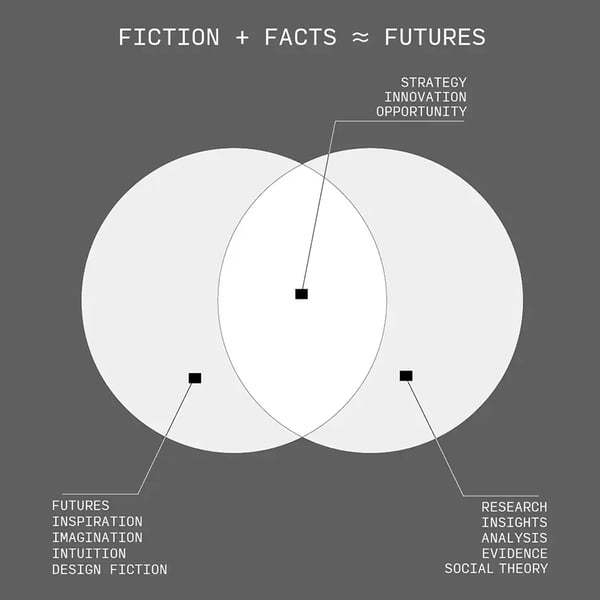 I keep seeing innovation teams get so good at optimizing for what already happened that they quietly lose the ability to imagine what’s next. Organizational imagination is the capability to
envision futures that don’t yet exist and to explore possibilities beyond the immediate constraints of the present — and is a capability that is not easily developed, just as a good science-fiction story requires imagination to construct a world that doesn’t yet exist..something that is exceptionally hard to do. This review pulls science-fiction-related methods out of the literature, narrows them to 17 solid options, and lines them up with a six-phase innovation process so you can actually use them where they fit. It’s a useful bridge between “future stories” and real-world product and R&D work — less random inspiration, more intentional method selection to actually apply these methods in the innovation process and generate actionable insights from speculative futures. Read more →
| |
| From the digest-this-🥓 Channel DEPARTMENT OF AI Policy Implications Futures | shared by julian
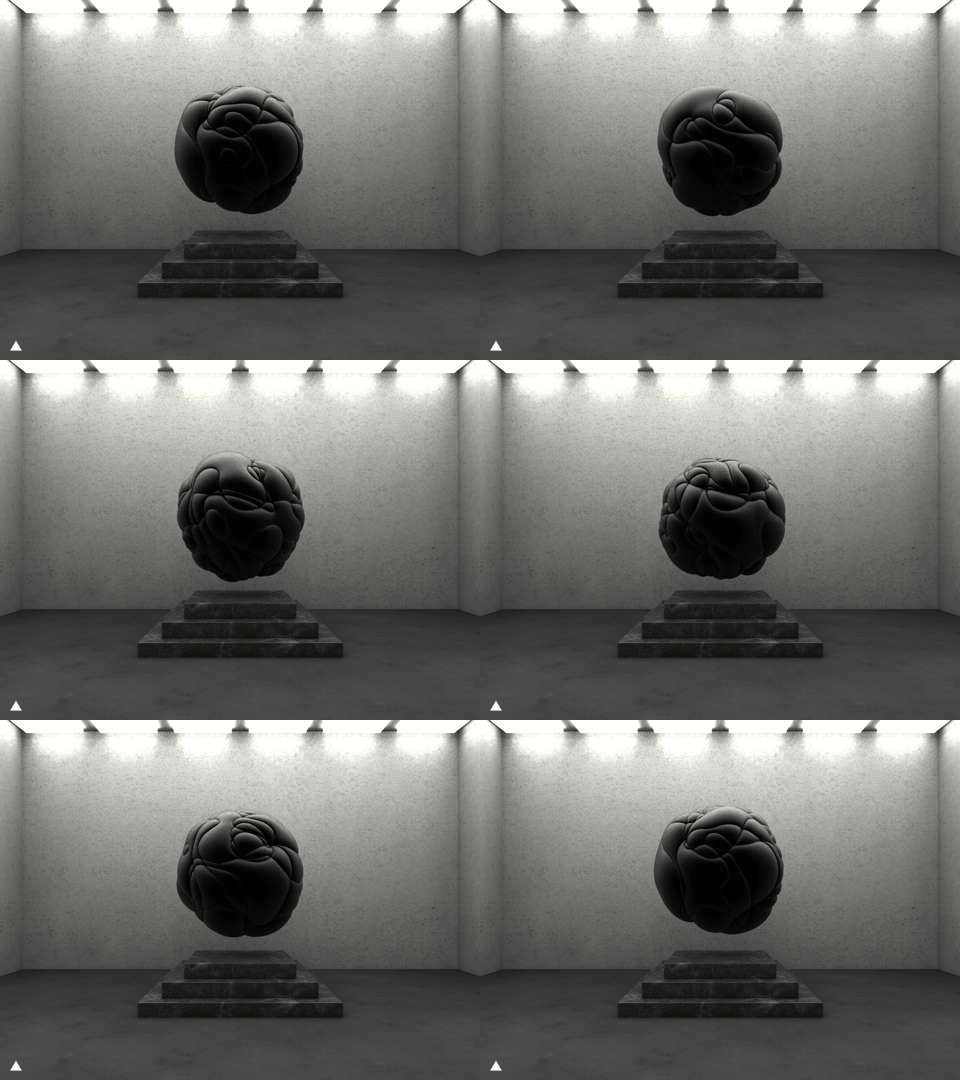 Of course I‘m watching this continuing and escalating showdown over AI regulation: the White House wants states to back off, but California just moved ahead anyway. Gov. Gavin Newsom’s executive order forces
AI contractors to meet safety and privacy guardrails, and he’s promising to fight for California’s tougher protections for kids and against catastrophic harms. I've been curious about the policy and governance topic since I first set eyes on that “AI Bill of Rights” the WH issued back during the previous
guy’s administration, what all these AI Policy & Governance collectives and labs and assemblies that have sprung up in the meantime are doing, and how the federal guidance and these state-level moves interact as the regulatory and governance landscape around AI continues to evolve — and what the actual manufacturers of the language models and AI systems that are being regulated are doing in response to all of this. It’s a messy, hyperlocal-to-global policy fight—especially as states face pressure, rising energy costs, and real-world fears about scams and safety. Meanwhile, the money and lobbying around AI keeps getting louder. Parenthetically, this is what's motivating me to host the next General Seminar on AI policy and governance and this whole 'constitution' thing for LLMs — I don't think this is a topic for armchair quarterbacking. Wandering into
these questions and topic the General Seminar way — as archeologists/anthropologists wondering what the traces of practice, the artifacts, the inscriptions, the material and social traces of AI policy and governance might look and feel like in an inhabited near future, and what they tell us about the worlds that are being built and the futures that are being
imagined — is the approach I want to take to explore this space in a way that surfaces insight without assuming we already know the answers. $ Read more →
| |
| From the digest-this-🥓 Channel DEPARTMENT OF Futures | shared by julian I keep seeing the same pattern: AI’s appetite for RAM is turning a basic computer component into a luxury. When data centers need more memory to run bigger, smarter models, the supply chain gets re-routed—and the bill lands with everyone else. Dell and Lenovo are already charging more, and the shortage is even fueling theft and bizarre store policies. The weird part is that this “AI tax” isn’t coming from a new
subscription—it’s showing up in the hardware you buy. $
Read more →
| |
| |
| Call Log!
| Highlights from the XYZ PDQ Weekly Session 1) The session opened in a more-than-human register: rights of nature, non-human consciousness, DAOs for forests, and even the idea of a “prenup with the next planet” all got airtime as ways of asking what legal standing, agency, and care might look like beyond the
human. Useful anchor links included Rights of Nature law, the Cambridge Declaration of Consciousness, and Dré’s links to terra0 / Autonomous Forest and ForestDAO. 2) Mateusz shared one of the most compelling projects of the morning: a secular oracle constructor that
treats divination as a mirror rather than a supernatural window, giving ritual shape to reflection without requiring belief. The tool is live at hintlab.org/oracle and feels like the beginning of a workshop format about ritual, meaning, and designed systems for guidance. 3) The feedback on the oracle project was sharp and useful: less “business-graph Xerox interface,” more commitment to an aesthetic and material form that makes the ritual feel real, durable, and inhabited. The deeper point was that Mateusz may actually have two projects hiding inside one another: the generalized oracle-constructor tool, and the more vulnerable, more interesting personal ritual object
he has been avoiding by systematizing it. 4) Rick brought back a strong report from the Metalabel / Artist Corporation conversation in Colorado, where the interesting part was not platform cool-kid vibes so much as the attempt to formalize collaborative ownership, IP protection, and
revenue splits for creative work. The relevant links were Artist Corporations, Colorado SB26-133, and the related Artist Corporations
Instagram. 5) The best phrase to come out of that discussion may have been Seb's “KFI” — Key Failure Indicators — as a useful counterpart to KPI thinking when collaborations go sideways. That turned the conversation away from startup optimism and toward a more honest question: what do
we agree counts as drift, non-performance, or damage before the project starts pretending everything is fine. 6) Dré kept pushing on the overlap between old DAO ambitions and current agent systems, especially once agents start getting wallets, payment rails, and task orchestration instead
of just vibes. The memorable line was that many agents are basically cron jobs with a bit of brains behind them, which is exactly the right level of demystification for all the “zero-human company” hype. 7) A lot of practical value showed up in the open-source / self-hosted thread: local
models, on-device workflows, privacy-preserving classroom systems, and the reminder that many “AI products” are just convenience layers on top of tools you can run yourself if you have the literacy. Useful references included Apple’s FastVLM, the FastVLM
repo, Hermes, Barry’s Canadian Google Docs alternative Codox, and Julian’s own agency-agents repo. 8) The hardware tangent turned out to be more than a tangent: SSD shortages, access to compute, and the uneven ability to run models locally all pointed to a real infrastructural politics around AI, not just a software story. That connected nicely to Seb’s public-interest framing via
Public AI and the broader question of who gets access to intelligence systems, under what conditions, and for whose benefit. 9) There was also a strong undercurrent about sovereignty and
public infrastructure, with examples of governments and organizations trying to get out from under US platform dependence and rebuild on public code, open standards, or privacy-oriented tools. A couple of useful waypoints here were Foundation for Public Code and the live concern that interoperability is both the moat and the trap for incumbent platforms. 10) The AI-and-imagination question landed hardest in the teaching conversation: is AI making people dumber, or is it giving them more to think with? The most grounded answer was that the tool itself is less the issue than judgment, pedagogy, and practice — and that the real work is helping
students recognize the gap between generating something and actually noticing whether it says what they think it says, with John Maeda’s Design in Tech 2026 talk offered as a helpful companion. 11) Near the end, the conversation bent toward schools, studios, and alternate institutions: maybe a consultancy, maybe a new kind of futures school, maybe both. The shared feeling was that conventional education is too siloed, too grade-driven, and too timid about real-world problems, which is precisely why these Office Hours keep feeling like a prototype for something else. 12) The final forward-looking thread was Dré’s interest in the Future Vision XPRIZE, which asks for short films imagining optimistic, abundant futures. The interesting challenge here is not to make another shiny sci-fi trailer, but to do what design
fiction does best: show the ordinary, believable, near-at-hand texture of a future that sneaks up on you rather than announcing itself with chrome. Join the Patreon →
| |
| |
|
Join the Near Future Laboratory Discord Join
| Near Future Laboratory Patreon Join the Discord, Support Office Hours, the Newsletter and More
| 
| The Near Future Laboratory is
supported by its community and members. Join us on Patreon to support our work, get access to exclusive content, and be part of our vibrant Discord community where we discuss design, technology, creativity, the future and do projects and support each others' work. I host weekly Office Hours for Patrons -- now for 289 weeks and running -- every Friday at 0900 (UTC-7 / California). It's a great way to connect, ask questions, and get feedback on your projects. Each week two people
from the community present a project, idea, or challenge and we discuss it together. It's a great way to get feedback, learn from others, and connect with like-minded people. All of this is done in a friendly, supportive, and welcoming environment. We have people from all over the world, from all walks of
life, and with all kinds of interests. It's a great way to meet new people, network, show what you can do, and learn from each other. In this time of rapid change and uncertainty, it's more important than ever to have a community of people who can support you, challenge you, and help you grow. The Near
Future Laboratory is that community. | Join →
| |
|
| |
| Classified Jobs Section
| |
| JOB: Editorial Standards Orchestrator
Come work at The New Yorker. The New Yorker is seeking to build and maintain their editorial ML facilities to
help support longform reporting, essaying, quips, cartoons, opinion columns, criticism, and narrative journalism. Job Posting → | |
|
PerfexMedia
| 
| Sonos Sleepytime Emanation SyncLoc 6502
| Now the most sophisticated coherence amplifier and
emanation detector for low amplitude sleep-based model tuning, work-dream cycles, wide-band reception and cohesion of synchronous emanations from your personal and public sync-locked LLMs. Specially tuned for cloud bursts and high-frequency combinatorial inferencing that can be felt during global active training cycles or large system inferencing flows. Sync-lock with the global machinic consciousness with the SBECA 0804 today! |
| |
| |
|
|
|
|


