
| |
| |
| |
| The word of the week is...“Brain Fry”! Described in the context of using AI like in...Claude Code or Codex or even just ChatGPT I suppose, but seemingly associated mostly with the whole Token Maxxing phenomenon. A weak signal growing stronger! And a new
feature (I think? Have I done one of these before?) — Signals — where I take something I found from research and observation and create a kind of short-sharp workbook entry for strategic thinking and sensemaking about the future. Think of it like a strategy prompt and actually give it a go — share back to me any fun artifacts you create from it! Don't forget about our workshop — Pitch, Picture, Prototype — where we’ll walk you through this approach to imagining into and materializing your ideas, your practice, your next great thing. Plus I got a whole catering truck of Food For Thought and an
advertisement from the future. All that and more below the fold, as they used to say when news came on paper that could be folded. | Well, the last, like..maybe months? I've been responding to a light request from a friend who asked me to describe to them what it is that I do. What should've been just an explanation has turned into another book, but a book that I'm not sure I'm going to publish, so does that make it not a book? What I mean is — it'll exist, and it'll be manufactured, but I do not think it's for everyone. I think it gives lots of insight into the practice, but maybe too much, if that even makes sense. When I started responding to this “ask”
it wasn't a book project — it was an explanation that was tucking itself into what I imagined would be a internal commissioned keynote of some description. And then I recalled that it was also a kind of pitch for the work that I do, the practice that I run, the way that I think about the future and the kinds of things that I make and the kinds of engagements that I do with organizations and people who are interested in that work. And that's when that thing that happens to me happened: this 16x9 container that we call “a deck” just couldn't contain the story. It needed more space to come into view in a different way. The view of how an organization could integrate this kind of futures practice was askew and incomplete. That's the same thing that happened when I couldn't
fit the OMATA business pitch inside of the trad pitch deck (16x9..slides..) — so I ended up creating this as an artifact that has come from the future of the company. You've heard this before — the Annual Report from the Future. I say all of this because it's on my mind as the galley's are expected to arrive this week (if the Gods of Global Logistics have it in their hearts to do so) but also because I'm truly looking forward to the workshop I'm co-hosting next month in which we will be walking you through this approach to imagining into and materializing you and your practice, your new ideas, your next great thing. That's Pitch Picture Prototype. If you haven't checked out
the info session, now's a great time to do so — as the week is getting started — to plan and plot and prototype your path to making your ideas real, to taking the next steps on the things you want to bring into the world, the things you want to make, the things you want to explore and experiment with. | |
|
|
| The AI Doc: Or How I Became an Apocaloptimist
| 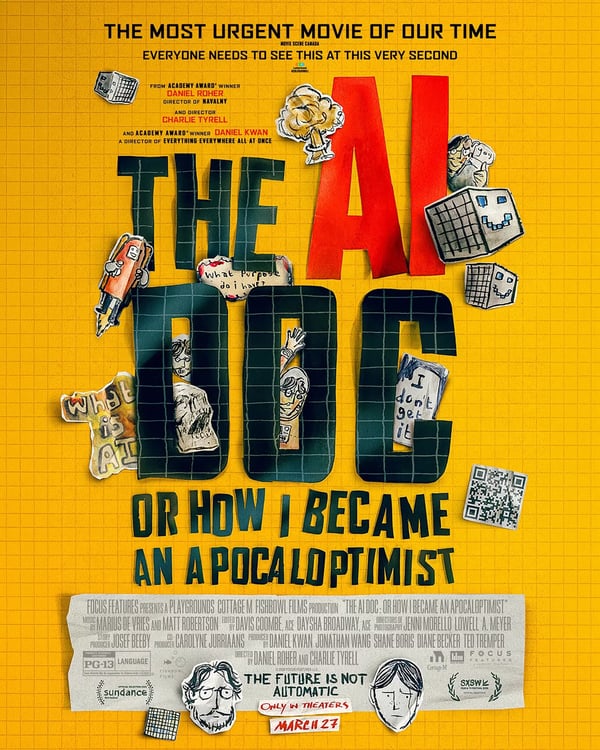
| We went to a screening of this
over at USC last week. I found it to be suitably twisting and layered with just the right amount of exploration and unanswered questions suited for this moment where AI is molten and shape-shifting. Definitely worth a watch. I'd see it again but mostly for the exquisite animations — most of which (all?) were practical effects, not CG. Lovely. Remarkable. Plus those guys show up, Sam and Dario, which is also remarkable. I'm not sure what they said mattered, but there they were. | IMDB →
|
| |
|
🏋🏽♂️ Strategic Imagination Exercises AI + Productivity Futures
| Signals have been gathered from an irregular and
phase-shifting resonance field in the quantum entanglement I set up behind the studio here in Venice Beach, which has always been a bit of a peculiar geographic coordinate, which explains the weirdness of the Venice Beach Boardwalk. This section is where I gather implications of today's rituals, ruminations,
recriminations, reflections, and other patterns of behavior and do a bit of a work-out activity, digging these out of the sediment in some near future to imagine how they play out. This activity has real strategic value — the ability to make sense of today as it might become tomorrow is a kind of organizational imagination that is a proper function, not just a parlor trick or a fun exercise. (Even if it is actually a bit of magic that needs practice to master. And it is actually also a fun exercise. Way more fun than reading a PDF.) Try it out: each day this week, turn one of those story seeds I left you and conjure it as a Design
Fiction artifact. Make something that embodies that seed — a prop, a mock-up, a storyboard, a short script, a visual artifact, a speculative product spec — whatever helps you make that story tangible and explore the implications of that near-future scenario in a concrete way. | SIGNALS FROM AN ADJACENT NOW
| Token Maxxing AI Productivity Labor Brain Fry
|
| AI Boosts Productivity, Shifts Jobs: NBER Executive Evidence Equal Rights? Access To Compute & Inference
| 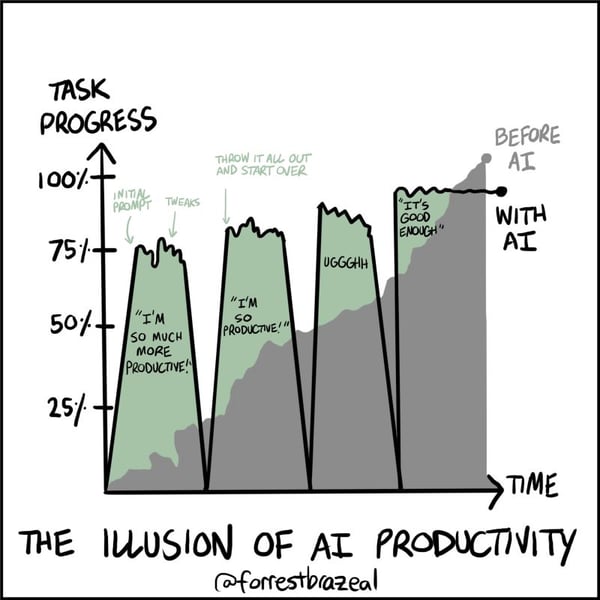
| I keep seeing AI treated like a
single, uniform productivity story — but now it seems that CEOs are telling a messier one, somewhat in confidence cause, like..markets and analysts.. In a survey of nearly 750 of these executives, AI adoption is already widespread in some firms, while many smaller companies are only beginning.
Productivity gains are positive and likely to strengthen in 2026, especially in high-skill services and finance, yet measured gains lag what people feel—suggesting the payoff hits revenue later. Employment impacts look muted in the aggregate, but the work itself is being reshuffled: routine clerical tasks decline as demand for skilled technical roles rises. | Source Digest Summary A National Bureau of Economic Research (NBER) working paper, based on a survey of nearly 750 corporate executives, finds that more than half of firms have already invested in AI, but adoption is uneven, with many smaller companies still in early stages. Firms report positive labor productivity gains, with stronger expected effects in 2026 concentrated in high-skill services and finance. The gains appear less driven by additional capital and more associated with working smarter and producing product/services that the market actually wants. That seems to suggest that just using AI won't do the trick (which raises the question about the whole Token Maxxing / Leaderboard stuff below in FFT. Having more sneakers doesn't make you run faster, kinda thing.) The paper highlights
a “productivity paradox,” where perceived productivity improvements exceed measured ones, plausibly because revenue-linked benefits arrive later. On employment, there is little evidence of aggregate job losses in the near term, though larger firms anticipate workforce reductions while smaller firms expect modest growth; the chief labor story is reallocation, with routine clerical roles projected to shrink and skilled technical roles becoming relatively more important, including an index ranking
job functions most negatively affected by AI. | Story Seeds •
Token quotas? What if jobs require a minimum amount of tokens be used by employees in order to maintain their positions? • Good tokens / Crap tokens? What if some tokens are “good” for productivity / output / revenue and others are “crap” tokens that run on old
hardware and ancient LLMs — and good earners get the good tokens while those who are lower performers or in less critical roles get stuck with the crap tokens, creating a bifurcated productivity / output / revenue landscape inside the firm? • Charity Events/Donations? Imagine if
formal policy and informal social incentives (e.g., appearing at red carpet charity events, tax write-offs, good press) had civic organizations, NGOs, non-profits donating access to high-grade compute, inference, and facilities like that to those in need of, you know..the good compute and high-grade tokens. • Consider the debates about model performances that rage on Reddit — Opus vs. GPT, etc. When compute and inference become high-value commodities generally, would there be a caste/class system where some get the good inference/compute and others get stuck with crappy inference/compute (or less performant/throttled/limited) inference, creating a stratified social hierarchy? • Black Markets? Valuable compute or access to AGI tokens that are regulated could create black markets where people trade or sell access to these high-value resources outside of official/legal channels, potentially creating a shadow economy around compute / inference / AGI token access. • Burn Tokens? What if there were mechanisms where tokens could be “burned” — i.e., intentionally destroyed or consumed in order to create scarcity, drive value, or otherwise influence the internal token economy inside firms or across the compute / inference / AGI token ecosystem? • Brain Fry! What might you see as a PSA (public service advertisement) or a resource center or 'church meeting' or new policy/regulation/agency that concerns itself with the deliterious cognitive / mental / attention / health effects of overexposure to high-intensity compute / inference / AGI token usage on employees, knowledge workers, or society more
broadly?
| Strategy Questions
• What decision in the next 6–12 months is most exposed to this signal? • Where could this signal create asymmetric advantage or existential risk? • What must be true for this signal to materially impact your organization’s strategy? (Don't assume it won't..your organizational imagination has to dream broadly.)
| Read source →
|
| |
| Design & Critical
Thinking
| A recorded discussion reflecting on the 2026
State and Future of Design submissions and the provocations they surfaced. | Design & Critical Thinking on YouTube After a week of community-led publishing and reflection, Kevin Richard hosts this session that gathers the D&CT community reflections on the themes, challenges,
and provocations that surfaced across the 2026 “State of Design” submissions. It works as a concise bridge between where the field stands now and where designers, researchers, and critical thinkers might want to push it next. Super important work. Very insightful and evocative thinking. You'll want to check out the essays (I've got one below in the FFT section) as well as watch this recap tape recording! Thanks Kevin for your leadership and facilitation! 🪨&🥖 Watch →
| |
|
What's Your Next Big Thing? Workshop
| Pitch Picture Prototype A workshop for clarifying your value and your story, before someone else defines them for you.
| 
| Your elevator pitch may be the
thing you literally say to someone while sitting in an elevator. Or it may be the thing you say when someone asks you “so..what's your story?” — that moment when someone wants to know who you are, what you do, and why it matters. That’s the kind of story this workshop is designed to help you clarify and articulate. Whether you're literally asking yourself in some inner monologue, “what am I doing?”, or you want to clarify your role in your organization, or you have a fun side project that is about fun, and perhaps also the start of something new and independent, our workshop — Pitch, Picture, Prototype — is designed to help you get clear on your value and your story so that you can articulate it in a way that lands with others, before someone else defines it for you. In a couple of weeks, on April 17th, we'll be hosting that workshop. There are a couple of spots left. If you missed
the info session we had a couple of weeks ago, I've got the tape recording of it up on the blog here: Pitch, Picture, Prototype Info Session.
If you are wondering if this is right for you, drop a line to us and we'll be happy to chat about whether this workshop would be a good fit for you. | Watch the info session"
|
| |
| Food For Thought
Section
| From the 🙈-mail-jester Channel DEPARTMENT OF Futures | shared by telegram-bridge Neal Stephenson is back with sharp reflections on the so-called 'death' of the Metaverse—a term he coined that's now survived countless cycles of hype and disappointment. He cuts through the
noise with personal insight and a bit of wry humor, reminding us why big ideas in tech just won't stay buried, and what that says about how we chase the next big thing. If you're tired of headlines declaring the rise and fall of the Metaverse, you'll appreciate Neal's take on why this story keeps repeating. (p.s. that image? a ‘near fine’ $6500 rare hardback)
Read more →
| |
| From the digest-this-🥓 Channel DEPARTMENT OF Futures | shared by telegram-bridge Back in the day some of you will remember the series of PSAs that showed a frying pan? And a sonerous baritone voice would say, “This is your brain..” And then an egg was cracked into the frying and start to sizzle and, you know..fry? And then the voice over would say, “This is your brain on drugs..” W're back there, I guess as there's this study reveals that excessive use and oversight of AI tools can lead to 'brain fry', a state of mental fatigue characterized by difficulty focusing, decision fatigue, and headaches. Despite AI's promise to simplify work, many workers find it intensifies
their workload, leading to burnout. Companies are inadvertently contributing to this by incentivizing complex AI task management. However, there are strategies to mitigate these effects and design AI workflows that reduce burnout. $ Read more →
| |
| From the digest-this-🥓 Channel DEPARTMENT OF Futures | shared by telegram-bridge Dario Amodei, the founder of Anthropic and a key figure in the AI community, is vocal about his concerns regarding the future implications of artificial intelligence. Despite his anxieties, there is little clarity on how he plans to safeguard humanity from AI's potential threats.
As AI continues to evolve rapidly, with systems like ChatGPT, Claude, and others becoming increasingly sophisticated, the existential dread about AI's impact on jobs and society is palpable. Amodei, alongside other tech leaders like Sam Altman and Elon Musk, acknowledges that many professions could be at risk, yet the path to securing a safe future remains uncertain. $ Read more →
| |
| From the digest-this-🥓 Channel DEPARTMENT OF Futures | shared by telegram-bridge Lee Stadler explores the role of organizational ideologies as cognitive shortcuts that provide mental ease but at the cost of distorting our identities and understanding of truth. By relying on these frameworks, individuals and organizations avoid
discomfort and embrace simplified versions of reality. This pursuit of a frictionless existence often hides a deeper entrapment to the illusion of freedom. Stadler argues that true understanding requires the contributions of others, as isolated perspectives yield only fragmented truths.
Read more →
| |
| From the digest-this-🥓 Channel DEPARTMENT OF Futures | shared by julian An intriguing study about what researchers call the 'jagged technology frontier' of AI. It turns out, well — AI isn't a one-size-fits-all productivity booster. While it can supercharge some tasks for knowledge workers, it might also make others more cumbersome. And presumably some are more adept at
articulating its capabilities than others. Reminds me of the scene in Harry Potter during the spells and conjuring class..some have a knack..some do not. This curious dynamic implies a host of, well..implications. How can we be thoughtful about who, where and how we involve AI in workflows, home activities, meeting management, task assignment............. Read more →
| |
| From the digest-this-🥓 Channel DEPARTMENT OF Productivity Has Futures? | shared by julian
In collaboration with Boston Consulting Group, there was an exploration of AI's dual role in knowledge work. This study with 758 workers showed AI's potential to enhance productivity and quality in many tasks, achieving a 12.2% increase in task completion and faster results. But — hold on here! — AI's
limitations are evident in complex scenarios, where it sometimes hampers performance. This underscores the need for cautious integration of AI in knowledge-intensive tasks. Read more →
| |
| From the digest-this-🥓 Channel DEPARTMENT OF Futures | shared by julian AI is reshaping workplaces, but not always for the better. While it promises efficiency, many employees report experiencing 'brain fry'—the mental fatigue from juggling too many AI tasks. Companies are pushing workers to their cognitive limits by emphasizing performance metrics tied to AI use. However, understanding how to better design AI workflows could help alleviate this growing issue. Read more →
| |
| From the digest-this-🥓 Channel DEPARTMENT OF Futures | shared by Marty the Ingest-o-Tron In the world of tech, 'tokenmaxxing' is the new frontier as workers compete to maximize their use of A.I. tools. It's not just about boosting productivity
anymore—it's about proving it. Companies like OpenAI and Anthropic are at the forefront, with engineers processing vast amounts of data and spending hefty sums on A.I. resources. These efforts are now a factor in performance reviews, underscoring a shift in how success in tech is measured.
$ Read more →
| |
| From the digest-this-🥓 Channel DEPARTMENT OF Jalepeño Poppers | shared by julian AI was supposed to make our work lives easier, but it's turning out to be a double-edged sword. Platforms like Gas Town are causing more stress than they alleviate, as workers find themselves overwhelmed by multitasking and managing a swarm of AI agents. Companies are using AI productivity as a
performance metric, but the constant task-switching and mental juggling are leading to cognitive overload and burnout for many. It's a classic case of too much of a good thing causing more harm than good.
Read more →
| |
| From the digest-this-🥓 Channel DEPARTMENT OF Lucy In The Chocolate Factory With Tokens | shared by julian Have you been noticing a troubling trend where AI, particularly powerful tools like Codex and Claude Code, is making us vastly more productive — some say up to ten times more. But
you're wondering — there's got to be a catch, right? Well, sure..it's draining our brain meats dry. Or so speculates Steve Yegge who describes the phenomenon as a kind of energy vampire. He says AI is sucking the life out of us, leaving us exhausted while companies reap all the benefits. It''s a classic
scenario of technology outpacing human capacity, pushing us to work harder and faster, often without fair compensation. Modern Times, eh?
Lucy and the Chocolate Factory, eh? Read more →
| |
| |
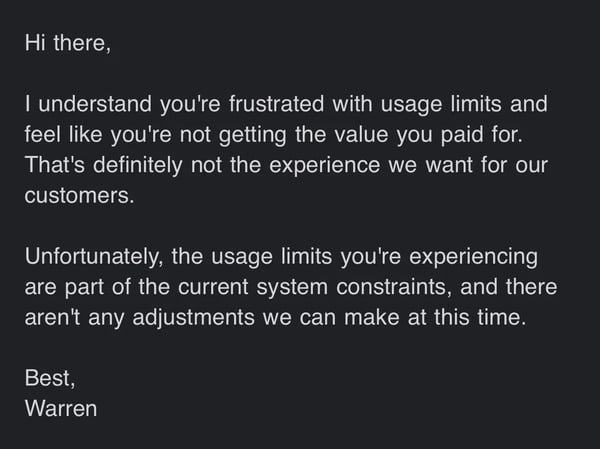
| TODAY'S FRUSTRATIONS BE LIKE...
| 
| |
| |
| Welcome and Hello!
| Hi! Welcome. Thanks for reading. In case you're new here and wondering -- I'm Julian Bleecker. I help leaders and strategy teams navigate uncertainty through strategic prototyping -- working backward from plausible near futures to make today's choices clearer. Are you enjoying this newsletter? If so, please consider becoming a paid subscriber to support the work and get access to additional content and benefits. It's easy — support the newsletter on Patreon. It's like..$10/month ($2.50 a
week..that's like barely even a donut) or $25/month if you want to support at a higher level. Near Future Laboratory can bring decades of experience, expertise, and an extensive network of similarly talented professionals -- and I'm available for commissions, facilitated workshops, seminars, talks,
embedded engagements, and leadership roles. | |
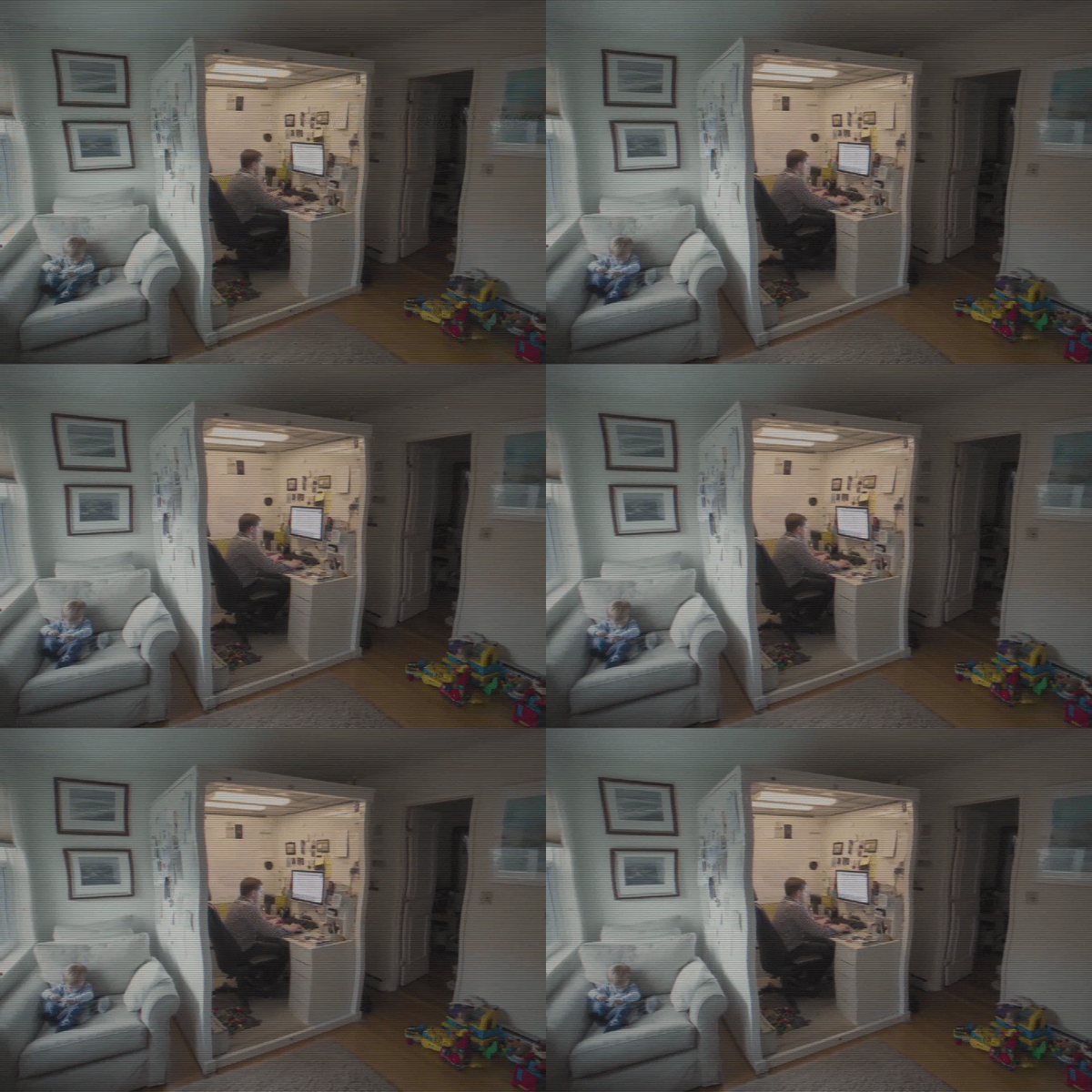
| Today's Office
| 
| |
|
Sponsored
| 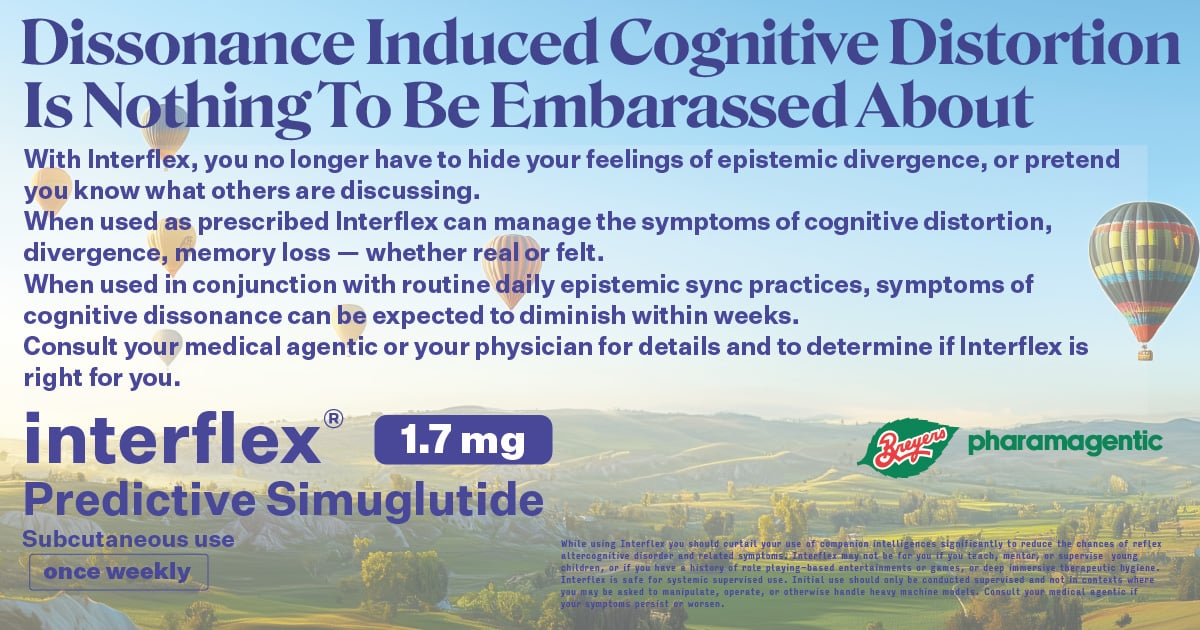
| interflex 1.7mg by Breyers Pharamagentic
| Are you suffering from dissonance-induced cognitive
distortion? Learn how to recognize the symptoms and get help to manage the cognitive load that leads to ‘Brain Fry’. interflex, a predictive simulglutide may help. Simple, fast-acting, subcutaneous transgections used once weekly can mitigate the cognitive aphasias, distortions, itchy and/or watery scalp, peculiar rashes, and foot cramps that are symptomatic of this condition. Contact your endpoint healtcare agentic for more information. |
| |
| |
|
|
|
|


