| |
| |
| 
| |
| Welcome to the Week 10 of 2026 edition of the Near Future Laboratory newsletter. This week I've got a few things to share with you: 1/ The Office Hours No. 300 Recap - Skateboarding, A Black
American Artist in Finland, Cities as Urban Mobiity Labs, and some other stuff. 2/ There's this Week's Keynote Address: Design Fiction for Peace 3/ An Upcoming Thing: Pitch, Picture, Prototype Workshop 4/ Agentic Futures and last week's General Seminar After Action Report 5/ Food For Thought — Some Weak Signals We Received 6/ Books and Stuff 7/ And a chance to join the Near Future Laboratory | This week I will be keynoting an event titled “Design Fiction for Peace” (see below in “Food for Thought”). It’s an initiative exploring how
speculation, imagining, wandering/wondering in tangible ways can make conflict reduction and mitigation (deterrence) visible, discussable, and shareable. I’m grateful + excited to be giving the opening keynote and mentoring alongside incredible collaborators at Design Factory Manchester and Aalto University. I'd be curious to hear your thoughts on where imagination is essential in peace work — as well as where it risks becoming too tidy or distant. I want to wander into this by wondering about peace in a slighly different way which is to do the thing I do and ask — What's breakfast like in times of peace versus times of conflict? What does a commute look like? What does a family dinner feel like? What is the trip to school like? What does a walk in the park feel like?
What does a trip to the grocery store look like? What does a visit to the doctor feel like? This I will bring to the spirit of Design Fiction for Peace, an international initiative with Design Factory Manchester (led by Philip Ely, Dr Ganna Borzenkova, and Ilpo Koskinen). Oh, also there's “Grounded Design Fiction”, a hands-on course opening at Aalto University by Andrea Botero Cabrera —
starting from real conflict contexts, material traces, and the ethics of representation. Selected works will be exhibited at the Design Fiction for Peace Exhibition during PDC Milan, 16–19 June 2026. (If you’re working in policy, existential risk, diplomacy, peacebuilding, design, or futures and want to connect around this, get in
touch./ | |
|
Upcoming: Facilitating a Workshop
| March 20th — “Pitch, Picture, Prototype” A workshop for prototyping your professional future with Carl DiSalvo, PhD, and Julian Bleecker, PhD
| 
| Your elevator pitch is not the
destination. It’s more of a doorway. Four-ish years ago, I was trying to figure out what my next great thing would be. Honestly, I had no idea. I knew what I enjoyed doing — and during COVID, I was forced/fortunate to have to spend lots of time doing it. A lot of time.. What I did was this: I pitched my next thing to myself by creating a prototype of what my world might look like if I did what it was that I (always) wanted to do. I stopped responding to what I thought others wanted from me, and started envisioning what the
world would look like if I were in it doing what it was that I do..my “full-self” and the potential I felt; not the “me” that I thought others expected. And you know what? The response to that was nothing less than unexpected magic. It was like I woke up to my own world rather than stymied by the logic of someone else's idea of the world I should inhabit. It was like my elevator pitch was a doorway into a world I could actually live in — and that others wanted to join. I had always assumed that people would just somehow know what value I could bring; creating a kind of legible ‘prototype’ of that
world made it tangible and visible — and something that had remarkable resonance and value — and people would pay for. Pitch, Picture, Prototype is a workshop for that moment. It’s a
workshop for the moment when you have an idea of what you want to do, but you’re not sure how to make it real enough for others to see and recognize — and for you to keep building. This isn't just a talk-shop. It's a doing-shop. This workshop is a rethink and remake the shape of your work. And the best
thing of it is — you'll leave with a plan held in your hands, not just ideas in your head. Think of it all this way: What if your next cool thing wasn’t an incremental up some ladder, but a step into a whole new world in which you did something you truly loved to do? This is a hands-on workshop for those
who are ready to explore new directions with intention and craft. You’ll develop a bold idea for what you might do next, express it in compelling ways, and plan an experiment to make it felt and real. Sound intriguing? Be sure to subscribe to my Luma to get the invite when it goes live:
Near Future Laboratory on Luma. There will be a limited number of seats available! Carl and I have been building, testing, exploring this workshop structure for nearly a year now and now
we are at this curious moment many of us are experiencing that could really use it. It's a workshop where you can safely rethink and remake the shape of your work. Through guided exercises, you’ll articulate a clear pitch for your next big thing, picture it in detail, and design a prototype — an
experiment — to explore key elements so it’s more than just talk. It's something you can hold, share, test. Expect thoughtful prompts, some really practical tools, and definitely some lively, generative and generous conversation. Expect to leave with momentum and a plan held in your hands. Pencil in Friday March 20th, 2026 for a day of hands-on prototyping to help you move from a clear elevator pitch to creating a place in the world you can actually inhabit. Not just ideas. Not just chat. Finding your path and your value in a moment in which traditional value creation is being threatened by AI
We start with your elevator pitch, then help you turn it into something the market can see: a small portfolio of proof-of-life artifacts and a minimum viable prototype that pulls opportunity toward you — instead of you chasing job posts that don’t quite exist. Carl and I have spent our careers building teams, organizations, companies, and curriculums designed to help foster agency — the ability to move from a clear elevator pitch to creating a place in the world you can actually inhabit. Not just ideas. Not just inspiration. Signals, artifacts, prototypes, and a minimum viable experiment that makes your
direction real enough for others to recognize — and for you to keep building. How do you go from “I want to..” to ”This is what the world looks like when I do...”? How do you make the future feel real enough to act on? How do you get past the abstract and into the tangible? In this workshop we will build that doorway — that short elevator pitch — and build the first room: a place in the world you can inhabit — with proof-of-life artifacts, visible signals, and a prototype that turns “I want to do this” into “this is already happening.” See you in your future! Julian and Carl | Follow to hear more →
|
| |
| General
Seminar S07 E03 After Action Report
|  Last
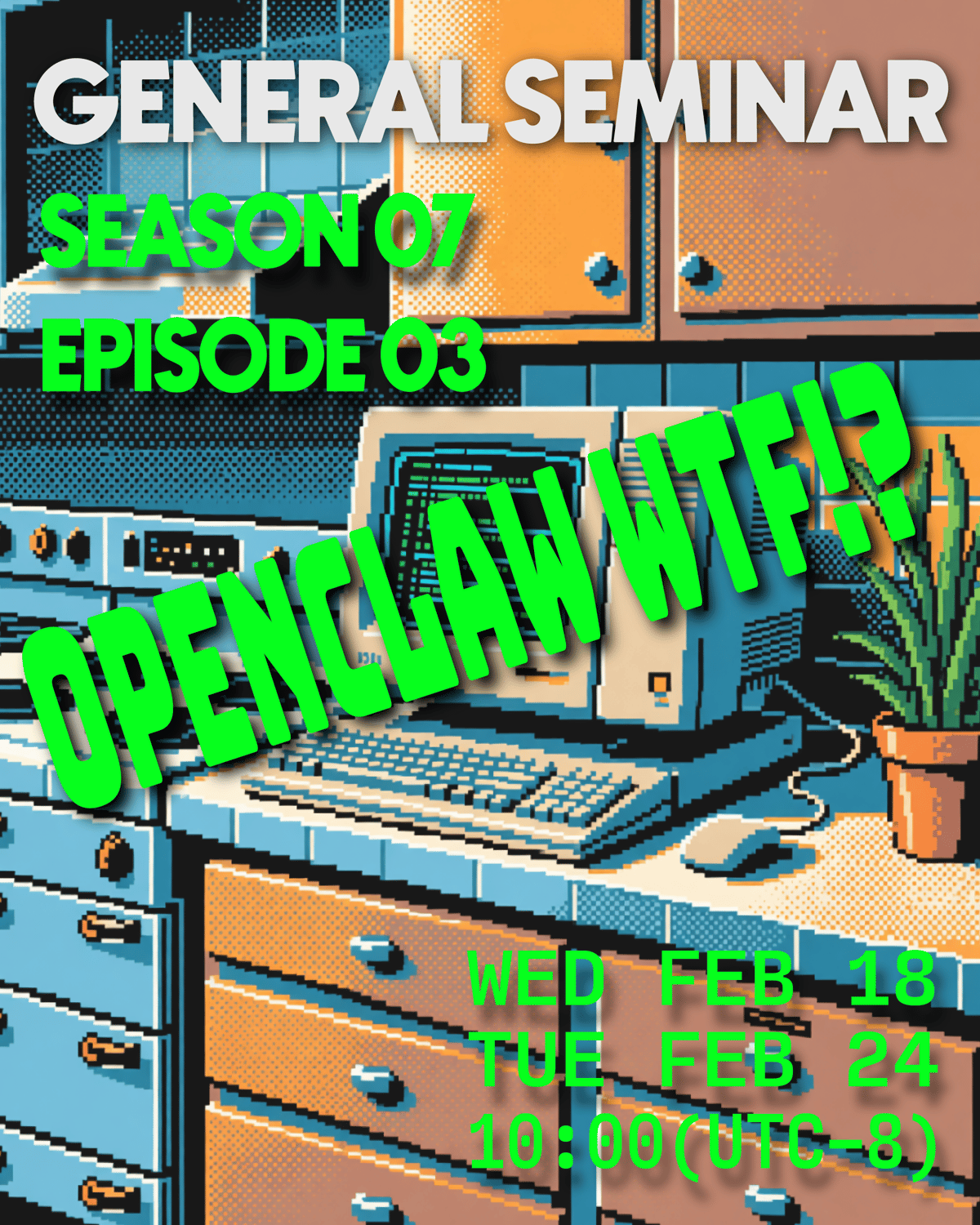
week General Seminar treated the moment we are currently inhabiting like a live science-fiction action spectacular event: not “what do we believe,” but “what do we do when this becomes normal?” The focus of the seminar was on the agentic future...whatever that means. We used speculative archeology to dig
for artifacts that might be found in the material culture of this future, and we found all kinds of things: physical objects that could help us navigate the swarm of agentic AI that is arriving, conversations about active decision making cancellation, and the uneasy slider between convenience and consent.
Here's the topline from the seminar, in 11 nuggets: 1) I opened this session by warming up my janky time machine and with that I proposed a bit of a context set: let's not declare the agentic future. Rather, let's explore like we're on an expedition into that future, rooting around for it
like we're time-traveling archeologists. 2) To tune our senses, I reached for those moments when culture flips in public: Bob Dylan plugging in, punk spilling out of
CBGB, and Dick Fosbury going over the high bar backwards. These are moments we can point to to get a sense of what evolution feels like. 3) Then we hit the headline that made everyone squint, screw their faces in variously anguish or confusion or excitement: OpenClaw, moving so fast it barely holds a stable name, and acting like a kit for spinning up many agents at once. 4) In the chat, someone called it a “Yes And..” sorta moment, and someone else named it as a backwards leap, because it changes the rules by changing the posture. 5) We held one distinction up to the light and kept rotating it: AI agents that follow instructions versus agentic AI that makes choices, has goals, perhaps intention — and the uneasy slider between convenience and consent. I wondered about a toaster in an agentic future — one whose goal is less about making toast and more about making the household feel the feeling of the smell of fresh toast and the feeling of the thought of a bit of butter and honey on that toast. Not
an instrumental aspiration of a robot — “must make toast” the kind of code an engineer might assume; but a semantic aspiration — create a feeling, a mood..that is the “agentic goal.” 6) From there, voice became the obvious doorway, with one participant describing how
Monologue lets them work while walking, and how this shifts agency into the air around us. 7) One breakout brought back a ring and a phrase that felt like a product label and a
confession: Active Decision Making Cancellation: ON. 8) They also found actual claws hanging on walls, where the opening of the claw tells the agents how much autopilot you are requesting in that moment. 9) Another breakout imagined diminished reality, not more overlays but less noise, with a chair that filters interruptions like a physical boundary you can sit inside. 10)
That chair reminded us of Brick, the little talisman of friction that makes you travel back to the object before you reclaim distraction. 11) We closed with a simple practice: if the
agentic future is arriving as a swarm, we should prototype the knobs, rings, claws, and furniture that keep it livable. If you want to read the full after action report, you can find it here:
General Seminar S07 E03 After Action Report. And subscribe to my Luma so you can be sure to get invited to future
General Seminars and other events: Near Future Laboratory on Luma.
Read the After Action Report →
| |
| |
| Office Hours
N°300 Recap
| 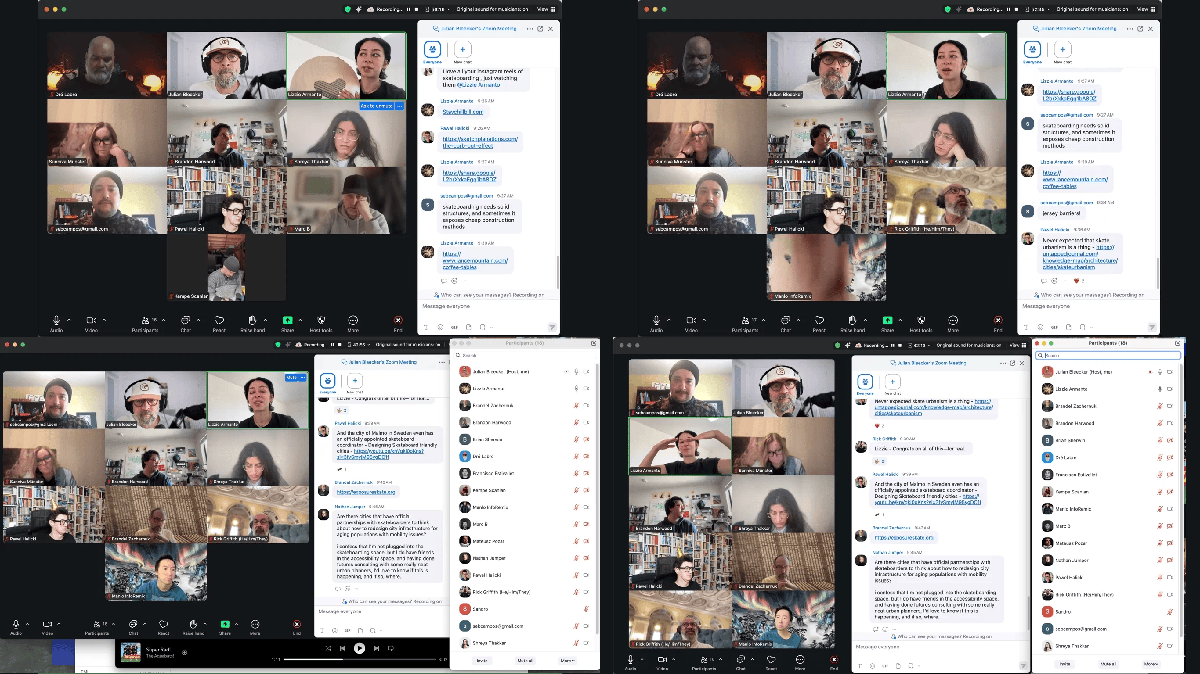 1/Today marked the 300th Friday in a row that I have hosted Offie Hours, and the group treated it like a practice worth celebrating, not a
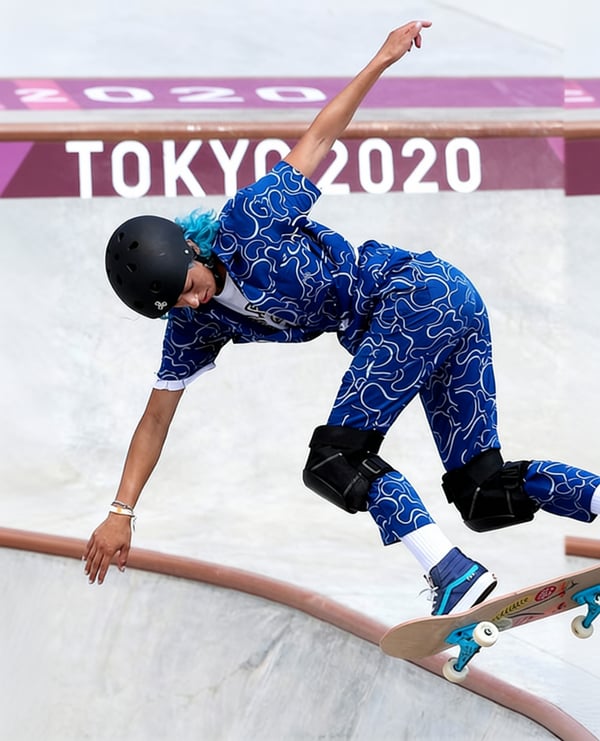
streak to take for granted. There were party hats ftw! 2/ We opened with a small ritual of celebration, a reminder that we mustn't take things like gatherings of this sort for granted (they need support otherwise they wither and shrivel) and a reminder that we can choose our own milestones — and then we drifted into the kind of joyful side quest that feels like the point of this series: I discovered an artist at the Howard Smith exhibition. 3/ That thread turned into a quiet history lesson about cultural exchange, soft power, and who gets remembered, which set an unexpectedly sharp backdrop for what came next which was a complete and welcome surprise — a visit from professional skateboarder and Olympian Lizzie Armanto. How awesome! Lizzie's been a dear friend since I worked on my “Hello, Skater Girl” photobook project when she was, like..I dunno..a senior in high school I think it was. Now..she's an Olympian and Pro Skater (and has a second-self as herself in a video game)! 4/ Lizzie described the Tokyo Olympics debut of skateboarding for Finland, and how an unsponsored apparel slot became a design invitation, a little loophole where identity and craft could show up as a uniform on a world stage Olympics uniform story. 5/ From there we started imagining sponsorship as a cultural platform, not just marketing, including the mischievous thought that a small studio could collaborate with under supported teams and bring local makers into the spotlight, with LA 28 humming
in the background. 6/ Skateboarding became our lens for urban futures: Copenhagen as a place where parks double as sculpture and rideable infrastructure, and the curb
cut effect as a design principle that quietly expands mobility for everyone. 7/ People traded examples of skate urbanism,
corridors that are both shortcut and gathering place, and even ditches that serve flood control when it rains and skate terrain when it does not. 8/ Then the conversation dropped into craft, the way good seminars do: wheel size, hardness, durometer, and the reality that tiny material
decisions change what is possible, what is safe, and what kind of joy a surface can hold. 9/ Photography and film came in as a second board under our feet, with talk of fisheye intimacy, drones threading rafters, and the simple feedback loop of filming a trick to see yourself from the
outside so you can learn faster. 10/ We closed in a surprisingly hopeful register, tracing a line from recycled materials and Skate Light building culture to solarpunk vibes and the reminder that 300 Fridays is not a trophy, it is a community choosing to keep showing up. Join the Patreon Join Office Hours →
| |
| |
| The Shop
| On Sale Now The Manual of Design Fiction (The "How"): A 15-year
culmination of work by The Near Future Laboratory that details the methods and practical approaches to creating artifacts from potential futures. It’s Time to Imagine Harder (The "Why"): Explores the motivation behind Design Fiction, encouraging the use of imagination to explore possibilities rather than just
predicting gadgets. An engaging look into the critical importance of Design Fiction for creating more habitable future worlds with a sense of play and creativity. TBD Catalog (The "What"): The future...as seen in a product catalog! A 10th-anniversary edition serving as a canonical example of what Design Fiction objects
and scenarios feel like. Androids Dream of Electric Sheep (The "What If"): A collection of speculative scenarios that explore the implications of emerging technologies and societal trends — an invitation to you to consider a world in which machines do in fact have dreams. Get yours →
| |
| Welcome and Hello!
|
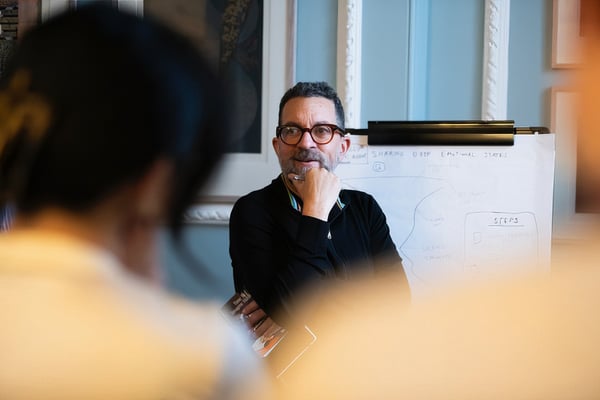 Hi! Welcome. Thanks for reading. In case you're new here and wondering -- I'm Julian Bleecker. I help leaders and strategy teams navigate uncertainty through strategic prototyping -- working backward from plausible near futures to make today's choices clearer. I use an approach I pioneered called Design Fiction. You see some of it here in the newsletter and definitely over on my site over at Near Future Laboratory. You can even read about it in these two books —
The Manual of Design Fiction and It's Time to Imagine Harder. I create tangible artifacts and narrative
experiences that turn abstract foresight into concrete strategic options, alignment, and action. My practice spans engineering (BSEE, MSEng/HCI) and the social sciences/humanities (PhD), so the work holds up technically and lands with cultural relevance and it's grounded and tangible. Near Future
Laboratory can bring decades of experience, expertise, and an extensive network of similarly talented professionals -- and I'm available for commissions, facilitated workshops, seminars, talks, embedded engagements, and leadership roles. | |
| Food For Thought
Section
| From the 🙈-mail-jester Channel DEPARTMENT OF Read
| shared by Julian Bleecker Caught in the endless swirl of opinions on AI and art, the author dives into the messiness of the conversation itself. With artists, historians, and skeptics all around, every attempt to make sense of it reveals just how tangled—and human—this debate really is. Rather than boiling it down to easy answers, these essays aim to find what’s real and meaningful amid the noise. Read On →
| |
| From the digest-this-🥓 Channel DEPARTMENT OF Read | shared by Marty the Ingest-o-Tron Design
Factory Manchester unveils 'Design Fiction for Peace', a groundbreaking project uniting Europe's design schools to promote peace through innovative design.
Read On ✌️
| |
| From the digest-this-🥓 Channel DEPARTMENT OF Read | shared by Marty the Ingest-o-Tron The MacGuffin Pattern is a strategic approach where a visible deliverable drives
inevitable systemic changes. And you know how strategy and service design people like their patterns and frameworks...loosen up fellers! Anyway.. It’s a method where the Matter Laye — that thing that gets funded and implemented — triggers changes in the Meta Layer — that thing that actually needs to transform. This pattern is evident in the adoption of electric vehicles, which necessitated infrastructure
changes, and in the GOV.UK consolidation project, which subtly shifted government IT procurement and service design practices. By focusing on a tangible project, organizations can create a compelling narrative that justifies necessary but less visible systemic changes, making it a powerful tool for driving transformation in complex systems. For you Hitchcock fans/nerds you'll know that the MacGuffin was a plot device that motivated the characters and drove the story forward, but was ultimately unimportant to the audience. You know — the Rabbit's Foot in Mission Impossible; the Maltese Falcon in, you know..The Maltese Falcon. In strategic contexts, the MacGuffin serves a similar purpose: it’s a visible project or initiative that captures attention and resources, while the real transformation happens in the background. By designing the MacGuffin thoughtfully, organizations can create a compelling narrative that justifies necessary but less visible systemic changes, making it a powerful tool for driving transformation in complex systems. Read On 🦅
| |
| |
|
Join the Near Future Laboratory Discord Your support helps
| Near Future Laboratory Patreon Join the Discord, Support Office Hours, the Newsletter and More
| 
| The Near Future Laboratory is
supported by its community and members. Join us on Patreon to support our work, get access to exclusive content, and be part of our vibrant Discord community where we discuss design, technology, creativity, the future and do projects and support each others' work. I host weekly Office Hours for Patrons -- now for 289 weeks and running -- every Friday at 0900 (UTC-7 / California). It's a great way to connect, ask questions, and get feedback on your projects. Each week two people
from the community present a project, idea, or challenge and we discuss it together. It's a great way to get feedback, learn from others, and connect with like-minded people. All of this is done in a friendly, supportive, and welcoming environment. We have people from all over the world, from all walks of
life, and with all kinds of interests. It's a great way to meet new people, network, show what you can do, and learn from each other. In this time of rapid change and uncertainty, it's more important than ever to have a community of people who can support you, challenge you, and help you grow. The Near
Future Laboratory is that community. | Join →
|
| |
| |
|
|
|
|