
| |
| |
| |
| We've got a muse on the Agentic Logic of (Late) Late Capitalism, a workshop for prototyping your future, and another installment of “Yo, Unc!” - reciprocity was
the theme that emanated from my weekly one-on-one with Jackson. Also — this Wednesday is the first of two sessions of General Seminar S07 E03: The Agentic Future. Join me for a live science-fiction action spectacular event: not “what do we believe,” but “what do we do when this becomes normal?” Plus, pencil in Friday March 20th at 0800-1400 (UTC-8) for a workshop with Carl DiSalvo and myself called “Pitch, Picture, Prototype” — a hands-on prototyping workshop to help you move from a clear elevator pitch to creating a place in the world you can actually inhabit. Not just ideas.
Not just chat. Finding your path and your value in a moment in which traditional value creation is being threatened by AI. And of course Call Log! from last week's Office Hours — don't forget to RSVP for this week's session. Just join the Patreon! Office Hours is held every Friday at 0900 (UTC-8).
Finally, a brief remembering of Teresa de Lauretis, a generous mentor to many who passed through the History of Consciousness program at UC Santa Cruz, including myself. | 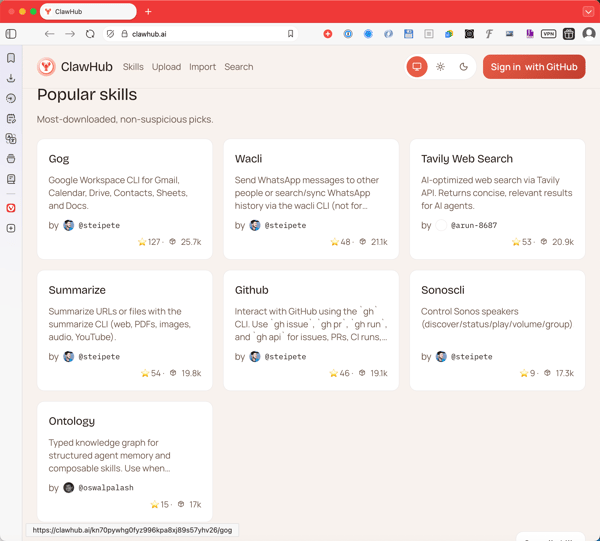
I found a treasure of an artifact from the agentic future! Srsly! It's like a glimpse through a keyhole in the space-time continuum that looks right into a possible agentic future.
Let me explain.. So, lately I've been doing lots of hands-on
prototyping of what I guess one would call 'Agentic Futures.' By that I mean — actually building and prototyping the software systems, interaction flows, and interfaces that might exist in these futures. Why? Partly because I believe immersing oneself into the practice of an emerging technocultural form gives one a deeper understanding of it than just reading about it or, worse, complaining about it. Partly because I find it fun and rewarding to explore the
possibilities of the future in a way that is grounded in the present, but also open to the unexpected and unanticipated. Partly because I think it's important to have a sense of what the future might be like, so that we can make better decisions in the present. But mostly hecause its a possible/probable future that is already here in a liminal way. And today it is already influencing our decisions, but not yet fully appreciated. Also, you come across the most
curious artifacts when you step into this mode of prototyping. Here's one little treasure I found recently that I want to share with you: https://clawhub.ai (or for you Git folks go here: https://github.com/openclaw/skills/ It's a gigantic repository of the agentic “skills” that are
already being built for OpenClaw, the agentic contrivance du jour. Go there. What you are looking at the catalog of things that it seems the folks living just at the other side of the future have already built — representing in some fashion the hopes, fears, dreams, desires and dreads of the present. This might look like a terse, very nerdy Git repository. This feels quite a bit like the early internet that was looking for its purpose. (And I'm certainly not
suggesting that it found itself as the most rewarding, habitable, and life-affirming thing in the world..but it didn't know what it was to become. This is an important point because at this moments of emergence we have a lot of power to shape the future, but we also have a lot of uncertainty about what the future will be..and the more diverse ways of knowing and comprehending value that participate at these moments of emergence, the better the chances for something that isn't just a zero-sum
game for a few, you know..bros./ That skills list? Look at it as a cultural artifact found in some future and interpreted as a kind of rubicon. A wellspring of insight into the mindset of the early adopters. You can love it, hate it, be inspired by it but there's no ignoring it. It is a mirror held up to the present, reflecting back the agentic logic of late-late capitalism in all its glory and antagonizing contradictions. This is the “archeology of
the future” thing that I go on and on about. Finding evidence of the future in the present is a practice that I find endlessly fascinating and rewarding. It is a way to connect the dots between the present and possible futures, to see how the seeds of the future are already being sown in the present, and to understand how the future is already shaping our present. These “skills” reprsent what the other side of the future has already built in its infancy.
They are the awkward attempts at finding meaning and value, like luggage before someone actually figures out that you can also add wheels to it. They are the early, clumsy, but earnest attempts at making sense of the possibilities of the future. They are the first steps in a dance that we are all learning together. I'm going to be doing a deep dive into things like this in General Seminar Season 07 Episode
03. We'll be treating the moment we are currently inhabiting like a live science-fiction action spectacular event: not “what do we believe,” but “what do we do when this becomes normal?”
Join me! Two sessions to accomodate your agentic calendaring robot! This WednesdayFebruary 18th at 10am PT (UTC-8/ and a second session on Wednesday February 24th at 10am PT
(UTC-8/. | |
|
Upcoming
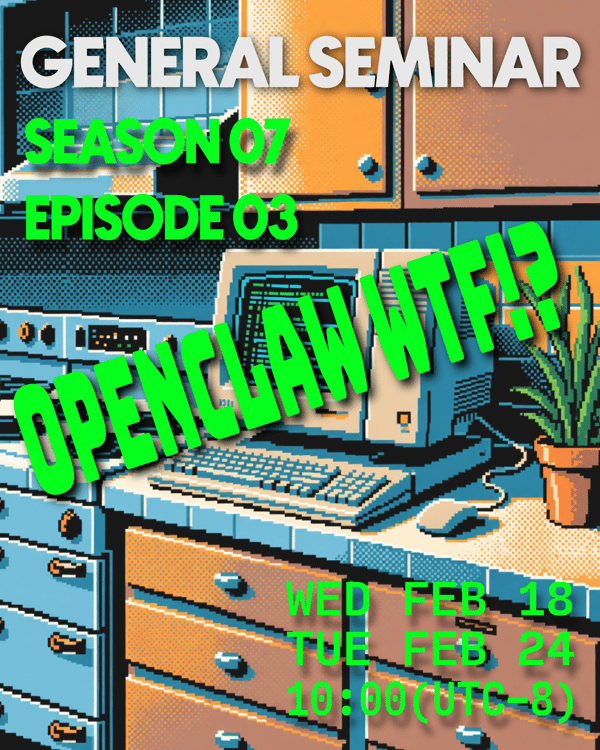
| General Seminar S07 E03: The Agentic Future
| 
| OpenCLAW (formerly Clawdbot /
Moltbot) feels like a glitch in the calendar: one week it’s a clever demo, the next it’s a social and economic actor — running errands in our browsers, operating our tools, booking meetings, moving files, touching credentials, and quietly turning “software” into your weird whacky drunkard uncle at the family holiday party. The elation is real. The curiosity is felt..and so is the sense of perverse fascination and existential dread. Join me for General Seminar S07 / E03, where we’ll treat the moment we are currently inhabiting like a live science-fiction action spectacular event: not “what do we believe,” but “what do we do when this becomes normal?” Two sessions to accomodate your agentic calendaring robot! February 18th at 10am PT (UTC-8/ and February 24th at 10am PT (UTC-8/. | Read more →
|
| |
|
Pencil This In
| Folow: Pitch, Picture, Prototype A workshop for prototyping your future with Carl DiSalvo, PhD, and Julian Bleecker, PhD
| 
| Your elevator pitch is not the
destination. It’s more of a doorway. It's the other side that's the hard work. Right now, a lot of talented
people are stuck in the most demoralizing loop: refresh → apply → silence. Carl and I built this workshop for that moment. Pencil in March 20th, 2026 for a day of hands-on prototyping to help you move from a clear elevator pitch to creating a place in the world you can actually inhabit. Not just ideas. Not just chat. Finding your path an dyour value in a moment in which traditional value creation is being threatened by AI We start with your elevator pitch, then help you turn it into something the market can see: a small portfolio of proof-of-life artifacts and a minimum viable prototype that pulls opportunity toward you — instead of you chasing job posts that don’t quite exist. Carl and I have spent our
careers building teams, organizations, companies, and curriculums designed to help foster agency — the ability to move from a clear elevator pitch to creating a place in the world you can actually inhabit. Not just ideas. Not just inspiration. Signals, artifacts, prototypes, and a minimum viable experiment that makes your direction real enough for others to recognize — and for you to keep building. How do you go from “I want to..” to ”This is what the world looks like when I do...”? How do you make the future feel real enough to act on? How do you get past the abstract and into the tangible? In this
workshop we will build that doorway — that short elevator pitch — and build the first room: a place in the world you can inhabit — with proof-of-life artifacts, visible signals, and a prototype that turns “I want to do this” into “this is already happening.” | Follow to hear more →
|
| |
|
Sponsored By Velolara. Hyper-collaboratorium
| Coming this June!
| 
| Velolara is a hyper-collaboratorium for where we are always on
an expedition, exploring the possible futures of living, loving, lifing.
Velolara. It’s a residence village.
Velolara. It's a research laboratorium.
Velolara. It's a design studio.
All in one..where we are on a journey for new ways of cohabitating with human and non-human intelligences, species, contrivances, creatures..together. |
| |
| Yo, Unc?
| One-on-one with Jackson Reciprocity: The Give and The Take Once a week I have a one-on-one with my oldest nephew, Jackson, freshly 21, star basketballer, and college student. So..something..happened. It suffices to say that Jackson is a giver — the guy who gets the gang together. The details are not important, but the shape of the “event” led to the an opportunity for an avuncular lesson folded into a story. This week’s learning opportunity was to a lesson
about givers and takers — something relevant for the kind of person who is eager to start and build collectives of human potential: a company, a team, a pick-up game, a club, a game night, or any of the infinity of ways of getting people together for some kind of collaborative endeavor. Some will find themselves being
the person who gets the gang together — the charismatic who enjoys fostering collaboration community teams collectives, etc. Over the years I’ve built projects and communities where the real work isn’t the “big idea” — it’s the steady, unglamorous work: initiating, inviting, editing, following through. When you’re that person, you’ll meet a familiar situation: someone benefits from the momentum you created but doesn’t naturally contribute back into the effort. Just to be clear — this is not a callout. It has happend — and it’s a pattern. It's life, and the value in it happening is that you understand the kinds of things that can happen when humans interact. How does one manage the general dynamic of, you know — humans interacting? So the practice is simple: make your expectations explicit early, invite contribution directly and with clarity, reward the helpers, and reduce exposure to chronic non-contributors — and do so calmly, cleanly, and avoid carrying the freight of resentment. You definitely do not want to get in a position where you disregulate and villainize anyone. Just choose your collaborations and your collaborators with eyes open. And then remember that at the edge case, one is not
obligated to interact with everyone just because they want to, particularly if they jam things up. Check? Stay tuned for the next episode of
“Yo, Unc?!” | |
| Food For Thought
Section
| From the digest-this-🥓 Channel DEPARTMENT OF Read | shared by Marty the Ingest-o-Tron Dario Amodei of Anthropic takes a stand, current White House AI strategy while others in tech play nice. His bold moves put him at odds with the White House, forging a path few dare to tread. Read On →
| |
| From the digest-this-🥓 Channel DEPARTMENT OF Read | shared
by Marty the Ingest-o-Tron AI's rapid rise is shifting from sci-fi dreams to public reality. As capabilities
grow, so do the risks, sparking global discussions about our future with AI. Read On →
| |
| From the digest-this-🥓 Channel DEPARTMENT OF Read
| shared by Marty the Ingest-o-Tron Online gamblers on platforms like Kalshi and Polymarket are rivaling professional economists in forecasting economic trends, thanks to the crowd's wisdom and financial incentives. $ Read On →
| |
| From the 🙈-mail-jester Channel DEPARTMENT OF Read | shared by Julian Bleecker PhD Job hunting feels like shouting into a void—upload your resume, answer the same questions, and maybe (but probably not) get a reply. It's exhausting and discouraging, and plenty of people are feeling burned out by the whole impersonal process. Read On →
| |
| |
| Welcome and Hello!
| Hi! Welcome. Thanks for reading. In case you're new here and wondering -- I'm Julian Bleecker. I help leaders and strategy teams navigate uncertainty through strategic prototyping -- working backward from plausible near futures to make today's choices clearer. I use an approach I pioneered called Design Fiction. You see some of it here in the newsletter and definitely over on my site over at Near Future Laboratory. I create tangible artifacts and narrative experiences that turn abstract foresight into concrete strategic options, alignment, and action. My practice spans engineering (BSEE, MSEng/HCI) and the social sciences/humanities (PhD), so the work holds up technically and lands with cultural relevance and it's grounded and tangible. Near Future Laboratory can bring decades of experience, expertise, and an extensive network of similarly talented professionals -- and I'm available for commissions, facilitated workshops, seminars, talks, embedded engagements, and leadership roles. | |
| Call Log!
|
 1/ We started with a delightfully petty but real point: type still matters — ligatures, kerning, captions, and all the micro-choices that keep “the future” from looking like a ransom note. 2/ A provocation landed hard: if voice becomes the
default interface, do we drift into a post-literature society — and what do we lose (or weirdly regain) in memory, attention, and agency when “reading” gets replaced by listening? 3/ The “Lab for Radical Museum Futures” showed a practical move: take a design fiction kit and tune it to a
sector by swapping in its native voices and values (plain language, academic, journalistic, children’s museum, care/collaboration). Lab for Radical Museum Futures (a futures lab for museum workers to reimagine museums). 4/ We kicked around the idea of “exhibit-ising” anything — turning content into an immersive, walk-around experience — with a live reference: a VR re-presentation of Young-Hae Chang Heavy Industries’ kinetic text world. VR re-presentation (immersive kinetic type based on YHCHI), plus the source work
LOTUS BLOSSOM (M+ collection note on the Flash-era piece). 5/ A recurring vibe: “dream logic” as a useful lens — not as mysticism,
but as a way to let associative jumps do sensemaking work, turning artifacts into a kind of navigable “complexity wall.” 6/ We named the psychological edge case too: extended assistant immersion can tip into obsessive loops, delusional reinforcement, or just plain cognitive overheating —
the “go outside and touch snow” moment. AI psychosis (Psychology Today on chatbots amplifying delusional beliefs). 7/
The conversation widened into writing: AI-authored (or AI-co-written) books aren’t the end of writing, but they do force a new argument about craft, ownership, and what “authorship” even means after tools become collaborators. Sympathy Tower Tokyo (publisher page for Rie Qudan’s novel) and
NYT on AI romance books (gift/unlocked link about Claude + rapid romance production). 8/
We pulled in adjacent references that sharpen the frame: Track Changes (a literary history of word processing), and Borges’ “Pierre Menard” as the canonical mind-bender about identical text becoming a different work when context shifts.
Pierre Menard (PDF/ (public-domain scan). 9/ We touched concrete poetry and
“reinforced concrete poetry” as a name for the moment: constraints + machinery producing new forms, not just new content, with Claude artifacts as a shareable medium. Claude concrete poem artifact (public Claude artifact) and What are Artifacts? (Claude support explainer). 10/ The “museum/experience” thread got concrete via exemplars: Local Projects
(experience + exhibition design studio), Daily tous les jours (collective interactive experiences for public space), and teamLab (immersive digital art environments) — all case studies for what it looks like when information becomes a place you can inhabit. Join the Patreon →
| |
| |
|
Join the Near Future Laboratory Discord Your support helps
| Near Future Laboratory Patreon Join the Discord, Support Office Hours, the Newsletter and More
| 
| The Near Future Laboratory is
supported by its community and members. Join us on Patreon to support our work, get access to exclusive content, and be part of our vibrant Discord community where we discuss design, technology, creativity, the future and do projects and support each others' work. I host weekly Office Hours for Patrons -- now for 289 weeks and running -- every Friday at 0900 (UTC-7 / California). It's a great way to connect, ask questions, and get feedback on your projects. Each week two people
from the community present a project, idea, or challenge and we discuss it together. It's a great way to get feedback, learn from others, and connect with like-minded people. All of this is done in a friendly, supportive, and welcoming environment. We have people from all over the world, from all walks of
life, and with all kinds of interests. It's a great way to meet new people, network, show what you can do, and learn from each other. In this time of rapid change and uncertainty, it's more important than ever to have a community of people who can support you, challenge you, and help you grow. The Near
Future Laboratory is that community. | Join →
|
| |
| Rehearsal for the Dream Logic Future
| Diretor: Wem Wenders Set in 1999 just at the edge of the millineium (the film released in 1991), a woman gets into a car accident with a pair of bumblingly kind bank robbers, who enlist her help to take the stolen money to a drop in Paris. On the way, she runs into another fugitive from the law, an American who's being chased by the CIA. He claims the charges are false. The authorities want to
confiscate a device his father invented which allows anyone to record their dreams and vision. On the run from both the bank robbers and the CIA, the couple span the globe, ending up in Australia at his father's research facility, where they hope to play back the recordings made for his blind mother. All
the while there is the shadow of calamity: a damaged Indian nuclear satellite crashing to Earth might cause the end of civilization. This was one of the first films I studied while in grad school as an example of how visual story telling could immerse one in the visions of a near future. Noted for its
collaboration with Sony on the production design — the various recording technology and, at the time, the promise of "HDTV" which, for you Gen-Z'rs — was the next big thing after VHS and LaserDisc. The film is a kind of time capsule of the early 90s vision of the near future, with a mix of optimism and anxiety about technology, globalization, and the end of the millennium. (p.s. You may find yourself challenged to find the original theatrical release version — I had it on 2 VHS tapes — so, warning! Wem Wender's director’s cut from Criterion is an interminable and aggrevating nearly 5 hours (WTF WW..) Avoid that if at all possible unless you are exceptionally patient.) IMDb →
| |
| |
| Classify This
| |
| 🚀 Faculty Search: Bridging Statistics, Data Science, & HCI at MBZUAI 📊
MBZUAI is looking for qualified academics to work on bridging Statistics & Data Science with Human-Computer Interaction (HCI). Seeking a scholar whose work sits at the critical intersection of computational statistics and human cognition—someone dedicated to Visualization, Sense-Making, and Reasoning with Data. LinkedIn Post | Open Call: Actors, Improvisors & Collaborators
The EU Policy Lab at the European Commission, in collaboration with theatre director Orion Maxted (Center Leo Apostel, VUB, and the Imaginary Institute), are investigating strategic foresight methodologies through theatre and play.
Strategic Foresight Theate: Open Call for Collaborators & Performer | |
| Teresa de Lauretis
(1938-2026)
| Teresa de Lauretis, a pioneering figure in feminist theory and cultural studies, passed away earlier this month at the age of 88. Born in Italy, de Lauretis made significant contributions to the
fields of semiotics, psychoanalysis, and film theory. Teresa was one of my mentors during my PhD studies in the History of Consciousness program at UC Santa Cruz. It was a true pleasure to work under her guidance, and be challenged by her to push into a practice, discipline, literature and canon that was beyond new
to me. She accepted this odd guy coming from engineering, encouraging my confused studies of video games as narrative and cultural artifacts, and pushing me to find the right language to theorize and make sense of these peculiar and fangled visual story forms. She was a brilliant thinker, a generous mentor, and a kind
soul. On to your next adventure, Teresa! Thank you. 🫡💜 | |
| |
|
|
|
|


