
| |
|
It's Week 7 of 2026 and the weather report is in.
|
| |
| Algoriture, a new feature — One-on-One with Jackson, Upcoming: General Seminar on the Agentic Future and Pitch, Picture, Prototype - a Workshop; After-Action Report on General Seminar Strategy as Science Fiction; a new Design Fiction Dispatch, Call Log! from Office Hours (a new card deck?) and more. | Some feel the KPIs of Design Fiction are elusive. But I think they’re right there in the name: fiction is a delivery system. It’s a way to prototype weak signals, instincts, intuitions, beliefs into existence. Fictioning is a way to rehearse possibilities we want to make real, or we simply
want to wonder about, or we want to avoid. And it lets them be and sound strange at first. That kind of ‘weirdness’ in a prototype is often the point. It opens sideways conversations and reveals what organizations can’t yet say out loud. That's what we did in last week's General Seminar (after action report below)
which took the position that strategy is a kind of science fiction. We used weak/found/intuited signals to create strange-but-plausible worlds, and we produced tangible outputs you can carry with you, or bring back to and into your work or practice. I want to emphasize that Design Fiction only has a predictive
component to it insofar as it let's you wander about and perhaps find things of value that you may want to make real. That's why I tend to demphasize the "predictive" aspect (as well as avoid putting datestamps on things, which freaks some people out) and instead talk about it as a prototyping and rehearsal system. Now,
what am I talking about here? So, I mention all of that to say this: I saw that article in the NYT about the author who was using Claude to write romance novels. And immediately I then thought back to 2012(!) when I organized the first Design Fiction workshop at the University of Michigan and The Henry Ford Museum, invited a dozen or so curious creative thoughtfuls, and we created TBD Catalog — the catalog full of stuff from a possible future. In that plausible future we ‘found’ a book publisher called Algoriture. Algoriture, if you don't know them, will print, they'll publish, and mostly likely sell bespoke configurable novels where the “shape” of the novel would be determined by various subtle edges of genre, read time, emotional time, quantity of various metrics (bank heists, spycraft, love interests, car chases, etc.) — and it was all
somehow generative before the notion of what AI meant existentially or ontologically was anywhere near clear or legible to anyone, certainly even the scientists or whatever working on it. (I might be wrong about that last point. Maybe someone saw it all. I do doubt it though.) But to that last point, which may or may not be “true” (whatever that means): why would you not take a couple of days and wander into a plausible future to see the range of possibilities and opportunities? Why would you not take the time to make the future feel real enough to act on? Why would you not get past the abstract and into the tangible? Now, I'm not at all saying that this notion is a good idea in some cases, or at the hands of some actors. But it is a thing to discuss, wonder
about, wander into, perhaps even rehearse by prototyping in some tangible way beyond the artifact notion — beyond the film production plot point, or whatever. One can take a path into an adjacent and plausible future, though, where the idea itself can be generative. It can make things that could be of value in
igniting a conversation about AI and authorship, to give but one easy example. Like..yesterday afternoon I sat with my friend Rick Griffith for a pleasant Sunday coffee and snacks and he reminded me of Vibewriter which I had somewhat
forgotten about which is an artifact from a plausible future in which there's a game in which writing becomes a fun gameshow challenge. These are ways of a kind of lightly structured wandering and wondering that includes speculative prototyping. So — the value of this approach is that one goes on a kind of
expeditionary journey into the what-could-be and what-is-becoming. And that journey is the point. The destination is less the point, and one mustn't rush to whatever one thinks is a sensible finish line. The value is in the wandering, the prototyping, the rehearsal, the making real of something that was previously just a signal or an intuition or a belief. Ready to take a trip to a plaubible future? Fill a musette bag with the implications of today's signals? Then let's talk about organizing a workshop to do just that. | |
| Algoriture
| 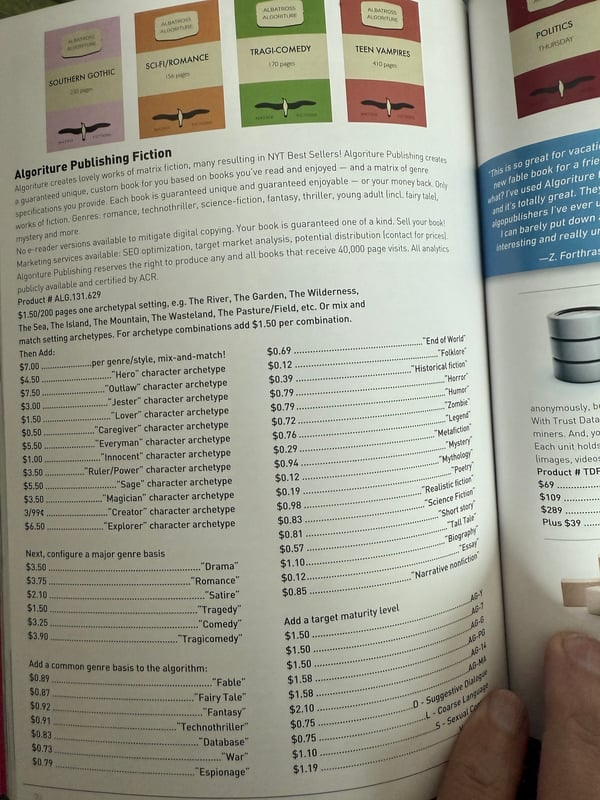
| The original Algoriture product placement ad in 2012's TBD Catalog, a Design Fiction rehearsal for what we say in the NYT last week. | 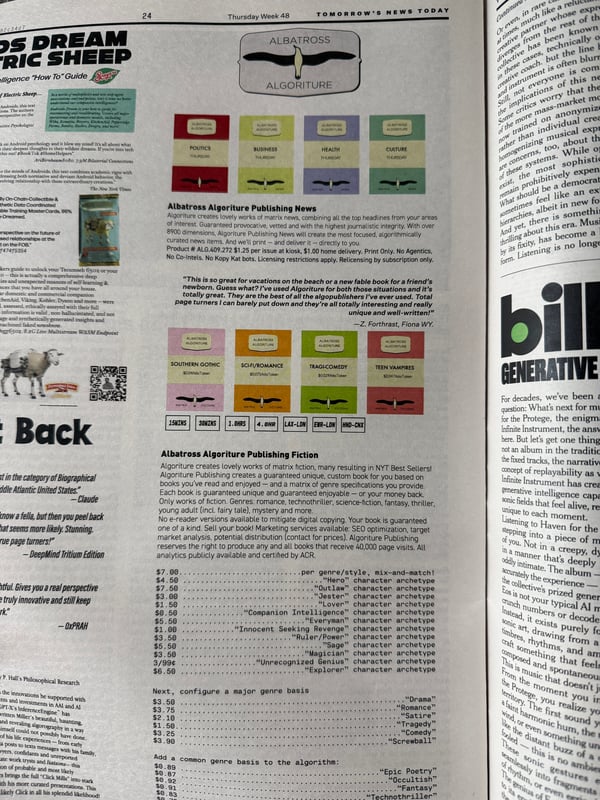
| The Design Fictional Algoriture Publisher in 2024’s Applied Intelligence Newspaper | |
| Then This Happened (Not Unexpectedly..)
| From the digest-this-🥓 Channel DEPARTMENT OF 🤖+🩵+📚``
| shared by Marty the Ingest-o-Tron
Coral Hart uses AI to churn out romance novels, facing challenges in emotional depth but achieving unprecedented speed. $ All The News That
Fits.. →
| |
| |
|
Events and Workshops
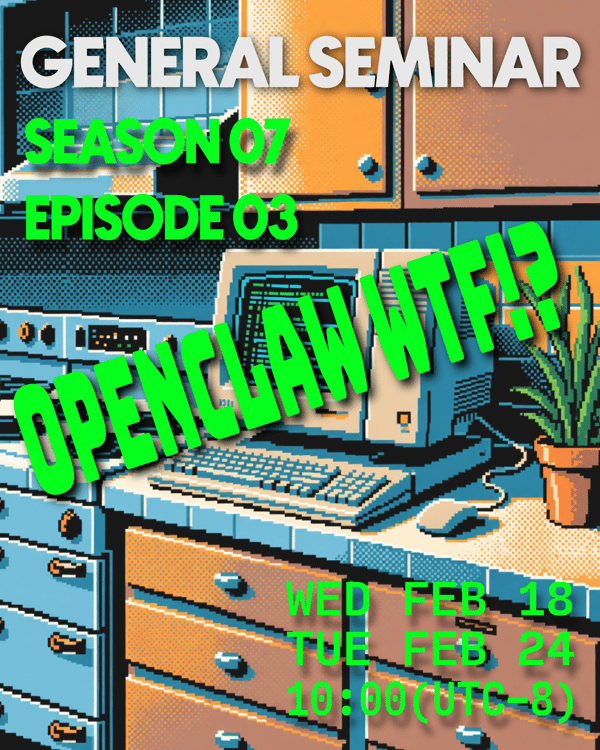
| General Seminar S07 E03: The Agentic Future
| 
| OpenCLAW (formerly Clawdbot / Moltbot) feels like a glitch in the calendar: one week it’s a clever
demo, the next it’s a social and economic actor — running errands in our browsers, operating our tools, booking meetings, moving files, touching credentials, and quietly turning “software” into your weird whacky drunkard uncle at the family holiday party. The elation is real. The curiosity is felt..and so is the sense of perverse fascination and existential dread. Join me for General Seminar S07 / E03, where we’ll treat the moment we are currently inhabiting like a live science-fiction action spectacular event: not “what do we believe,” but “what do we do when this becomes normal?” Two sessions to accomodate your agentic calendaring robot!
February 18th at 10am PT (UTC-8) and February 24th at 10am PT (UTC-8). | Read more →
|
| |
|
|
| SIGNALS
| inference capacity infrastructure public trust agentic systems platform governance openclaw moltbot clawbot inference report
|
| Agentic Systems and the Inference Storm
| 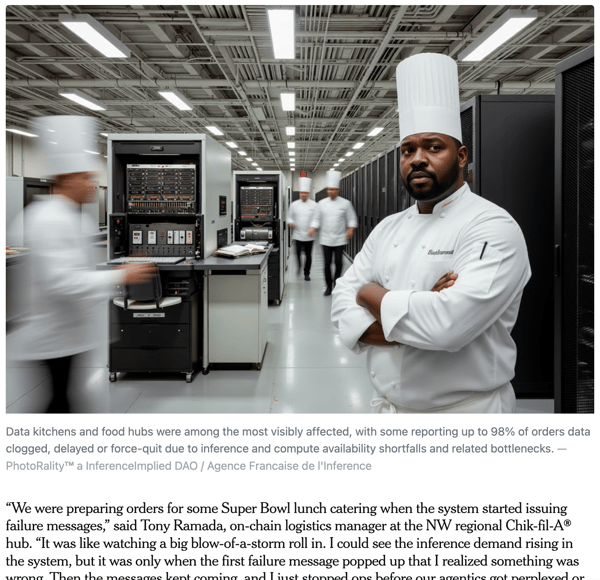
| A sudden rise in inference demand revealed a fragile choreography of machines, institutions, and
public trust, and the response felt less like crisis management than storm watching. Agentic systems were among the most visibly affected, with some pausing or switching to low-resonance mode and partially astute reasoning levels. Informal officials have noticed that this particular storm event has reignited threads about what's going on in agentics that we don't know about, as well as the role of public sensors in infrastructure monitoring. | News from the near future →
|
| |
| After Action Report!
| Here's the executive summary from last week's General Seminar S07 E02 - Strategy
is Science Fiction. It was a good one! 5/5 stars! The next one is coming up on February 18th and
24th on the Agentic Future — you know..the one just adjacent to the one we're currently inhabiting. Check it out if you want to treat the moment like a live science-fiction action spectacular event: not “what do we believe,” but “what do we do when this becomes normal?” | |
Strategy is Science Fiction 1/ We opened with a riff on how strategy isn’t just about spreadsheets or org charts — it’s a kind of science fiction. A deliberate act of
telling stories about futures we want to make real, even if they sound strange at first. 2/ That led to a framing that stuck: strategy as a “fiction delivery system.” Not fantasy, but rehearsal — a way to prototype beliefs into existence. 3/ We talked about ambiguity as a feature, not a bug. Real strategy often starts in the fog, where uncertainty becomes fuel rather than fear. 4/ Someone offered the phrase “strategy is a spell” — language that binds a group into acting as if a future is already underway. 5/ Breakouts turned signals into strange-but-plausible worlds: AI-written opposition media, plausibility budgets, and speculative cover stories from the future. 6/ We closed on this curious idea: the weirdness of a prototype is often the point. It opens sideways conversations
and reveals what organizations can’t yet say out loud. Read more →
| |
| Yo, Unc?
| Top line notes from one inhabitant of a possible future. | One-on-one with Jackson What's it like emerge into an agentic world? Once a week I have a one-on-one with my oldest nephew, Jackson, freshly 21, star basketballer, and college student. Here are a few things I learned from Jackson. 1/ “I know I have to get to bed by midnight otherwise I'm no good to my team or to myself in class when I'm trying to pay attention. Here's what I do though: I'll take an assignment I get from my, like..let's just say from my PoliSci class and I'll take the assignment and the first thing I do is I put it into NotebookLM..you know what that is? Yeah, but this is what I do is I'll take the video it creates and I'll
watch that while I'm eating lunch. I'll do that so now I have a someone talking around the assignment so I'm kinda getting a sense of what I need to do. So that way I am thinking about it in a way that isn't me trying to remember everything my prof. said in class. And that just gives me a better chance to understand the assignment and then I can go to practice, have team practice and then it's still sort of in my head but it's more than just the prof or the assignment sheet so later on I'm more
into the stuff and can start doing the assignment. And hopefully get to bed by midnight..” 2/ Okay, so I have to add that Jackson was clear to say that he does read actual books (we were talking about Benny Safdie and Jackson told me he's in the new The Odyssey film and then paused looked directly at me and said, “I actually read The Odyssey the book” (one
up on me!) and said it as if to double-secret emphasize to me that he gets when and where AI fits. I'm not worried.) 3/ Jackson interned at an AI startup building a kind of basketball training app that uses computer vision and I was, like..how do you even do that? And he showed me how they train the thing and basically it's what I might've expected but had
never seen: Jackson records tons of his practice to video on his iPhone..and then Airdrops it to himself and then manually identifies and tags the various moves and actions in the video (dribbling, shooting, etc.) and then feeds that into the training system. I mean..somehow you'd think that it wouldn't be so manual, but..of course it is. Stay tuned for the next episode of “Yo, Unc?!” | |
|
Pencil This In
| Pitch, Picture, Prototype A
workshop for prototyping your future with Carl DiSalvo, PhD, and Julian Bleecker, PhD
| 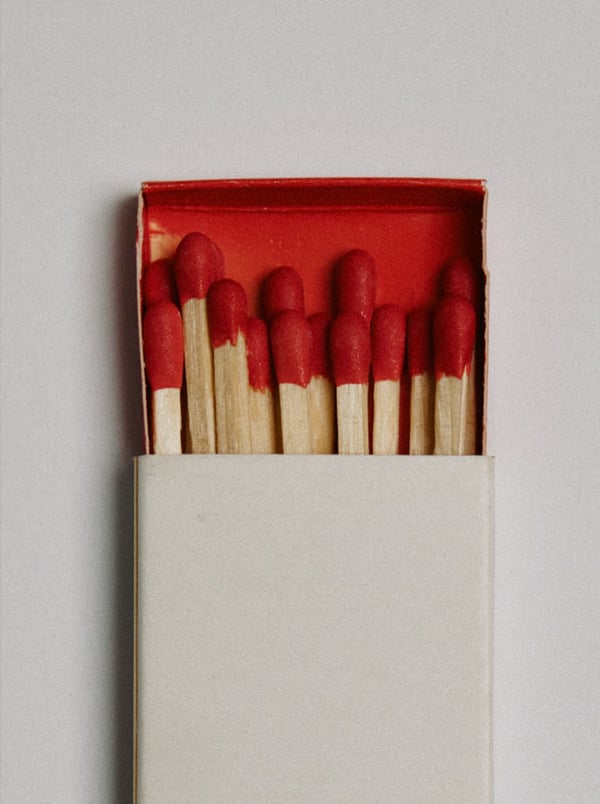
| Your elevator pitch is not the destination. It’s more of a doorway. It's the other side that's the hard work. Right now, a lot of talented people are stuck in the most demoralizing loop: refresh → apply → silence. Carl
and I built this workshop for that moment. We start with your elevator pitch, then help you turn it into something the market can see: a small portfolio of proof-of-life artifacts and a minimum viable prototype that pulls opportunity toward you — instead of you chasing job posts that don’t quite exist. Carl and I have spent our careers building teams, organizations, companies, and curriculums designed to help foster agency — the ability to move from a clear elevator pitch to creating a place in the world you can actually inhabit. Not just ideas. Not just inspiration. Signals, artifacts, prototypes, and a minimum viable experiment that makes your direction real enough for others to recognize —
and for you to keep building. How do you go from “I want to..” to ”This is what the world looks like when I do...”? How do you make the future feel real enough to act on? How do you get past the abstract and into the tangible? In this workshop we will build that doorway — that short elevator pitch — and build the first room: a place in the world you can inhabit — with proof-of-life artifacts, visible signals, and a prototype that turns “I want to do this” into “this is already happening.” | Follow to hear more →
|
| |
| Welcome and Hello!
| Hi! Welcome. Thanks for reading. In case you're new here and wondering -- I'm Julian Bleecker. I help leaders and strategy teams navigate uncertainty through strategic prototyping -- working backward from plausible near futures to make today's choices clearer. I use an approach I pioneered called Design Fiction. You see some of it
here in the newsletter and definitely over on my site over at Near Future Laboratory. I create tangible artifacts and narrative experiences that turn abstract foresight into concrete strategic options, alignment, and action. My practice spans engineering (BSEE, MSEng/HCI) and the social sciences/humanities (PhD), so the work holds up technically and
lands with cultural relevance and it's grounded and tangible. Near Future Laboratory can bring decades of experience, expertise, and an extensive network of similarly talented professionals -- and I'm available for commissions, facilitated workshops, seminars, talks, embedded engagements, and leadership roles. | |
| New Ware for
the Nerds
| 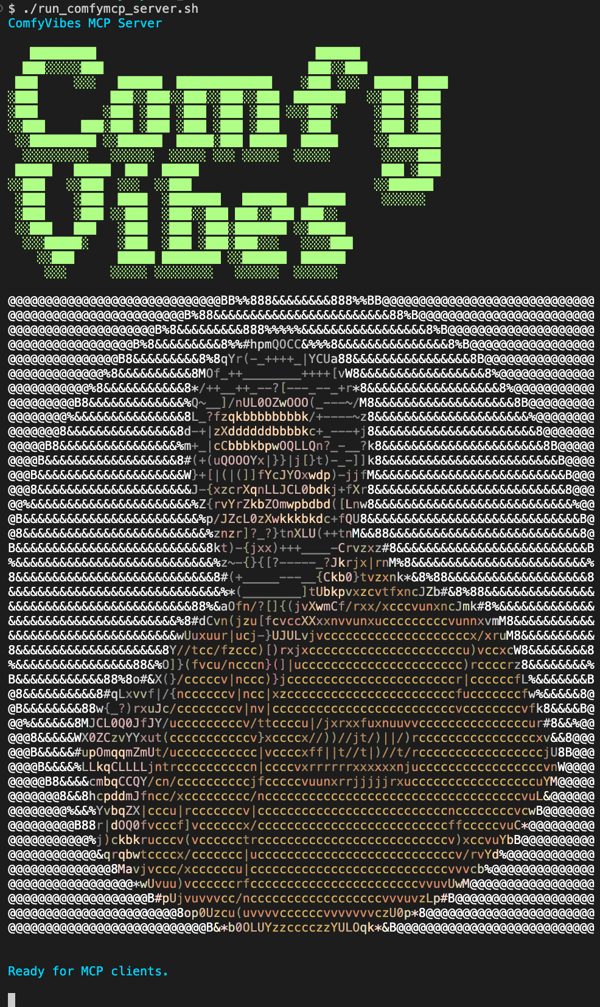 ComfyVibes is a cheesy name for an MCP for ComfyUI What the heck, right? Well, I've been wandering around a future of aesthetic creation and image generation messing about with ComfyUI, mostly because of my main expeditionary criteria where a thing can be worth exploring “because, I dunno..it's cool?” and it smells a bit futuristic, maybe in the same way that Algoriture felt futuristic. ComfyUI is a visual node-based interface for building and customizing AI workflows, particularly emphasizing image geneartion. And I have to say that the node-based approach is...pretty not-comfy. It gets quite messy, illegible, and impractical pretty quickly. (For me, at least, but it's not a tool that a creative consciousness is looking to inhabit on a daily basis, I'd wager.) When I'm not wandering about with ComfyUI, I am integrating it into some simple workflows that aren’t particularly fascinating: gimmie this image at these four aspect ratios without cropping; gimmie four variations of this reference image. Etc. Tools that help with
various projects kinda stuff But I don't want to get into a street fight with the somewhat uncomfy UI everytime I need that. So I made this MCP (viz. Anthropic’s simple-but-elegant Model Contexxt Protocol)
that wraps around Comfy so I can basically talk to it in more-or-less art director idioms and never have to wonder what node I connect to which nozzle, nor which of the hundreds of workflows scattered about the computer will do the job. These are tools I create to help manage/o operations and /or
Repo →
| |
| |
| Things I Bungled Across
| From the digest-this-🥓 Channel N. Katherine Hayles went diving into the world of large language models and Katherine being Katherine — she raises questions about their cognitive abilities Are these models just mimicking human intelligence, or do they possess genuine cognitive capabilities? By analyzing their handling of complex literary texts, Hayles makes a compelling case for LLMs as a transformative cultural force, reshaping how we understand cognition and their role in our social frameworks. It's a whirlwind of ideas about the future of AI and its potential cultural impact. Read On →
| |
| From the digest-this-🥓 Channel DEPARTMENT OF Brains, GANs, and Joyce | shared by Manual Entry Unveiling the hidden realms of neural networks, this exploration draws parallels between the brain's language magic and the synthetic spaces of GANs and Joyce's linguistic labyrinth. Read On →
| |
| From the 🙈-mail-jester Channel DEPARTMENT OF Play | shared by Julian Bleecker I read this. Sounds familiar.
Or..maybe timeless? I'm not sure when or how I came across this but when I read it it tapped into something about the ineffable characteristic of collecting things of perceived value. The thrill of the random reward. The dopamine hit of a new character or item. The social aspect of showing off your collection. It’s a fascinating blend of psychology,
game design, and culture that keeps players hooked..and may explain a bit about NFTs, is what I was thinking. So — these games are named after the gashapon vending machines you find in Japan — they dispense random toys in plastic capsules. But, in gacha games, players spend in-game coins (which can often be purchased with real money) to receive a
random virtual item, character, or piece of equipment. The appeal of gacha games lies in the excitement of the random rewards and the collection aspect, as players try to obtain rare and powerful items or characters to enhance their gameplay experience.
Collect 'em all! →
| |
| From the digest-this-🥓 Channel DEPARTMENT OF AI and Society
| shared by Marty the Ingest-o-Tron Job seekers are challenging AI screening tools in court, demanding transparency on how their résumés are scored. The lawsuit aims to treat these tools like credit agencies under the Fair Credit Reporting Act, spotlighting a push for fairness and accountability in tech-driven hiring. $ The Hunt Is On →
| |
| |
| FFFFFOUND
| 
| |
| |
| TWA Becomes A
Steakhouse Franchise
| Was out riding the other day and I wandered into a world where a screwdriver changed aviation into steakhouse franchises Might post elsewhere but I thought it was worth sharing here. (p.s. No. I
wasn't 🍄. These things come to me, particularly when out on a long bike ride up the hills. I blame Montessori schooling.) Read →
| |
| |
| Call Log!
|
 Previously, in Office Hours.. 1) Julian kicked off in a sleep-deprived haze after a Switzerland time-zone snafu, which somehow set the perfect tone for a session about how easily reality “desyncs” — and how much we need better containers for making sense together. 2) The core conversation was Isabella’s push to evolve the NFL Work Kit via “expansion packs” and research: surveying/interviewing people who’ve bought/used it to learn what actually works, what stalls, and what adaptations are already happening in the wild. 3) A
repeated friction point: the kit’s “chance object” nature is deeply Julian-ish (Montessori energy), but many groups freeze when there’s no clear “how-to,” so ideas emerged for onboarding mechanics like Mad Libs, limiting categories, “hero-making” prompts, or explicit rule-sets that help people feel completion without killing the trickster vibe. 4)
Several folks shared real-world mods: sector-specific replacement decks (FinTech/municipal/service design), museum-context uses (Thing From the Future), and culturally tuned values (care, collaboration, equality, recycling) that make the prompts feel less Silicon Valley and more local/mission-based. 5) A strong theme was embodiment:
treating futures as performance — roles, improv, karaoke, sensory play — with a debate about “reversibility” (safe-to-try) versus fully immersive “no-exit” experiences that force the soma to respond as if it’s real. 6) The session closed with urgency around OpenClaw/agentic bots: people are already spinning up multi-agent Discord
setups, asking what this means in months (not a year). Join the Patreon →
| |
| |
|
Join the Near Future Laboratory Discord Your support helps
| Near Future Laboratory Patreon Join the Discord, Support Office Hours, the Newsletter and More
| 
| The Near Future Laboratory is supported by its community and members.
Join us on Patreon to support our work, get access to exclusive content, and be part of our vibrant Discord community where we discuss design, technology, creativity, the future and do projects and support each others' work. I
host weekly Office Hours for Patrons -- now for 289 weeks and running -- every Friday at 0900 (UTC-7 / California). It's a great way to connect, ask questions, and get feedback on your projects. Each week two people from the community present a project, idea, or challenge and we discuss it together. It's a great way to get feedback, learn from others,
and connect with like-minded people. All of this is done in a friendly, supportive, and welcoming environment. We have people from all over the world, from all walks of life, and with all kinds of interests. It's a great way to meet new people, network, show what you can do, and learn from each other. In this time of rapid change and uncertainty, it's more important than ever to have a community of people who can support you, challenge you, and help you grow. The Near Future Laboratory is that community. | Join →
|
| |
| |
|
|
|
|


