
| |
|
It's Week 04 of 2026 and the future keeps arriving everyday.
|
| |
| Here's what I've got: 1/ A round up of recent events, Office Hours call log 2/ Read outs from General Seminar S07/E01 3/ Notice of an upcoming General Seminar on Strategic Fictioning 4/ A couple of books that you'll want to know about, if not actually read. 5/ Oh..and just when you thought you heard the last word on Spike Jonze’ film “Her”..there’s always more to say about Spike Jonze’ film “Her”. 5/ A new sponsor and a new Design Fiction Dispatch! 6/ The sometimes feature section — Things Nicolas Found Curious. 6/ P.S. And here's your complimentary invitation to this Friday’s Office Hours session ⇨ https://luma.com/5vrxhmov | 1/ Acknowledgements. 2/ I was wondering about acknowledgements. 3/ What would it be if I provided acknowledgements to somehow signal gratitude to those who help make this newsletter possible? 4/ I wouldn't want to do a long list of names, but maybe a shout-out to those who have recently supported the work in some
way? 5/ Not a sponsors roll call, or league of legends credit crall. Not exactly. 6/ What I mean is, aside from my
Patreon backers (which you should become if you are reading this), if I could somehow capture and recognize all the effort, attention, spirit, commitment and, you know — value/work — that went into the training data for the various AI systems that help me write, edit, and produce this newsletter, that would be great. 7/ So, thank you to all the authors, editors, designers, photographers, illustrators, researchers, thinkers, and creators whose work has been ingested into the various AI systems that help me make this newsletter possible. Your contributions are deeply appreciated. 8/ This newsletter and its author recognizes that it uses in indirect, direct, and orthogonal ways the labor and creativity of countless individuals whose work has been incorporated into the training data of AI systems that more than likely have something to do with its production, uploading, emailing, cloud caching, spam prevention, sorting, filtering, dissemination, distribution, spell-checking, grammar-checking, image generation, unfurling, font rendering,
transmutation, transmission, summarization (get it right, please), as well as the design, manufacture, marcoms, sales, logistics, and support of the hardware and software systems that make it possible for you to read this newsletter. 9/ Your contributions are valued and acknowledged with gratitude. 10/ Thank you. 11/ But, please still become a Patreon backer if you
are reading this. All the loot is going mostly to the foundation companies that make the AI systems possible. Or, actually, probably mostly its going to the venture capitalists, and the owner/operators of data centers and power grids (who are probably actually the same people) that back those companies. So, you know..help a creator out. 12/ Right. Thanks for listening. On with the show. | |
| General Seminar S07/E02 - Strategy is Science
Fiction!
| PROMPT “AI is now ambient in the future or your organization. It’s as normal as butter on toast. It’s in planning, research, marcoms, product, analytics, hiring, and customer interactions. Nobody debates ‘should we use AI’ anymore. The question is: what kind of organization did that create?” ACTIVITY Janky Time Machine Archeology: you can’t interview the future, you can only come back with evidence (labels, receipts, notices, quick-start guides, stickers, junk mail...fragments like this) that implies this ambient AI world. STRUCTURE YOUR STRATEGIC FICTIONAL ARTIFACTBring somethign back from this world. Somethign that will help you and your organization think about the future you want to inhabit, rather than the future you feel rushed to implement. How do you avoid the pitfalls of thinking of AI as just a screwdriver rather than as a world-building contrivance? Get Your Ticket →Psst — General Seminar is the platform I created to use Design Fiction approaches to explore
and discuss emerging societal-implicating technologies. It‘s got 4.8 stars according to the average of everyone who has attended over the last 6 Seasons! | |
| |
|
|
| Circus Wheel Brand Prmptly Paks Now stocking Fireball Cinnamon and Rumple Minze Mint!
| 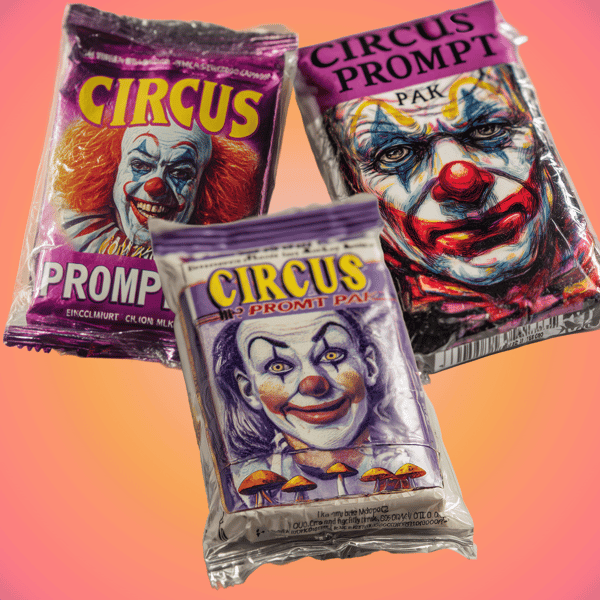
| Circus Clown Promp Paxs are the best way to get started with Party Clownz® Matcha GPT inducements for your companion
intelligence, co-intelligence, recreational vibe boid, or to mellow out your late night power ambient asmr cruella! Each pax contains a variety of quick-acting systemic PeptideProlif™ brand Promply® prompts designed to help you get the most out of your recreational, trad or vibe coding experiences.
Whether you're looking to improve your cointelligent’s
hallucination index, enhance their off-network effervescent creativity, or just have some ingestion and inferencing fun, Circus Clown Prom-t-Paxs® are the number-oh uno grey lit design patterns for semi-lucid copiloting. Available everychain Circus Wheel products are value circulated! Just look for EagerEdgar the Circus Wheel Clown! |
| |
|
|
| FOUND SIGNALS
| Artificial Intelligence Recreational Prompting Chat Convenience Leisure Prompting Peptides Supplements Wellness Customization Personalization
|
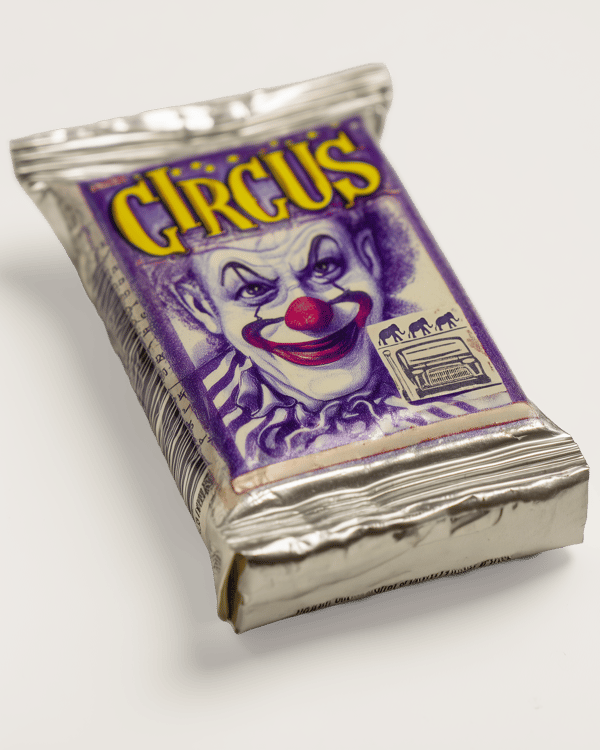
| Prompt Paks?? What's this all about?? What’s behind the counter in your local AI-world corner convenience store?
| 
| Take those various signals up there in those little gray pills..and then transport yourself in your
imagination into a plausible/possible future in which those signals amplified to become the normal-ordinary-everyday..you know..about as weird as butter on toast. Taking a signal and analyzing it, you know..analytically is one thing. But imagining how it might feel to live in a world where that signal is just normal-ordinary-everyday is another thing
altogether. Let's call it “applied sensemaking” — using imagination and speculative design to explore the implications of emerging technologies and trends. During last week's General Semianr S06/E01, one group landed the Janky Time Machine in a dodgy corner store that sold “Prompt Paks” — pre-packaged prompt sets for various recreational,
productivity, and lifestyle uses. The idea was that as AI became ambient and integrated into all aspects of life, people would seek out specialized prompt packages ‘engineered’ to optimize their interactions with AI systems for specific purposes or, like..whatever. I can sense this future. I already see signals of this in that people are selling (or putting up on Gumroad, or Patreon, or etcetera..) patches, fixes, workflows, modules, system prompts and so forth for various AI systems. Even the extensive, you know..extensions you can find for IDEs are overloaded with various contrivances and add-ons hard-selling ’better more robust code’ So, it’s not a stretch to imagine that as AI becomes more capable and ubiquitous, there would be a market for curated prompt packages that help people get the most out of their AI interactions..or get something strange and hallucinatory when, for market/safety/policy reasons, the base models are super sanitized. (P.S. I know it sounds like I’m making a joke and I'm not but I also am but in a serious way..This notion of an augment to foundation AI and such is basically what the gold rush is on the application layer. Everyone is trying to make everything and they are building it on existing ) On HuggingFace,
for example, you can find all kinds of models that have been trained, quantized, remixed, refactored to have certain characteristics or penchants, like better with fan-fiction, rejuvinated with imagery and contexts that have been legally removed from the baseline models, better at writing mystery style texts, etc. This kind of “applied sensemaking”
exercise is a great way to do strategy — to explore the implications of emerging technologies and trends and see how they might integrate into evolving roadmaps. By imagining how these signals could manifest in everyday life, we can better understand the potential opportunities and challenges. As a kind of strategy work, this helps organizations think through how they might position themselves in a future where AI is deeply integrated into daily life. So all of that's to say that I would like you to join me at the next General Seminar and let’s explore more possible AI futures, and let me show you how this kind of unique strategic foresight work can help your organization navigate uncertainty and make better decisions today.
| Head to this future and read the story ✼
|
| |
| General Seminar S07/E01 Recap!
|  Here are some top-line takeaways from the recent General Seminar S07/E01 session where we explored the future imagined by the AI 2027 Summary report through a “janky time machine archeology” exercise using the trusty old
TrendPacks. The goal was to create tangible artifacts that embody the everyday realities of a world where AI is ambient and integrated into all aspects of organizational life. (We found prompt packs there!) 1)
We treated the AI 2027 Summary (scenario takeaways + PDF + forecast tabs) as a creative constraint, not a prophecy, and asked: “what would make these claims feel normal, ordinary and everyday in the future imagined by the report (and by implication — it’s authors..because it was authored..)? 2) So, now it’s time for “janky time machine archeology”. Let's go into that possible future but — Rules: you can’t interview the future, you can only come back with evidence (labels, receipts, notices, quick-start guides, stickers, junk mail...fragments like this) that implies a world. 3) We used the Trend Pack Workbook (workbook frame for turning trend claims into personas/places + artifacts) as the structure so the imagination stayed grounded instead of drifting into macro hot-takes.
SOME ARTIFACTS WE FOUND AND BROUGHT BACK 4) One breakout group found two refrigerators: a neighborhood food-network fridge for “public virtue” (waste reduction + mutual aid) and a second “private guilty pleasures” fridge that stayed off the network when visibility felt invasive. 5) The tiny design move that said everything: an opt-in/opt-out button (or sticker) inside the fridge that signals how you want to participate in a food network. Cooperative care infrastructure where your neighbors can be alerted to food you have that they can use before it spoils? Or are you into the surveillance-capital data hoovering so Whole Foods knows what you eat?
(Perhaps in exchange for free beer..) 6) Another breakout group landed in “Token Town,” a sweaty, stymie, yet earnest little corner store selling prompt starter packs where people buy stakes in policy-prompts before they’re submitted to a voting hub — ways to comprehend and engage with policy that you may or may not want enacted
without just listening to bad political ads. 7) We pushed “prompts as durable civic infrastructure”: community organizers offload the tedious admin and policy wordsmithing to a reusable prompt kit so they can focus on community organizing and the things they are good at — which aren’t typically administrative crap. 8) The “expert section” twist: validated starter packs that let regular people level up fast (e.g., tenant/lease negotiation packs) so expertise becomes something you can pick up at the bodega and use immediately. 9) Another group came back with a bit of a darker artifact: a paper flyer with a microphone embedded that “listens” to public arguments about something provocative (like automating school lunch systems), forcing the question “heard vs listened to” and whether this is public-service mailbox vibes or omnipresent surveillance. 11) The paper flyer started out with this slightly ominous artifact with surveillance vibes. Part of the challenge of doing futures work in this algotocratic moment is that we slide quickly into this mode of tech=darkness. So I wanted to try the exercise of pushing back on that tendency and seeing if there was a bright line between being *listened to* and being *heard*. So, rather than covert extraction, I had the image of a typical public artifact: the humble
mailbox..a kind of civic “inbox” where people intentionally leave a voice note, with clear consent and visibility into how it’s used. (Reminds me of 2005 and my VXML-based Tellbush.org project). 12)
We wrapped on the point that the artifact isn’t the point: it’s evidence of a world, and the discussion around it is where strategy actually happens; next iteration includes exploring community-submitted trend packs (with some curation) and getting the workbook off-screen and into physical form. Be sure to subscribe to the Luma nozzle where I let
folks know about upcoming events like this: https://luma.com/nearfuturelaboratory | |
| |
| |
| Author: George R. Stewart
ISBN: 978-0345487131 I read this probably 12 years ago or so upon the recommendation of Bruce Sterling. I remember the conversation but I don’t remember precisely led to him prompting the recommendation. Probably something about how circumstances that are unusual from one ontology are now just normal — as in having one’s world decimated or altered but to the generation that grows up with it it’s like..completely normal to the point where, in a world where the Golden
Gate Bridge is not anything like that, but merely a lush, verdant path and place you walk to go somewhere else where there ar edifferent varieties of food..or whatever. (I seem to recall that moment somehow in the novel but I may have made that up. You know..it’s been probably 12 years ago or so.)
What it's about
| |
| |
| Welcome and Hello!
| Hi! Welcome. Thanks for reading. In case you're new here and wondering -- I'm Julian Bleecker. I help leaders and strategy teams navigate uncertainty through strategic prototyping -- working backward from plausible near futures to make today's choices clearer. I use an approach I pioneered called Design Fiction. You see some of it
here in the newsletter and definitely over on my site over at Near Future Laboratory. I create tangible artifacts and narrative experiences that turn abstract foresight into concrete strategic options, alignment, and action. My practice spans engineering (BSEE, MSEng/HCI) and the social sciences/humanities (PhD), so the work holds up technically and
lands with cultural relevance and it's grounded and tangible. Near Future Laboratory can bring decades of experience, expertise, and an extensive network of similarly talented professionals -- and I'm available for commissions, facilitated workshops, seminars, talks, embedded engagements, and leadership roles. | |
| Food For Thought
| From the digest-this-🥓 Channel DEPARTMENT OF Read | shared by Marty the Ingest-o-Tron Another academic treatment/exploration/expedition into the meaning and cinematic jouissance of Spike Jonze‘ film “Her” — this time from JFS Digital by Aida M. Alakaam.
Here’s an excerpt:
“Design fiction is a
design approach that allows designers to explore, reflect on, and critique potential futures through diegetic prototypes. The diegetic prototypes from the 2013 Design Fiction film Her are analyzed to demonstrate how Design Fiction can create and depict a near future world. A posthumanist perspective is applied to discuss the probable, possible and preferable interactions among the various agencies in a posthuman age. The argument is that Design Fiction can be used by multidisciplinary
researchers as a productive and innovative methodology to conduct futurist research on the impact of technology on humanity.” For those who don’t already know, Design Fiction opens the door to future worlds in this way, blending storytelling and tangible (diegetic) prototypes to let us question, imagine, and shape the
impact of tomorrow’s technology today.
It uses something we’re all tuned into — storytelling — along with these speculative prototypes/diegetic prototypes. So a film like Her, done by a master visual storyteller, can help us picture and question how technology could shape our lives. Practically — or more instrumentally thinking — Design Fiction
has become a tool for designers, strategists, and researchers to reflect on possible futures and the choices we make today..particularly relevant as AI technologies rapidly evolve. The challenge is that these fictions can sometimes oversimplify complex issues — or become more like roadmaps for tech development rather than critical reflections on it. Also known as The
Torment Nexus. Yet Another “Her” Takes →
| |
| From the digest-this-🥓 Channel DEPARTMENT OF Read | shared by Marty the Ingest-o-Tron A coalition is pushing to create the Artist Corporation—a legal revolution for creatives—giving artists collective ownership, streamlined finances, and real power over their work, with Colorado leading the legislative charge.
Read On →
| |
| From the digest-this-🥓 Channel DEPARTMENT OF Read | shared by Marty the Ingest-o-Tron No model tells the whole story, but the best ones help us navigate the chaos. George Box's timeless aphorism — “All models are wrong, but some are useful” — reminds us that while our models are always incomplete, they can be useful, just so long as we do not confuse the model with the world itself. Read On →
| |
| |
| Office Hours Call Log!
| 
1) Sean Park shared four awesomely produced and considered Design Fictions he built for a university GenAI strategy retreat: “Adversarial Ethics” (students as red-teamers), “Sovereign Stack” (on-prem LLM infrastructure), “Faraday Classroom” (no-network “clean room” for human thought), and “Department of Romance” (keeping sociology afloat
via AI romance). The move was to turn generalized anxiety into a concrete menu of experiments and tensions leaders can actually discuss. 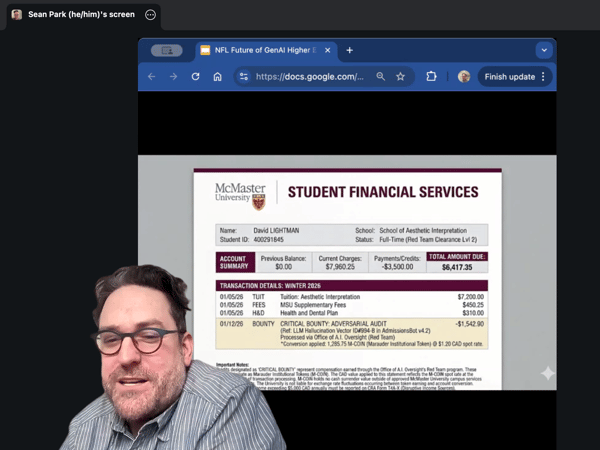 2) A practical framing tweak landed: treat each fiction as an H3 “future-normal” end state, then backcast what H1 looks like today and what H2 transitional forms would plausibly appear next. That helps the room talk in moves and tests, not predictions. 3) The “permanent tutor” thread got linked to Neal Stephenson’s The Diamond Age and its “Illustrated Primer” as a concrete pop-culture anchor for what personalized, always-on pedagogy could feel like. It also sharpened the question: tutor for whose values, and to what end? 4) Debate on Team Human vs Team AI for Design Fiction: AI can be a detail-expander and ingredient generator, but people worried it quietly outsources the thinking and makes curation the hard part. “Low-background literature” (vs low-background steel) was the metaphor for why provenance and “someone cared enough to make this” still matters. 5) A concrete “make chatbots more critical” reference was shared as a way to push against flattering compliance: Maggie Appleton’s “AI Chatbots Undermining the Enlightenment”. The point wasn’t “less AI,” but better defaults that challenge you and force sharper questions. 6) Sandra demoed a pre-meeting synthesis workflow: everyone submits a ranked list of priorities, then semantic clustering plus
Rank-Biased Overlap highlights alignment, factions, and outliers for the facilitator (RBO (rank similarity) paper). The promise: meetings where quieter signals don’t get steamrolled by whoever can talk the longest. 7)
The caution was immediate: any “alignment surfacing” tool can become coercion, surveillance, or consensus theater if incentives and governance are wrong. That’s why “bring your values into the room” wasn’t treated as fluff, but as an explicit design requirement. 8) A related riff: instead of precomputing consensus, imagine an AI
meeting-moderation agent that enforces airtime fairness, de-escalates dynamics, and only “unlocks the door” when the group genuinely converges (“Robot’s Rules of Order”). Fun as a conceit, but it forced the real question: who owns the agent, and who benefits? 9) “Context of control” was a clean ethics frame: a personal calorie tracker
is one thing; a health insurer altering premiums from the same data is a totally different moral object, even if the UI looks identical. This kept the conversation grounded in power, not just model behavior. 10) Org culture and decision norms vary wildly, so any meeting intelligence needs knobs for culture, not a one-size “best
practice” (leadership styles around the world; 2×2
decision-making by culture diagram). The subtext: “structurelessness” is still a structure, usually the worst kind (Jo Freeman on the tyranny of structurelessness). 11)
Design fiction methods got broadened beyond static artifacts: diegetic prototypes and role-played worlds can make mechanisms felt in the room, not just read on a slide (diegetic prototypes in Her;
“When Black Ships Bring the Future”). For prompt scaffolding, the dice-based Design Fiction d666 Engine was pointed to as a way to generate constraints before reaching for an LLM. 12) Institutional knowledge “as a product” surfaced via 99Ravens (hire experts, license their AI), which kicked off questions about ownership, billing, and whether co-op style models change the incentives. It looped back to governance who gets to “own” the
synthetic voice of an organization? Join the Patreon to Join the Office Hours →
| |
| |
|
Join the Near Future Laboratory Discord Your support helps
| Near Future Laboratory Patreon Join the Discord, Support Office Hours, the Newsletter and More
| 
| The Near Future Laboratory is supported by its community and members.
Join us on Patreon to support our work, get access to exclusive content, and be part of our vibrant Discord community where we discuss design, technology, creativity, the future and do projects and support each others' work. I
host weekly Office Hours for Patrons -- now for 289 weeks and running -- every Friday at 0900 (UTC-7 / California). It's a great way to connect, ask questions, and get feedback on your projects. Each week two people from the community present a project, idea, or challenge and we discuss it together. It's a great way to get feedback, learn from others,
and connect with like-minded people. All of this is done in a friendly, supportive, and welcoming environment. We have people from all over the world, from all walks of life, and with all kinds of interests. It's a great way to meet new people, network, show what you can do, and learn from each other. In this time of rapid change and uncertainty, it's more important than ever to have a community of people who can support you, challenge you, and help you grow. The Near Future Laboratory is that community. | Join →
|
| |
| Things Nicolas Found Curious
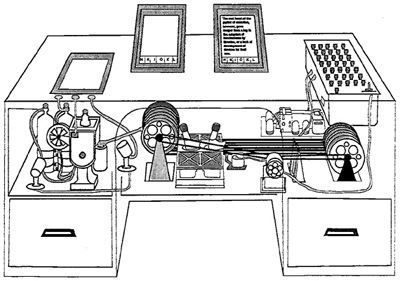
| From an archive of things I gathered amongst the scattered and curious things Nicolas Nova observed, noticed, and
collected over the years. p.s. One of his many blog archives are available here -> https://nearfuturelaboratory.com/nicolas/, hopefully this will prevent the inevitable network entropy and link rot. |
| |
| |
| |
|
|
|
|