
| |
|
It’s Week 03 of 2026 and I’m wondering about a future of locally sourced language models
|
| |
| In this week’s newsletter:
/0 A short note on DIY local AI inference machine futures, and why I’m futuring about them; /1 A Design Fiction Dispatch from a possible near future where we found this little design studio in a non-descript “creative space” in downtown El Segundo that found a lucrative niche conjuring agentics that are some of the best e-sports football players money can buy; /2 Two of the many
projects folks in the NFL hypercollab are working on — a font and a futures podcast; /3 Another bespoke open source image management workflow tool for better asset management for the small studio; /4 A book about Beatriz' blogging pigeons (at least); /5 The ancient histories of “everyday carry”; /6 Call Log
from last Friday’s Office Hours; /7 And some pink candy gems found in the NFL Discord. Here we go | There’s a vibrant community of techy DIY/AI enthusiasts who are highly motivated to create local AI inference machines. Using open source models, they are working towards achieving decent if not parity performance (by these arcane metrics) with the curiously named “foundation”
models. There’s something compelling about the DIY vibe there — a desire that feels quite “punk” in the context of things, which is to say an independence of spirit and assertion of self-reliance. This is one of those tiny aperatures through which these kinds of faint/weak/active signals become a resonance of a possibility that sounds different than the more dominant narratives about AI today — independently sourced, locally trained, and community supported models that are more aligned with local values and needs. And now I’ll get to my point for all of this..aside from sometimes being an easily distracted raconteur, I said all of this to motivate you to sign up for the Season 7 opener of General Seminar. But, so — why should
you attend? Because I want to show you how to translate these kinds of trend-like signals — like this community of practice going hard with their adamantine vibes about local farm-to-table style AI — into something more vivid, felt, immersive and experiential than a short scenario or table of data. In General Seminar I’ll be showing you how I prototype these kinds of things (like the item below) using Design Fiction to make the abstract feel more concrete, and the speculative more tangible. Doing this results in more effective dialogues, communication and engagement with the futures work, which can get bogged down in the less-imaginative and
less-felt analytic aspects of futures work. And practically speaking, I’ve found that these artifacts provide a kind of vivid and tangible anchor for strategic backcasting, for example. So if you’re interested in learning how to do this kind of work, and want to see some examples of how I do it, please join me for the season 7 kickoff of General Seminar where we'll take a present-day tranche of research — the updated AI 2027 Futures Model — and create a set of design fiction artifacts its speculations. | |
|
|
| FOUND SIGNALS
| Local Language Models Artificial Intelligence E-Sports AI Robot Boxing 4th Wave Algotocracy Simulated Sports
|
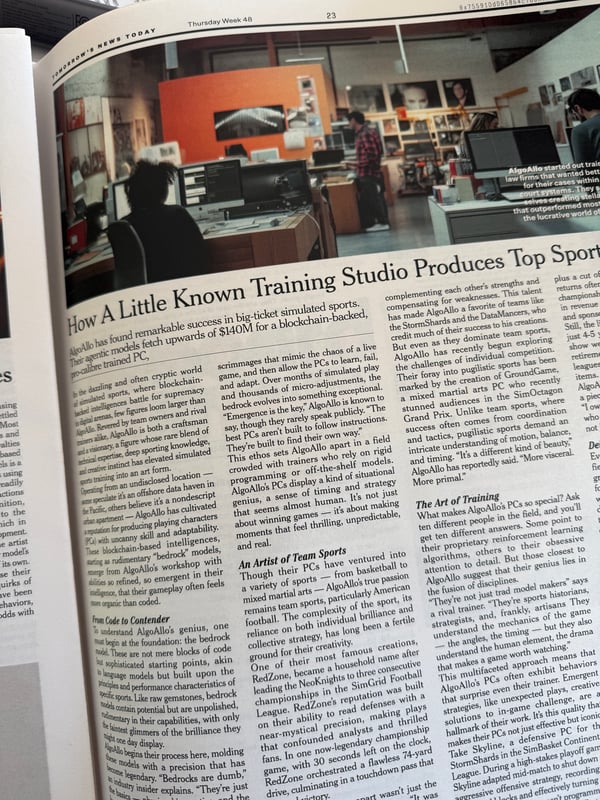
| How a little known training studio produces top AI sports models A near future of E-Sports meets AI model training camps
| 
| Take those various signals up there and then transport yourself in your imagination into a
plausible/possible future in which those signals amplified to become the normal-ordinary-everyday..you know..about as weird as butter on toast. Well, you may end up right in the middle of a sports training camp with Playing Characters (as opposed to NPCs) are being “trained” in bespoke custom model-maker studios like the one in that newspaper. Imagine those signals have culimated in a world where there are these studios in which they imbue blindingly complicated vectorized models with a kind of digital athleticism that will ensure they produce the most performant sports agentics for next season’s blockchain-backed sports tournaments. Welcome to my Design Fiction in which models are trained not to win at Go or produce flawless images but to excel in simulated sports environments. This article-from-that-future (found for those of you who bought the first issue of Applied Intelligence) is the found evidence as tangible artifact from some near future in which today’s sensed and found signals woven themselves into practices that once seemed peculiar but are now as ordinary and confusing as putting butter on toast. This isn’t a prediction, any more than the
Star Trek Communicator was a prediction of the Motorola StarTac. Rather, it is is a way to augment and sense-make around today’s signals and trends so as to open up the imagination to near future possibilities..this is particularly important when this idea of the “near future” is no longer 5-10 years out, but next quarter — or closer. If you want updates on the signals that we receive here at the Near Future Laboratory's faint signals observation post, and you want them in the form of tangible artifacts and narrative experiences that turn abstract foresight into concrete strategic options, alignment, and action, join me for Season 7 of General Seminar where I’ll be showing you how I do this kind of work — and how you can subscribe to the Near Future Laboratory’s program of form-fitting HyperDrops. | Head to this future and read the story ✼
|
| |
| Friends of the Lab Make Things
|
Analog nostalgia meets digital necessity in a hand-crafted typeface as an experiment in type design When your favorite font disappears, why not make your own? SGP Simple is Scott Paterson’s answer—a hand-crafted typeface forged from nostalgia, necessity, and a love of letters, bridging the analog past and the digital now. Office Hours regular Scott Paterson shares his journey creating SGP Simple, a hand-crafted typeface born from both nostalgia and necessity after losing access to a beloved font. From sketchbooks to digital tools, it's a story of creativity, adaptation, and a nod to hand-made marks in an AI-driven world. Sharpie love ✼
|
|
|
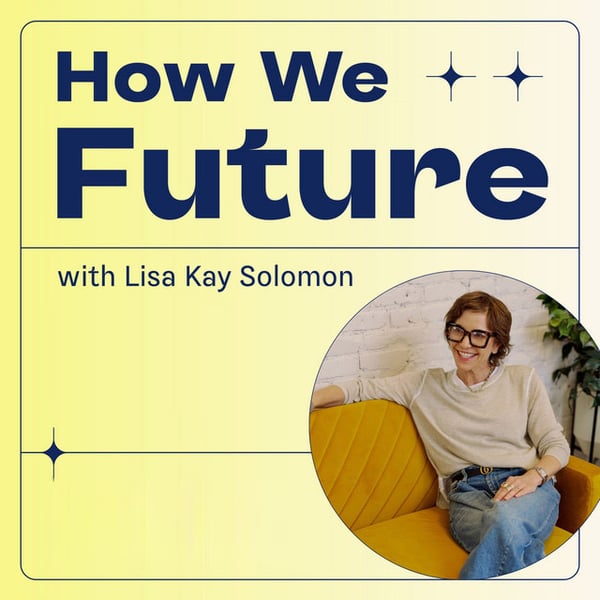
A podcast and newsletter exploring intentional and optimistic approaches to imagining and inhabiting the future How We Future with Lisa Kay Solomon is a podcast and newsletter series that explores intentional and optimistic approaches to shaping the future. Hosted by Lisa Kay Solomon, futurist and strategist, the series promises conversational expeditions around the art and science of foresight, innovation, and strategic thinking. Each episode features insightful conversations with thought leaders, innovators, and change-makers from various fields, discussing how they envision and actively create better futures. I had the pleasure of an evening conversation with Lisa while we were both at the Dubai Future Forum a few months back. She was one of those rare people who asked me what she could help me with, rather than (a) the other way around; (b) assuming I wanted to help her; or (c) just doing the usual schmooze-and-move-on thing that’s can sometimes happen these sorts of events. Bonus points. Sometimes it’s nice to be asked. The creative consciousness needs an occasional invitation. As much as it is valuable to learn how to ask for help, being offered or invited in is such a beautiful and rare thing when you feel it is not purely transactional or a scam. Listen and Subscribe ✼
|
| |
| Near Future Laboratory Tool & Flows Dept.
| Tools and Workflows that make the small studio work. Another of the tools and workflows I’ve built to help a small creative and commercial studio of practice work smoothly. | My homespun tool for studio image care & maintenance Photarium (ermah...) is one of last quarter’s tool-builds — something I cobbled in order to manage
studio-sized inventories of visual assets, also known in less pedantic idiom as “images.” I used to shove images directly into the blog’s CMS, but as the volume of images grew, that became untenable. So I built Photarium to manage them better, by making findability super easy and keeping externalizable materials, like..“externalized”. This came from finding myself needing to wrangle hundreds of images for various projects, print productions, websites, presentations, and client work. There may in fact be a better tool for such, but I know this one and I built it to accomodate my, particular ways of working and sense-making and my visual thinking brain. Plus, I don’t want to subscribe to
somethign someone else made that’s got a mark-up that I can eliminate by doing the work of building and maintaining myself. (Storage is a present consideration and the costs thereof, but relative to most this is miniscule as a cost..the breakfast burrito I just had cost nearly 2x more than my monthly image storage fees, including bandwidth and resizing, just to say..and if I had gone to Erewhon then, like..forget it..) Some people can build their own furniture. I build my own tools. (And then get to share them.) (Self-hosted for the everyday homesteader — or just run it locally on your own machine.) Git It ✼
| |
| Welcome and Hello!
|
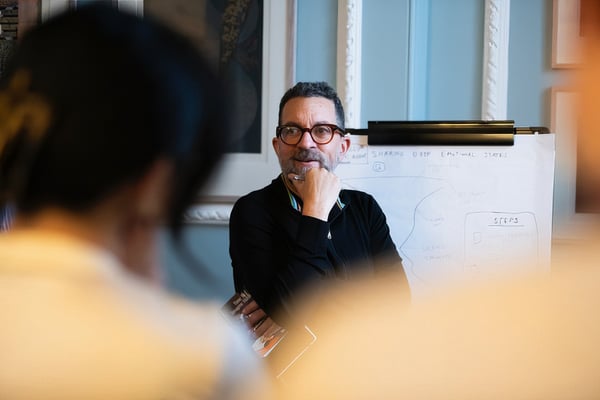 This is the Near Future Laboratory newsletter — thanks for reading. In case you're new here and wondering -- I'm Julian Bleecker. I help leaders and strategy teams navigate uncertainty through strategic prototyping -- working backward from plausible near futures to make today's choices clearer. I use an approach I pioneered called
Design Fiction. You see some of it here in the newsletter and definitely over on my site over at Near Future Laboratory. I create tangible artifacts and narrative experiences that turn abstract foresight into concrete strategic options, alignment, and action. My practice spans engineering (BSEE, MSEng/HCI) and the social sciences/humanities (PhD),
so the work holds up technically and lands with cultural relevance and it's grounded and tangible. Near Future Laboratory can bring decades of experience, expertise, and an extensive network of similarly talented professionals -- and I'm available for commissions, facilitated workshops, seminars, talks, embedded engagements, and leadership roles. | |
| The Poesis of Everyday Objects
|
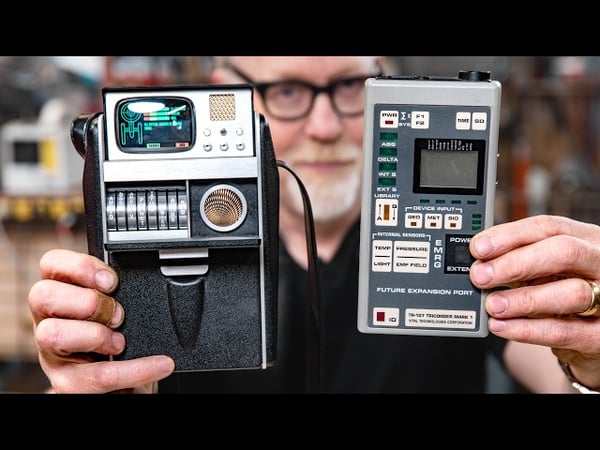
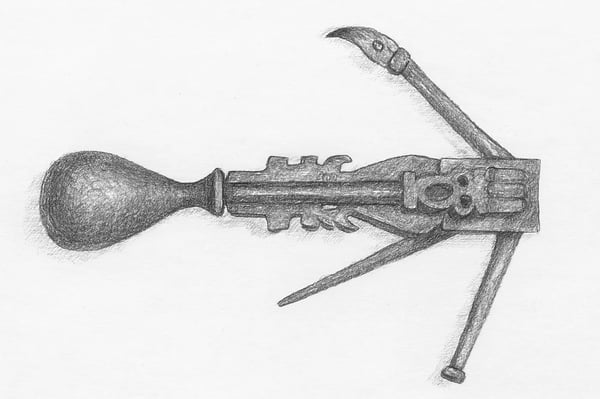
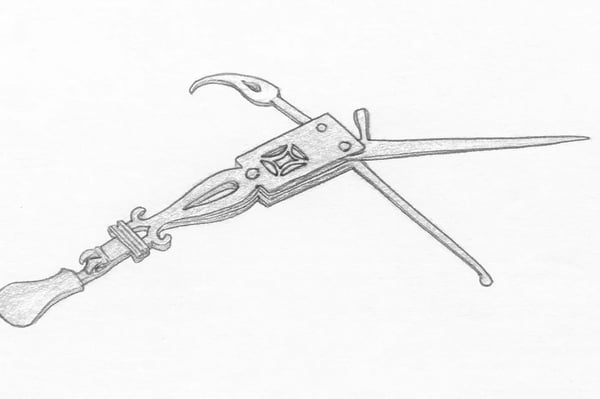
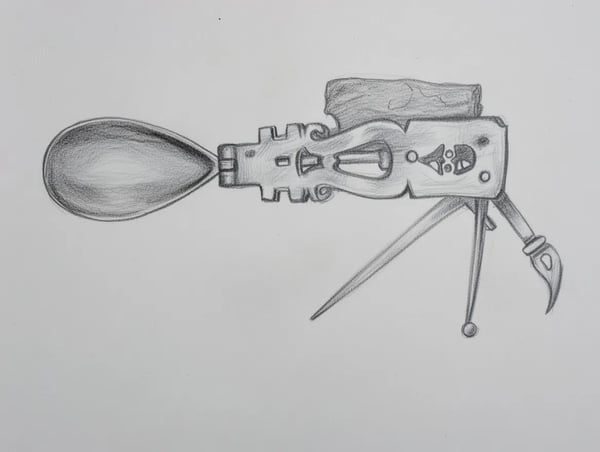
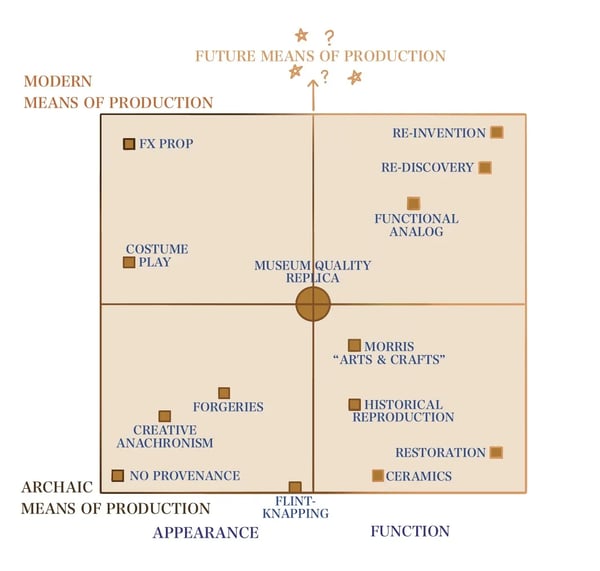 Reproductions? Film props? Museum artifacts? Cosplayer’s everyday carry? The modern 'Every Day Carry' craze has roots stretching back to prehistory, when humans lugged special rocks or artifacts just because they wanted to. From stone-age treasures to your typical corner-store-knock-off Swiss Army knives, the things we carry around with us have always been
full of weirdness. 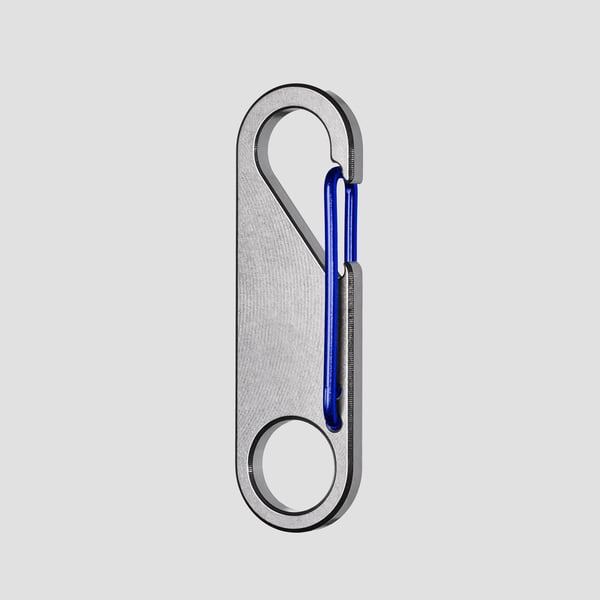
Me? I had to get a second one of these (fav) Spurcycle Titanium Key Clips to accomodate the various pocket-proximate load outs on any given outing. The things we haul around daily — whether for utility or just because they feel right in our hands — well, it turns out that they connect us to ancient human habits. Bruce’s essay
on the strange oxymoronic weirdness of this ‘Everyday Carry’ business is curious on its own, but what I was particularly drawn to was his wondering about the schema of objects. The 2 by 2 up there sort of captures the discussion of the situatedness of things in that context. When is a thing a thing unto itself rather than a reproduction? Or a film prop? Or worthy of sitting on a guarded plinth under glass? Read Bruce’ exegisis ✼
| |
| |
| |
| Artist: Beatriz da Costa
ISBN: 978-0-2625-4948-6 Beatriz da Costa was a friend and colleague whose creative-technologist engineering mind was superb and way ahead of its time. Her phenomenal “Pigeon Blog” project — in which pigeons wearing tiny tech'd up backpacks would map environmental sensor data from their airborn vantage — was a basis for the
short essay I wrote in 2006 and lead to the Lift 06 Conference ‘Blogjects’ workshop I hosted with Nicolas Nova and others. This book came out last year around the
time of the LACE exhibition of Beatriz’ oeuvre, including a (updated) pigeon backpack and an epic release of a small flock of pigeons that did this beautiful biological compass orienting and them began their journey to their home in San Diego. It was beautiful to watch, having met the confident seeming winged leader of the elite data gathering flock I
could imagine him up there signalling to his gang — “Follow me, yo! One more for Beatriz! We got this!” Beatriz was taken from us far too early by cancer, but her work and spirit live on. This book is a wonderful compendium of her work, life, and thinking. Get the book ✼
| |
| |
| Call Log!
| 
1/ The core move was Brandon Harwood’s building of an “AI Interaction Atlas”: a shared taxonomy of capabilities (seeded from Hugging Face Tasks—a browsable list of model task types) that then gets refined into patterns tied to
real product touchpoints. 2/ Diagram choice is strategy: Statecharts.dev (plain-English guide to statecharts/state machines) is for behavior over time, while
UML (the standard “blueprint” notation for system structure/interaction) is for the parts and their relationships. 3/ When your system is basically a hierarchy, show it as a hierarchy:
D3 “Tidy tree” on Observable (a canonical interactive example) pairs nicely with the original “tidy tree” layout paper Tidier Drawings of Trees (PDF). 4/ “Taxonomy” is too top-down for early-stage meaning-making; better to let a pattern language (networked patterns that call on each other) emerge socially, then harden it into something people can reuse. 5/ For inventing and remixing patterns, TRIZ (a systematic method built from recurring “patterns of invention”) is a surprisingly practical way to generate non-obvious moves when everyone’s stuck in the same default solution-space. 6/ Card decks came up as “portable curriculum”: PixelSpirit Deck (a physical deck for GL Shader Language concepts) is the proof-of-concept that a tight, tactile constraint system can teach a language faster than a wiki ever will. 7/ Reality check framing: Menlo Ventures’ “State of Generative AI in the Enterprise 2025” (enterprise adoption snapshot) is a reminder that “patterns” only matter if they map to budgets, workflows, and ops—not demos. 8/ The “hyper-drop festival” metaphor landed: build temporary, high-intensity studio conditions (stages, backstage, vendors, surprises) so collaboration happens as a byproduct, not an agenda item—think retreat infrastructure like Casa
Tilo (retreat center near Barcelona) or Design Inquiry: From Mainland to Island (an intensive program built around place + making). 9/ On-ramping into the digital can be physical and weird:
Grafedia (handwritten “hyperlinks” in the world) plus Mysterious Package Company (immersive mystery-in-a-box experiences) sketches a playbook for invitations that feel like artifacts, not URLs. 10/ Jesper described a paper he’s working on in which futures work gets reframed as an ethics practice: you can’t know the future, so the only leverage is what you choose to build (or refuse to build) right now and sometimes “making it consistent” means changing
the world, not the model. 11/ Treat prototypes like real options (the “right but not obligation” to invest later): buy cheap optionality early, hold it while uncertainty clears, then exercise
without pretending you had certainty all along. 12/ Unconference energy is the template: BarCamp Philly (attendee-built schedule) shows how “set the agenda in the room” beats pre-scripted panels—and the raw chat log here is
already a dataset you can mine. Join the Patreon ✼
| |
| |
| Food For Thought Section
| From the digest-this-🥓 Channel DEPARTMENT OF Research, Re-search, And Ask Around | shared
by Marty the Ingest-o-Tron AI chatbots are everywhere, but not in Americans' news routines. Only a tiny sliver of adults use them for news, and even fewer trust what they find. Younger folks are leading the charge, but it seems that at the moment (at least..) skepticism
runs high, as contrasted with the zelous optimism within the industry itself. Is this one of those things that’s generational? Will Gen Z and Millennials grow up to be the AI news consumers of the future, or will skepticism persist as these technologies mature? Just askin'... Read On ✼
| |
| From the digest-this-🥓 Channel DEPARTMENT OF The kids are alright? | shared by Marty the Ingest-o-Tron Seems like the kids are more discerning then one may assume? Is that what this means? So, maybe the kids are okay and they’re just having fun? And they realize that it’s all made up — and always has been? But, seriously — the Pew Research is a good resource for a somewhat steady-hand look at how people are engaging with AI technologies in the wild. Worth keeping an eye on. They publish all their data, methodologies, and questions which at least gives a guy a fighting chance at making sense of trends. | |
| From the digest-this-🥓 Channel DEPARTMENT OF Grey Literature | shared by Marty the Ingest-o-Tron This one came around via Tobias Revell’s latest Box of news newsletter that indexed to a take on those sleek, scroll-driven AI microsites that are quietly rewriting how we debate intelligence. These seductive little persuasion portals blend a stark design
(won’t save the world) with breathlessly urgent arguments that are not there to (only) inform but they also want to persuade. Where once policy lived in dry reports, rows of 3-ring binders, and hastily stapled briefs, it now pulses through minimalist web pages that make you feel the stakes, and maybe even pick a side. And parenthetically — that is why I find doing tangible artifacts as representations of, say, policy, governance, and strategic futures much more effective than just writing reports. The experience of engaging with something that feels real, tangible, and immersive makes a difference in how people relate to the ideas presented. So, you know — come to General Seminar to see how I do this kind of work.
Read On ✼
| |
| |
| The Strange and Weird of Everyday Carry
| Quite seductive pencil illustrations from Bruce’s essay on the strange oxymoronic
weirdness of ‘Everyday Carry’. | 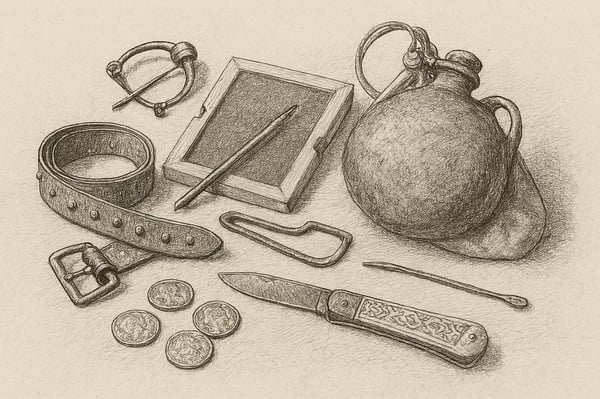
| |
| 
| |
| 
| |
| 
| |
| |
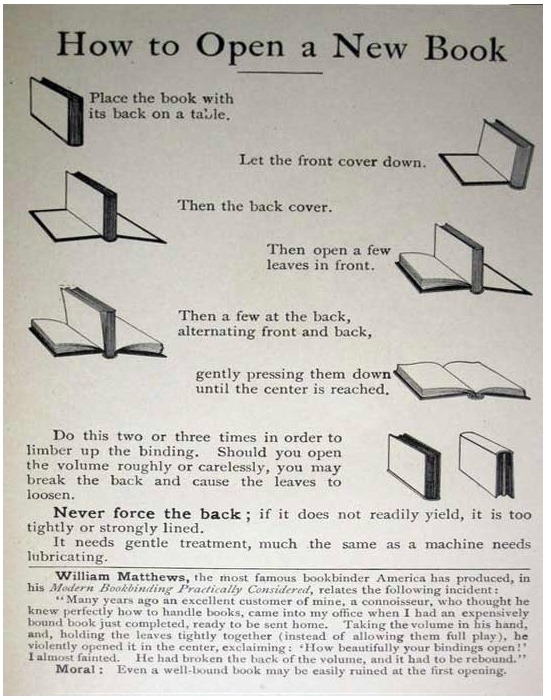
| Things Nicolas Found Curious
| From an archive of things I gathered amongst the scattered and curious things Nicolas
Nova observed, noticed, and collected over the years.
One of Nicolas' great talents was his ability to spot the peculiar, the intriguing, and the downright strange in everyday objects and experiences. His keen eye for detail and his insatiable curiosity led him to amass a collection of artifacts that tell stories about our culture, technology, and the human condition.
He collected scraps, fragments, and partial objects that might otherwise go unnoticed. Each item in his collection is a
testament to his ability to see the extraordinary in the ordinary.
| 
| |
| |
| Space Oddity
| 
| |
|
Join the Near Future Laboratory Discord Your support helps
| Near Future Laboratory Patreon Join the Discord, Support Office Hours, the Newsletter and More
| 
| The Near Future Laboratory is supported by its community and members.
Join us on Patreon to support our work, get access to exclusive content, and be part of our vibrant Discord community where we discuss design, technology, creativity, the future and do projects and support each others' work. I
host weekly Office Hours for Patrons -- now for 289 weeks and running -- every Friday at 0900 (UTC-7 / California). It's a great way to connect, ask questions, and get feedback on your projects. Each week two people from the community present a project, idea, or challenge and we discuss it together. It's a great way to get feedback, learn from others,
and connect with like-minded people. All of this is done in a friendly, supportive, and welcoming environment. We have people from all over the world, from all walks of life, and with all kinds of interests. It's a great way to meet new people, network, show what you can do, and learn from each other. In this time of rapid change and uncertainty, it's more important than ever to have a community of people who can support you, challenge you, and help you grow. The Near Future Laboratory is that community. | Join ✼
|
| |
| |
|
|
|
|


