
| |
|
It is Week One of 2026 (ish) and most everything that was to be done in 2025 has more-or-less been done.
|
| These are some things I’ve always thought are cool: Catalogs, archives, collections, repositories, libraries, anthologies, catalog resonné, taxonomies, inventories, (photo, product, diaristic) catalogs,
retrospectives, murder boards, anthologies, McMaster-Carr catalogs, compendia, digests, recommended backups and data storage schemes, clipboards held with confidence (and the contents thus clipped to the board), RAID levels and their methods, building directories, registries, listings, the classification structure of (printed) classified ads, guitar chord systems and their means of instruction and illustration, star ship control & navigation panels, floor plans, street maps (printed), HUD
symbology, land property maps, Dewey‘s decimal system, cockpit scanning patterns recommended for configuring a jet airplane for startup, personal computer file filing systems, Klingon vocabulary and grammar instruction guides, urban navigation nomenclatures, Thomas Guides, the “Information Please” Almanac..and the like I mention
this because I have been working on a number of these kinds of things over the last few months, and I have more in the works. Why this obsession? Well, I can only
suppose, but I guess part of it is existential: how do I know my world if there are no maps at hand to chart the work? If there are no means and mechanisms for classifying and ordering? What is a representation of my tiny sliver of it all if I cannot adequately represent it in some fashion — an indexed list (by year? by activity type? by data type?) Is that one of the 40lbs of journals and diaries in storage? Or is it a 6 page typed curriculum vitae? Would that do? Or is it a box of
representative “stuff”? Perhaps a dossier box consisting of samples? Or maybe it’s something from a speculative future self? Of course, all of this is very much situated, because these kinds of systems of classification and organization are enframed by the context in which they are created and used, as Starr and Bowker so
thoroughly and incisively taught me 25 years ago, opening my eyes to the question. (Bowker, Geoffrey, and Susan Leigh Star. (2000). Sorting things out: Classification and its consequences. Cambridge, MA: MIT Press.) But for our purposes and at this very moment, it is because indexes are useful tools for making sense of
complexity, for finding patterns, for discovering relationships, for seeing connections that might otherwise be invisible. And I’ve noticed that the index that the Near Future Laboratory has accumulated is “available” but also buried — a fact that the current state of the network does not help with. Earlier in 2025 (I think..) I had come across a site that was, like..an index to experiments in index (pages). (If you know what I'm talking about, please reply! I lost the link or maybe I just thought that’d be cool and made the whole thing up.) Anyone who has spent time configuring modules for the Apache web server knows that the "index.html" page and the
capability to somewhat automatically produce an index of files in a directory is a long-standing feature of the web, and I can only imagine one of the reasons that the heuristic of “index.html” became a convention in the first place. Nowadays those pages are essentially just broad SEO surfaces for bots, scrapers, and the like, but
I remember when they were actual indexes of content, and there was something simple and magical about this static index pages that just listed the site's contents like a card catalog. So, anyway. I mention all of that because I had been doing these light studies in indexing the material, posts, projets, etc. in a way that is
definitely not as discoverable nor SEO-y — but rather than is more like a library catalog or a card catalog. | |
| Index Study 04
| Tech stack: React, Vitejs, tldraw SDK, Tailwind CSS Bit of an informal HCI experiment; this is definitely a work in progress / prototype. Try it out! →
| |
| |
| From The Laboratory’s Project Archives
| William H. Whyte
Meets the Near Future Laboratory Author: Julian Bleecker 17 years ago I wondered what it would be like to have a camera on a tall pole looking down on life. I originally wanted to try that pov as I was doing some skateboard photography and
sorta wanted to break the mold of the usual angles. It was a pretty ridiculous idea, which means it was perfect as an experiment. But, I couldn't get a DSLR (of that vintage) really manageable from up there and it just felt unwieldly with a long cable for shutter release and all that. It was like having 7 pounds of expensive kit on a stick. But,
GoPros were on the scene and so I figured I'd try that, which was much more manageable. I built a rig to hold two GoPros to cover 360 degrees and just turned the things on. I was coming up to a trip back to NJ to visit family so I ordered a pole and had it shipped ot my brother's place — and we just rigged it up and ran around NYC shooting video.
(p.s. Got shoo'd out of the High Line park because they don‘t allow tall poles. And, ironically, was welcome'd by the NYPD in, of all places, Times Square.) To help make sense of the project, Jan C
fortuitously gave me a copy of William H. Whyte's "The Social Life of Small Urban Spaces" which anchored the projecdt in the context of a legacy of sociological observation and urban studies. Kinda. I did it mostly because it was fun, it felt like a curious apparatus to walk around with, and I was curious how I could re-present the flows of urban life
with some post-processing and such. Oh, it was also exhibited at Laboral in Gijon, Spain as part of a group show. So a long pole and a couple of GoPros got shipped across a continent and ocean to stand in a gallery. Which was cool. Explore the project →
| |
| |
| About Me
| Hi!
Welcome. Thanks for reading. I’m Julian Bleecker. I help leaders and strategy teams navigate uncertainty through strategic prototyping — working backward from plausible near futures to make today’s choices clearer. I use an approach I pioneered called Design Fiction; I create tangible artifacts and narrative experiences that turn abstract foresight into concrete strategic options, alignment, and action. My practice
spans engineering (BSEE, MSEng/HCI) and the social sciences/humanities (PhD), so the work holds up technically and lands with cultural relevance and it‘s grounded and tangible. Near Future Laboratory is available for commissions, embedded engagements, and leadership roles. | |
| From The Laboratory’s Essay Archives
| A Review Essay from 1993 Author: Julian Bleecker ISBN: 978-0942299298 Digging through the archives, I found a review I wrote of Zone 6: Incorporations (Zone Books, 1992), a multidisciplinary anthology exploring the intersections of technology, culture, and humanity at the close of the twentieth century. The book examines how advancements in
biotechnology, surveillance, and machine intelligence have reshaped the body and societal consciousness. Critiques on the commodification of life and the evolving relationship between humans and technology, the volume was a great and insight-rich challenge to its readers calling on them to reflect on modernity’s impact and the cultural frameworks shaping what was the future from the early 1990s. This was a time when I would have been a grad student (masters in engineering) at the University of Washington in Seattle, and was really at the early edges of thinking about what we then called technoscience and technoculture — and trying to find a bedrock of theory and ways of knowing to find my sort of..hybrid engineer-artist-critic voice and footing. Forcing myself to write a book review like this was part of that process. I remembe reaching out cold to Lynn Love who was maybe a managing editor and a grad student at the University of Rochester (I think..) with a proposal to write the review, knowing that if I got the green light, I would have to buckle down and read the whole book and write the review. She said yes, and so I figure dout how I might review this 662 page block
of pages and text. If memory serves, we also met in person at the CAA conference in Seattle probably around that time. (Managed all of that without cellphones.) Edited by Jonathan Crary and Sanford Kwinter with contributions include: Paul Rabinow, Eve Sedgwick, Francois Dagognet, Peter Eisenman, J. G. Ballard, Donna Haraway, Gilles Deleuze, Klaus
Theweleit, Elaine Scarry, Francisco Varela, Liz Diller, Ric Scofidio, John O'Neill, Manuel DeLanda, and Ana Barado. Read my review essay →
| |
| |
| Call Log!
| 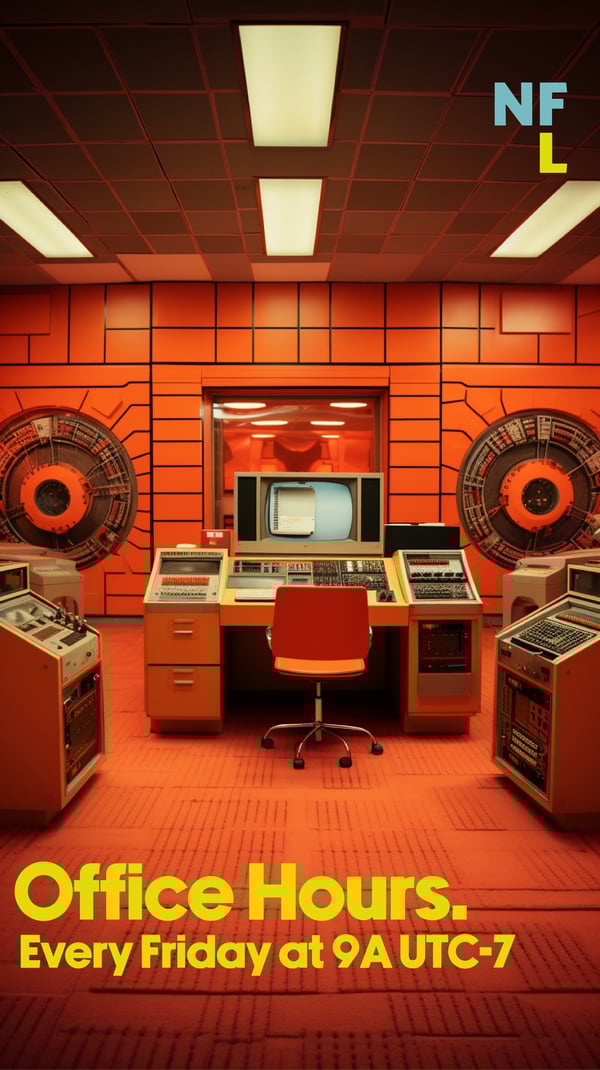 Here’s your call log — top-lines, elevated edicts, notable notes and questionably hashed highlights from the Near Future Laboratory's Weekly Office Hours. It was Episode N°291 last Friday Dec 26, 2025. 1) A screening of BLKNWS: Terms & Conditions kicked off a discussion around “containers” for media. Like..treating film like an album, or an album like a video in a box with an mp3 player and then let the meaning wash over you, so we wondered about how one might rethink how experience is packaged and received. 2) A “Super Drop” idea came up: some kinda recurring drop/subscription model where the Rick’s bookstore becomes the fulfillment engine for suitably unexpected/weird, collaborative creative goods, with a deliberately “blind box” trust-the-taste vibe. 3) Shipping and fulfillment were treated as
a real design constraint (not an afterthought), including how packaging and volume decisions shape what’s even possible. 4) “Ethical scaling” (“it isn’t about follower count; it’s about meaningful community”) wasn’t framed as a moral footnote but rather/also as an operating constraint baked into the model so that the notion of (huge)
scale doesn’t interfere with decisions about what to create. 5) “Releases as ZIP files??” versus the felt reality that digital goods are easy to lose, forget, or have vanish behind broken links and platform drift, making physical artifacts a more reliable memory anchor. 6) Call it “breadcrumb publishing” where you scatter small signals across media so people follow threads the way they used to through bookstores/records/films—worlds opening into worlds. 7) A “graph mindset” was proposed for curating
culture: map the network, find the maximum traversal distances, and intentionally stitch the farthest nodes together to create adjacency and collaboration. 8) Small, tactile proof-points matter. Things like stamps, marks, and physical signals can function as authenticity and presence thusly keeping “a pinky finger” in the physical
even when distribution gets hybrid (analog/digital; physical/digital). 9) Link me the links “movie as music video” — Lucky People Center International
One-shot/permadeath game — One Single Life
Resn / NZTA Flash Driving Game (Vimeo)
timebanking primer
Chick Tracts
FABx (Fab Lab gathering)
Love Hultén
Tom Sachs x Helinox J.Chair. Say, if you want to be in the room for this kind of
wide-band, high-signal wandering, sharing, reflecting, and laughing then you should definitely join and support my Patreon and show up for the next Office Hours! It's light, fun, smooth sharing, discussing, networking, and riffing
on all things near future, speculative design, technology, culture, and whatever else comes up. (No politics, I promise.) See you there! Oh, p.s. — we also do Side Project Shares where folks get to share what they’re working on. It’s a great way to get feedback and encouragement from a friendly, curious, and supportive group of technologists, graphic
designers, writers, futures-y sorts, and many indescribables. Join the Patreon →
| |
| |
| Jmail
| Emails in Gmail That one guy’s emails are in Gmail thanks to some folks who decided the best way to browse his emails was to cosplay Gmail. Which is to say, they made a custom interface that mimics Gmail’s look-and-feel but is actually just a front-end for his email archive. The point is that the container matters. The way we experience content is shaped by the interface and the context in which it is presented. Interface →
| |
| Food For Thought Section
| From the punching-keys Channel DEPARTMENT OF Read | shared
by Manual Entry Canon’s 1980s PW word processors were little Japanese marvels, if you stop to think about it. Portable, printer-ready..and each with its own keyboard personality. I had a Toshiba that I got for like..$500 to write my master's thesis on and it was great in
that, you know..it did exacctly what it said it did. This was a fascinating moment from an (industrial) design and definitely HCI perspective for sure, even as HCI was barely a thing at all then, at least as a formal professional category.
The Shfit Happens guy has been keeping that moment alive. From clicky to squishy, every model told a story of innovation and oddity, far from anything you’d find in the West. Read On →
| |
| From the merry-christmas Channel DEPARTMENT OF Tech & Faith | shared by Julian Bleecker, PhD When pastors lose their flock, tech
steps in 'cause now you can text an AI Jesus for spiritual advice, complete with scripture and a hipster beard. The app’s winning fans, sure and certainly ruffling feathers. When was faith ever not code, though? I mean..those commandments and the Talmud are basically ancient algorithms, right? Rules for living encoded in text form. So maybe this is just the next logical step in divine tech evolution? Worth wondering about anyway.. Read and ye shall be enlightened →
| |
| From the 🛠-whats-ai-good-for-anyway Channel DEPARTMENT OF The Pluribus | shared by (Kevin) SkepticalDesign AI is not just a tool; it's changing the very fabric of how we collaborate and make decisions. By blending human insight with machine efficiency, we're opening doors to innovative solutions
for our most pressing challenges. Make sense →
| |
| From the 🧰-artificial-intelligence Channel DEPARTMENT OF Film Futures | shared by Julian Bleecker, PhD The
future of visual storytelling? Maybe? The 1 Billion AI Film Award is where some folks with a vision as to what filmmaking may become are using AI to craft little short films. The confusing bit is that there’s a grand prize of $1 million instead of this billion figure but, you know..
Watch →
| |
| From the 📰-newsletters Channel DEPARTMENT OF Read | shared by (Kevin) SkepticalDesign Unused creativity can poison us; poetry and storytelling are integral to decision-making; be a co-creator rather than a mere consumer.
Read On →
| |
| From the 🚦signals-and-inspirations Channel DEPARTMENT OF Scraping Sounds | shared by Mateusz Spotify is grappling with a significant metadata scraping incident, where a pirate group has released millions of rows of track data. While Spotify has taken action against the offending accounts, this event
underscores the ongoing battle between copyright enforcement and the preservation of music culture. Read On →
| |
| |
| Near Future Laboratory Press
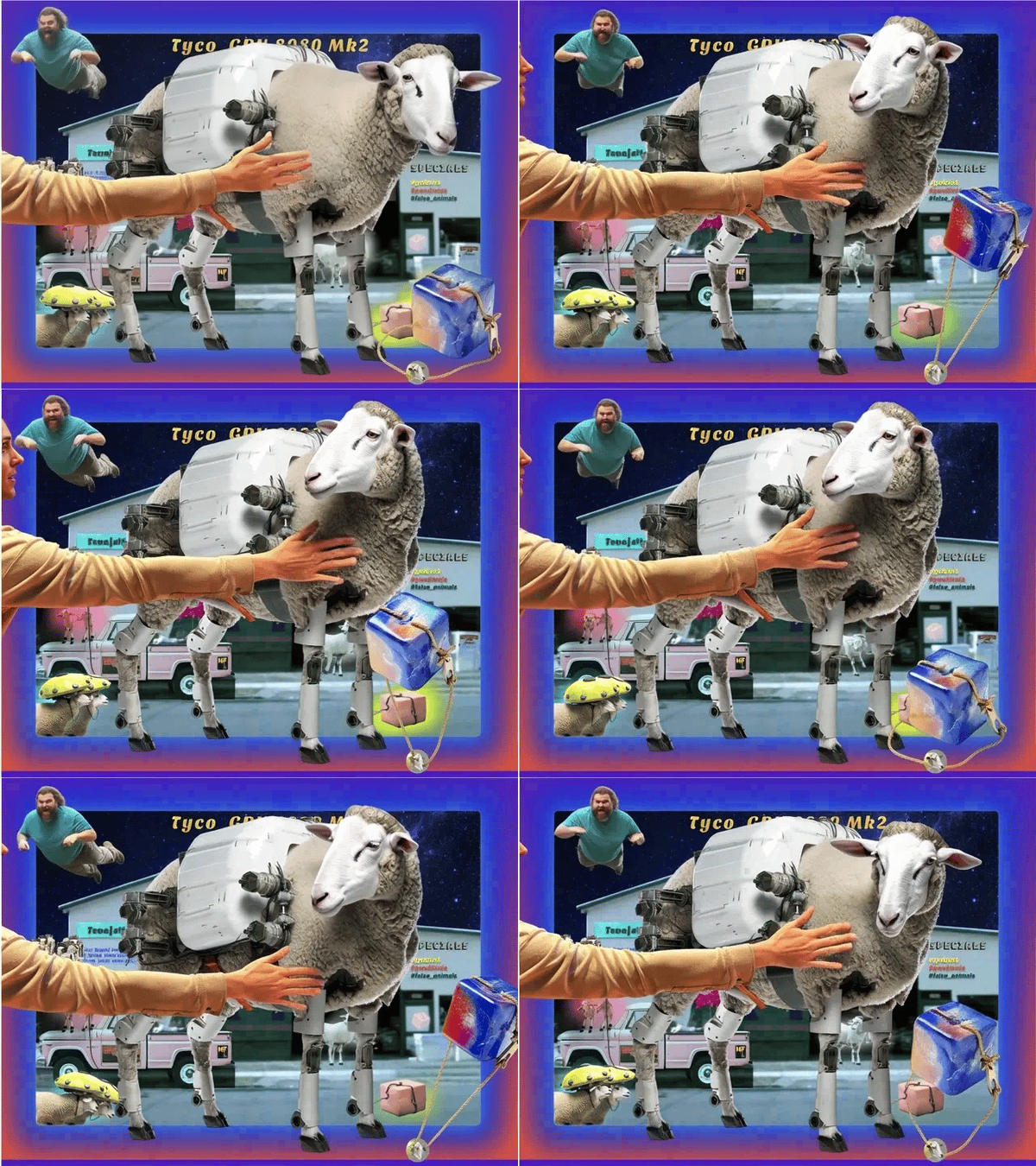
| Suppose P.K. Dick Was A Therapist? A counter-factual science-fictional premise: suppose P.K. Dick wasn't a science-fiction writer, but a scientist / engineer / android therapist, who wrote a hit bestselling pop-psychology book for an android world in which he lays forth the thesis that, you know, actually..android dream. That is, that they have a conscience that
does work while they rest, and those dreams shape their experiences. Couple that with my friend Jed’s artistic muse: fuzzy hooved beasts, and the result is this book and trading cards: “Androids Dream of Electric Sheep” (get it?), available over on the Near Future Laboratory shop! On Sale!
| |
| |
| Androids Dream of Electric Sheep.
| 
| |
| |
|
|
|
|


