| |
|
Near Future Laboratory Newsletter – W52 Y25
|
| Well, Happy Holidays and such all! I’ve got (finally!) a new podcast episode, some updates on what I’ve been up to, call log from the latest Office Hours, and a few other things to share, but first..a story
about containers, creativity, and worldbuilding. So..here's my holiday story. A couple of weeks back I was talking to a young artist — a musician — who was wondering what it is to be a young musician in the age of AI. After an introductory preamble, they paused, presumably looking for some insight or a perspective that would solidify their understandable confusion about how the course of their life might unfold with, you know..‘everything that’s going on these days.’ With
that lovely gap of silence the first phrase that crawled around at the back of my tongue was somewhere in the category of useless phrases like, “So..what can I do to help?”, and as much as I knew the offer could be seen as generous, it was also useless in this context insofar as I imagine if they knew what would help, they would’ve asked for that already, which, in a way, they did. But maybe they were not looking for help. From nowhere I could discern, I started telling a story. It started as most nonsequitor’s start which is to say I don’t know where precisely this story made sense until I started telling it. In the hour before that call, I had another call. I had no clear idea who I was talking to except that I had ordered a curious box from them that felt like it had come from 1984. And I wanted to talk to them about this intriguing bit of world design they had engaged in and — I dunno — discuss and admire their work in that regard. But I still didn't know what specifically was in the box, except it indexed to a website that was some kind of late twentieth century self-help program or materials or °something° of that sort. Somethign evocative of that moment, and for its clever incongruity with the here-and-now, and for its resonance with a felt era I had lived through — well, I was just, you know..in
that reverie of familiarity for something that had been. 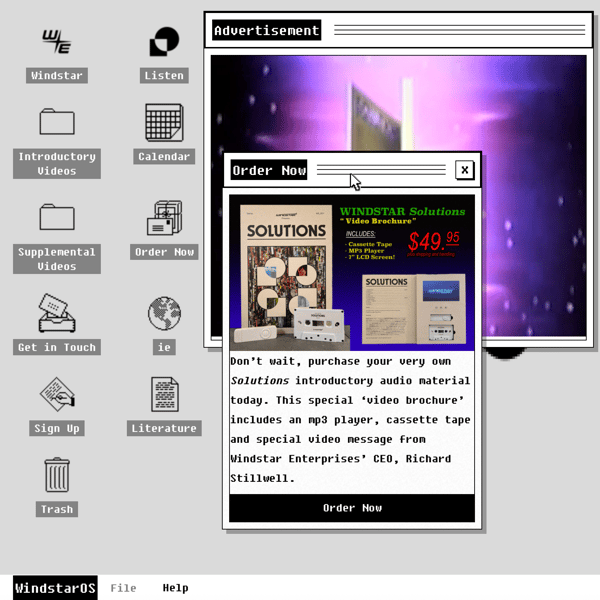 Turns out the the box — the container — and the elements surrounding it (the website, the materials in the box like the cassette tape and such) were all part of a design fiction project that riffed on the self-help culture of the late 20th
century, but with a twist that made it relevant to contemporary issues. But this was a very specific kind of design fiction project in that it was primarily the first of a series of what we traditional would call a ‘record album’. It’s a fair bit of world building, and-also or primarily a collection of music that just happens to not be pressed onto vinyl or whatever as one might expect an album to be (or used to be, depending). I reckon soon I’ll have more to say about
the specific project but this is the story I told. A musician (who just happens to have spent a fair bit of time as such as a sound producer at Radio Lab so, like..‘credible’) imagined a world, imagined a container for that world, and did more than feel inspired by it: they created material artifacts that provided entry points into that world — a curious 80s vibe website and videos, remixes of the ontologies, anxieties, hopes, fears, desires of that era — and related it through a tapestry of
visual and audio textures into the present moment. As the story was decanting from my brain into the Zoom nozzle in real time, I started sensing its purpose which was neither profound nor bursting with insight: there is a kind of creative audacity to call a box of stuff and the world it implies a music album.
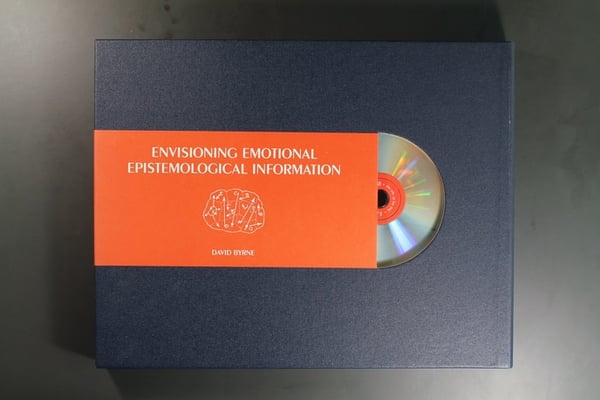 This isn’t new. Most of David Byrne‘s oeuvre has been exploring adjacent terrains and containers for ages. The “things in boxes” mode, for example: “Envisioning Emotional Epistemological Information” (book + DVD: music + animation) reads as a tongue-in-cheek poke at the PowerPoint
universe, and also as genuine worldbuilding through craft. Countless trad type (vinyl, cassette tape, cd) containers of lyrical stories we call ”record albums” reflect deep worldbuilding through sound and music, from Pink Floyd to Radiohead to Bjork to Tyler. The Creator, to The Flaming Lips, etc. And I suppose this was the point
I was rolling around with my chin-wagging: however well we operationalize stacks and services to maintain a presence in the consciousness of the endpoints of the internet, creativity doesn’t happen there. It happens in finding both the curiosity and confidence (and audacity) to refuse to accept the given forms. It happens in
imagining otherwise. It happens in finding one’s shape as distinct from the packaged and preserved, the off-the-rack identities already hanging in the storefront. So that happened. I told that story. It felt like it made sense to both sides of the chat.
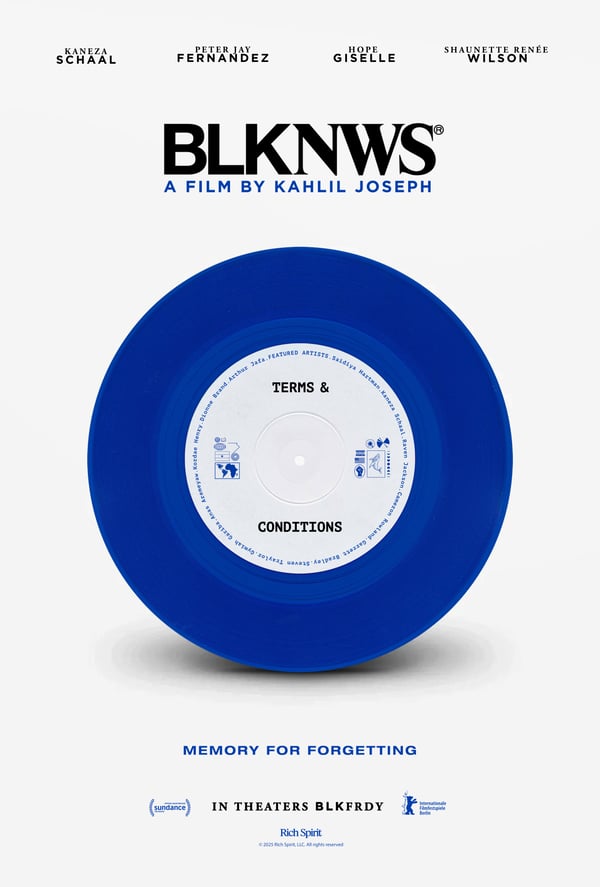 And then at the end of that week I went to see Kahlil Joseph’s film BLKNWS:Terms and Conditions without having anything close to an understanding as to what it was, let alone what it was about. And what I came away with is a reinforcement of this sense that audacity, more than recrimination, is where there is hope for imagining other kinds of habitable worlds. BLKNWS has an opening title card that implores audience — who is there to watch, remember — to receive what is about to be revealed as a sonic album; allow the textures of sound and images to wash over you as you might sit and listen — perhaps eyes shut — to a trad music album from start to finish. Whoa. Kahlil Joseph’s creative genius may be in the audacity to imagine that a “movie” can be other than a three-act structured thing with an inciting incident and all the rest. That we are told from the first moments that this is not what it is, and then are
taken by the hand through a multi-layered visual collage that holds together through TikTok clips and an expanse of story that spreads across generations while also allowing for a sci-fi visual bed that challenges what sci-fi can become.. At the end of the week that I told that story to the young musician about a box that
contained a video player that claims itself as an album, and saw the film that asked me to watch it like music my sense of things focussed into something felt and simple: creativity doesn’t live in the stacks, the services, the distribution logic, the endpoints. It lives in the audacity to choose (and teach) a different
container. To refuse the default form. To insist the work be received on different terms. And maybe that’s the only practical kind of hope: not recrimination, not status seeking, not name-calling, not blanket refusals to explore, nor critique-as-a-lifestyle. Rather finding the way to bring the stubborn, specific act of making other forms, other containers for carrying the freight of meaning. Which makes me think of this: in this kind of season that’s filled with literal containers —
all the boxes, wrapping paper, gift bags, objects of worlds we’d like to be a part of..all that stuff — this makes me feel with a particular clearity that the most meaningful work often doesn’t fit in the container with the familiar and default shape. If you're building new containers, reframing the brief, or dreaming up ways to make a project feel like a gift: I’d love to be part of it in the year ahead. | |
|
|
| Tom Guarriello: The Meaning of Branded Objects EPISODE 103
| 
| My friend Dr. Tom Guarriello joins me to unpack a deceptively simple question, which is this: why do some things matter more than others? Tom is a Psychologist and Professor at the School of Visual Arts, a founding member of their Masters in Branding Program. Have a listen to our chat, and-also-as-always: please subscribe, write a review, and share with friends! That kind of stuff is super easy to do these days, and it really does help keep independent content like this alive and feeling good about all the work that goes into production. Also, check out Tom's new book which gets into all of this and more. Check it out: ”The Meaning of Branded Objects” available now at all the places (p.s. Don’t forget to support the podcast by becoming a patron over at https://www.patreon.com/nearfuturelaboratory!
Thank you!) |
| |
| What Have I Been Up To?
| Here are a few of the projects I’ve been working on these last few months, along with some tools and
utilities that I’ve been building to help make the work here in the studio more to my sometimes kinetic yet leisured workflow. I've noticed that the practice has sort of woven into a kind of meta-project of tooling and infrastructure building that supports the primary work of speculative design and prototyping. This definitely felt like a “tooling”..H2/25;
like..creating the load out of mechanisms, sluices, nozzles, and interconnects to do the work. (Plus, learn Rust, which was a long-time coming..and doing more local LLM studies.) | Vibewriter What if AI was like pilates..but for your writer’s brain? I did a series of short-ish sprints pushing at the edges of this whole AI + creative writing (or just, like..writing generally) thing. I'm still pushing into my curiosity about how having an artificially intelligent writing coach or muse or partner might look like, and
what kinds of affordances it might provide — and all of this to wonder and wander about through speculative prototyping. One thing that I found is this particular speculative prototype that I call Vibewriter which is basically like a timed game where your AI game show host presents you with a passage of a paritcularly “pulp” writing genre (romance,
noir, sci-fi, etc) and once it conjures a sentence or two, it’s like..*tag* — your turn to continue the story in that same vibe. It’s actually fun, so long as you don‘t self-antagonize about the deprevation of solo writing purity. It’s more like a writing exercise, but with an AI partner that keeps you on your toes. Tech Stack: Vanilla JS, FastAPI, WASM, OpenAI, and TailwindCSS. Try Vibewriter ✼
| |
| The Work Kit of Design Fiction - Instrumented Edition Prototyping A Collaborative MadLibs Partner for Design Fiction I started working on what an instrumented edition of The Work Kit of Design Fiction might be. Although this
seems like low-hanging fruit in a world of LLMs and generative AI, there‘s a different approach or sensibility that I wanted to explore that was to make not just something that you pushed a button and got a result, but something that you used more like a collaborative MadLibs partner, pushing and pulling in various ways. More like a medicine ball for an imagination work out, than a pill you take to suddenly bulk up your creative muscles sans effort. Fun prototype built with a trad stack of Rust, Vanilla JS, Node, Tauri, OpenAI, etc. | |
| Tooling Upgrades Studio Utilities and Affordances Building custom tools to help make the work here in the studio more to my liking and workflow has been a focus this last half of the year. Two simple reasons: (a) I want to own as much of the infrastructure I use as possible, a bit like the machinist or carpenter who make their own tools
and affordances rather than pay rent to use someone else‘s, and (b) It gives me a wealth of experience and insight into back into the evolution of my primary skillset, which is technical design and prototyping — programming, hardware design, physical computing, and interaction design. Visual Thinking Aids that I find myself using are the evolving crop
of generative image generators, which allow me to quickly create visual representations of speculative designs and environments. These tools enable me to iterate rapidly and explore a wide range of possibilities without being constrained by traditional design methods. A bit like mood boards but for little corners of imagined futures. I find that, like storyboarding for film and visual storytelling, I become more generative of ideas when I start seeing little glimpses of the worlds I am trying to imagine. When doing this for commissioned works
or clients, one of the problems is that these tools are (a) way too prolific resulting in a ridiculously overwhelming tranche of images to sort through, and (b) they are not tailored to the specific needs of speculative design work. So, as my contribution to my local chapter of the ComfyUI User‘s Group, I created this management tool, mostly pulling
on my experience as a photographer: a clean, simple, interface to catalog and manage the output of generative image tools, with an MCP interface for introspection and inferencing. I call it Comfy Light Table — or ComfyLT for short. Beta version is being beta tested now! Tech Stack: Rust, Vanilla JS, Tailwind, Tauri, OpenAI, and ComfyUI, of course. | |
| Files2Book Another tool: a drag-and-drop utility that takes a folder of files (images, PDFs, text files) and turns them into a print-ready book PDF. This started out because I wanted to archive the Slack for OMATA, the
hardware product company I founded back at the end of 2014. There were so many stories embedded in the channels — not literal stories in the trad sense — but things that were evocative of the 10 years of action and activity, frustrations, worries, triumphs, and the general roller-coaster ride of a hardware startup. Keeping that all in the cloud seemed like I'd never get back to it — or something/one else would evaporate it — so in a fit of archival mania, I wrote this little utility to turn the exported Slack files into a print-ready book PDF.
And in that I sensed the value of a more general tool that could take a folder of files and turn them into a book — or the data dump of Instagram posts — or whatever else you might want to archive as a book. Tech Stack: Python, Rust, Tauri, Vanilla JS, TailwindCSS, WASM and a side salad of Node.js. Git Repo →
| |
| $tech Futures Let's future! What does $value$ means to Gen-Z..and what could it could? Just coming near to wrapping a four month project with a pretty e-mazing techfutures-team in your friendly neighborhood gigantic fintech outfit: Project Value Futures, which I cannot describe in any completeness for your typical confidentiality reasons excpet to say that the work was fun, the team was remarkably engaged, and the outcomes have had a deeply resonant impact on how unstated fintech company’s leadership and strategy teams comrehend how value can evolve and what it could evolve into based on grounded research, emerging trends and, of course, a collection of speculative prototypes that
helped make the possible implications of these more tangible and relatable. Stacks of five online facilitated workshops (3+ hours a pop), creative direction, integration of internal strategy/direction, trend analysis, speculative design, physical and digital prototyping, strategic foresight, production design and staging. | |
| Call Log!
|  Here’s your call log — top-lines, elevated edicts, notable notes and questionably hashed highlights from the Near Future Laboratory's Weekly Office Hours. It was Episode N°290 (that's five and a half years!), last Friday Dec 18, 2025.
1) The cyberdeck is back… but now it runs an LLM. A riff on the “all-in-one, off-grid computer” idea (solar, Raspberry Pi, etc.), except the new flex isn’t a disk image of Wikipedia. Nope. It’s running a local language model. 2) Newsletter guilt
detox: you’re not “polluting inboxes.” A really clean reframe on frequency anxiety: you’re not Uline or your least favorite spammer. Doin’t turn your fear of cluttering your subscriber’s inboxes into a moral referendum. The busker analogy landed: you’re playing your song in the subway — you do you. Don’t worry what other people think
to the degree that it introduces self-doubt or a moral quandry as to your role in enshittifying people’s inboxes. Who cares if they unsubscribe — think of that as clarity, not a reason to dispair or curtail your creativity..you're not a spambot. 3) How do people actually read newsletters? Rituals matter.
A great mini self-ethnography from SGP: wake up → water → stretch → coffee → sit outside (roof energy) with an analog book… then laptop time to triage subscriptions, bookmark what matters, and pipe the “signals” onward (Zapier →
LinkedIn + an Airtable archive). The takeaway wasn’t productivity but more like: make reading feel good enough to want to actually read. 4) AI filmmaking that doesn’t look like “AI filmmaking.” Examples of creators crossing into AI while keeping taste intact with such as motion control robots, casting, collage, “painting”. Plus advice for the anxious artist: don’t lead with fear; lead with judgment and intention. 5) The self-hosted future, ftw!
Get ye off the stacks — I’m looking at
you Squarespacers!github.com/awesome-selfhosted/awesome-selfhosted 6) Survival Research Labs
Watch your fingers! www.srl.org 7) Project Cybernetic Being
cybernetic-being.org 8) Dumb Type Works
dumbtype.com/works/2020e 9) My Robot Gets Me Products
a.co/d/8UKcSO9 10) My robot got punched in the face, but still had a decision tree and working GPU!
rex.com 11) Automatic Noodle
Automatic Noodle - Chicago Review of Books Say, if you want to be in the room for this kind of wide-band,
high-signal wandering, sharing, reflecting, and laughing then you should definitely join and support my Patreon and show up for the next Office Hours! It's light, fun, smooth sharing, discussing, networking, and riffing on all
things near future, speculative design, technology, culture, and whatever else comes up. (No politics, I promise.) See you there! Oh, p.s. — we also do Side Project Shares where folks get to share what they’re working on. It’s a great way to get feedback and encouragement from a friendly, curious, and supportive group of technologists, graphic
designers, writers, futures-y sorts, and many indescribables. Join the Patreon →
| |
| |
| Yuletide Tales
| 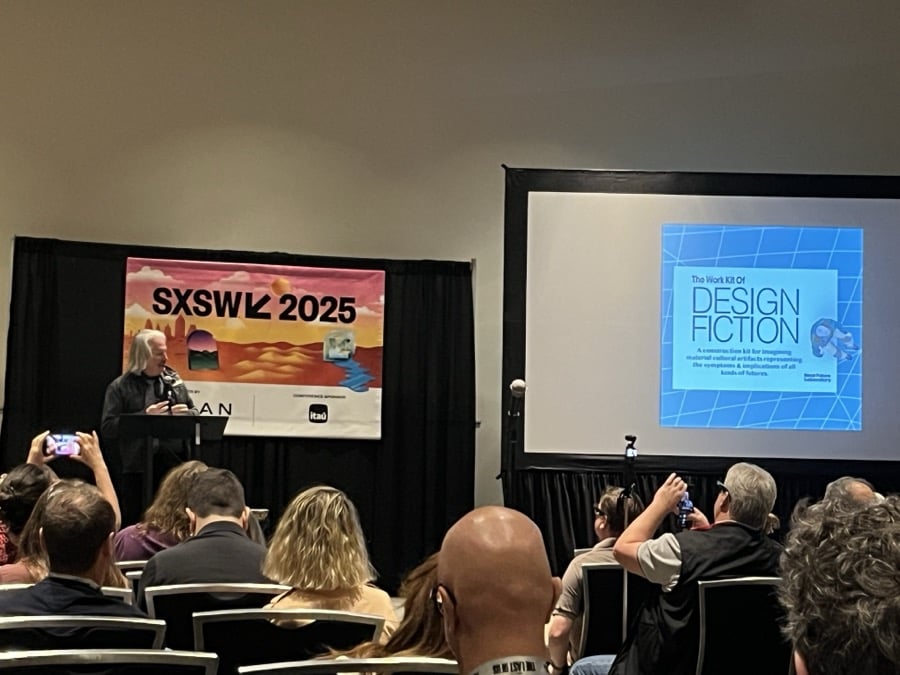 Back at SxSW earlier this year, Bruce Sterling revisits the essential concept of 'design fiction,' reflecting on how speculative prototypes can influence our current technological landscape. He draws connections between iconic sci-fi elements like the Communicator from “Star Trek” and real-world advancements,
highlighting the dialectic between imagination and reality. Sterling emphasizes the need to revive and iterate upon imaginary narratives from visionary thinkers like Primo Levi. Rebuilding these visions is not just an exercise in nostalgia. It is really a way to inspire innovative solutions for contemporary challenges. Sterling‘s argument is that connecting past speculative visions to present-day issues can help shape a better future. Here a particular kind of creativity that is able to imagine broadly alternative futures, suggesting that such exercises can materially drive evolutions in the worlds we inhabit. Engaging with speculative fiction can empower designers and technologists to envision possibilities beyond the limits of current paradigms. This all calls attention to the necessity of interdisciplinary thinking in tackling complex problems. Ultimately, he advocates for a proactive approach to the future, where resurrecting old visions can lead to concrete advancements. Read more →
| |
| |
| From The Laboratory’s Project Archives
| A Card Deck for Navigating Uncertainty Author: Near Future Laboratory, Dawn Lozzi, Mike Kruzeniski The Drift Deck (Analog Edition) is an algorithmic puzzle game used to navigate city streets. A deck of cards is used as instructions that guide you as you drift about the city. Each card contains an object or situation, followed by a simple action. For example, a situation might be — you see a fire hydrant, or you come across a pigeon lady. The action is meant to be performed when the object is
seen, or when you come across the described situation. For example — take a photograph, or make the next right turn. The cards also contain writerly extras, quotes and inspired words meant to supplement your wandering about the city. Processed in collaboration with Dawn Lozzi and Mike Kruzeniski who did all of the graphic design. Originally developed for exhibition/workshopping at the Conflux 2008 Festival, NYC, September 11-14, 2008
Explore Drift Deck →
| |
| |
| Books and Stuff
| TBD Catalog, The Manual of Design Fiction and more. Author: Near Future Laboratory All four books for only $60! Shop The Books →
| |
| |
| Items Found in the NFL Discord
| From the what’s-ai-good-for Channel DEPARTMENT OF Pulitzer Prizes For Everyone! | shared by Julian Bleecker, PhD AI just passed a new literary test: after being fine-tuned on an author’s collected works, it wrote a scene that creative writers found more powerful than anything their
human peers could craft. The future of fiction just got a lot stranger—and more competitive. $
Read On →
| |
| From the meshtastic Channel DEPARTMENT OF Censorship-Resistant Tech | shared by meshtastic Reticulum makes it possible for anyone to spin up secure, censorship-proof networks using off-the-shelf hardware. No gatekeepers, no surveillance, just pure autonomy and privacy—encrypted end-to-end, everywhere. Read On →
| |
| From the meshtastic Channel DEPARTMENT OF Not A Phone | shared by dré-labre A tiny powerhouse for makers, the T-Display P4 brings together a vibrant touchscreen, Wi-Fi 6, Bluetooth, camera, and LoRa in one sleek board. Sold out now, but a dream for anyone who loves building smart tech. Read On →
| |
|
From the 🛠-whats-ai-good-for-anyway Channel DEPARTMENT OF The Artistic Revolution Will Not Be Tokenized | shared by Julian Bleecker, PhD “AI is transforming the way artists create, offering new tools and possibilities that enhance creativity rather than diminish it. From generating
ideas to refining techniques, AI is becoming an invaluable collaborator in the artistic process. The implications of AI on artists and creative professional raises concerns, questions, antagonisms all of which you’ve heard of already: originality, authorship, and the economic impact of AI-generated works. But, the debates and discussions continue
around how AI — liek most of the previous technological evolutions — may redefine the nature and the very meaning of creative work.” $ Read On →
| |
| From the what's-ai-not-good-for Channel DEPARTMENT OF Botched Wasteland Recap | shared by anon Prime Video’s “Fallout” recap of season one tried to bring everyone up to speed, but an AI voice and some botched facts seemed to indicate
that no one actually checked the recap for, you know — it actually being a recap of season one. Seems the AI that generated the recap inferred that the show was set in the 1950s when, in fact, it’s set in 2070 that just happens to have a sun dappled 1950s retro vibe.
Read On →
| |
| |
| Classifieds Section
| |
| MBZUAI HCI Apps Due Feb 27, 2026 (5 p.m. GST) MBZUAI stands out as a powerhouse for artificial intelligence education and research, and their HCI Department is accepting applications for their incoming cohort of Doctoral Students. The university offers a range of
programs—from undergraduate internships to PhDs and specialized master's degrees like Applied AI—catering to students at every level. Its research labs focus on hot topics like computer vision, machine learning, and natural language processing, while its innovation centers support startups and digital health. The campus buzzes with events, partnerships, and resources that fuel both academic and entrepreneurial ambitions. Whether you're looking to join a fellowship, collaborate on AI projects, or
tap into career services, MBZUAI is building a global network for the next generation of AI leaders. MBZUAI PhD HCI Program | |
|
Join the Near Future Laboratory Discord Your support helps
| Near Future Laboratory Patreon Join the Discord, Support Office Hours, the Newsletter and More
| 
| The Near Future Laboratory is supported by its community and members.
Join us on Patreon to support our work, get access to exclusive content, and be part of our vibrant Discord community where we discuss design, technology, creativity, the future and do projects and support each others' work. I
host weekly Office Hours for Patrons — now for 289 weeks and running — every Friday at 0900 (UTC-7 / California). It's a great way to connect, ask questions, and get feedback on your projects. Each week two people from the community present a project, idea, or challenge and we discuss it together. It's a great way to get feedback, learn from others,
and connect with like-minded people. All of this is done in a friendly, supportive, and welcoming environment. We have people from all over the world, from all walks of life, and with all kinds of interests. It's a great way to meet new people, network, show what you can do, and learn from each other. In this time of rapid change and uncertainty, it's more important than ever to have a community of people who can support you, challenge you, and help you grow. The Near Future Laboratory is that community. | Join →
|
| |
| |
|
|
|
|