Near Future Laboratory Newsletter
Join nearly 21,000 members connecting art, product, design, technology, and futures.

Date: October 27, 2025

Summary:

Essentially:

But why?

Near Future Laboratory – w44y25
Frameworks make us feel safe, but imagination thrives in ambiguity. Play, not process, keeps the creative mind alive.

It's Week 44 of 2025 and frameworks sometimes hurt my head

View/share online

Near Future Laboratory Work Kit of Design Fiction in Action

I now realize that I'm an anti-frameworks kinda guy.

Maybe that's too strong.

I don't *hate frameworks. I just have trouble with them.

Like..actually cognitively. They hurt my brain meat a bit.

When I use them, I begin to see a kind of feeling of surety build up — a field of slightly satisfied confidence that leaves out the unexpected and potential for the excess that lives outside of that structure, and that confidence in the effectiveness of a framework.

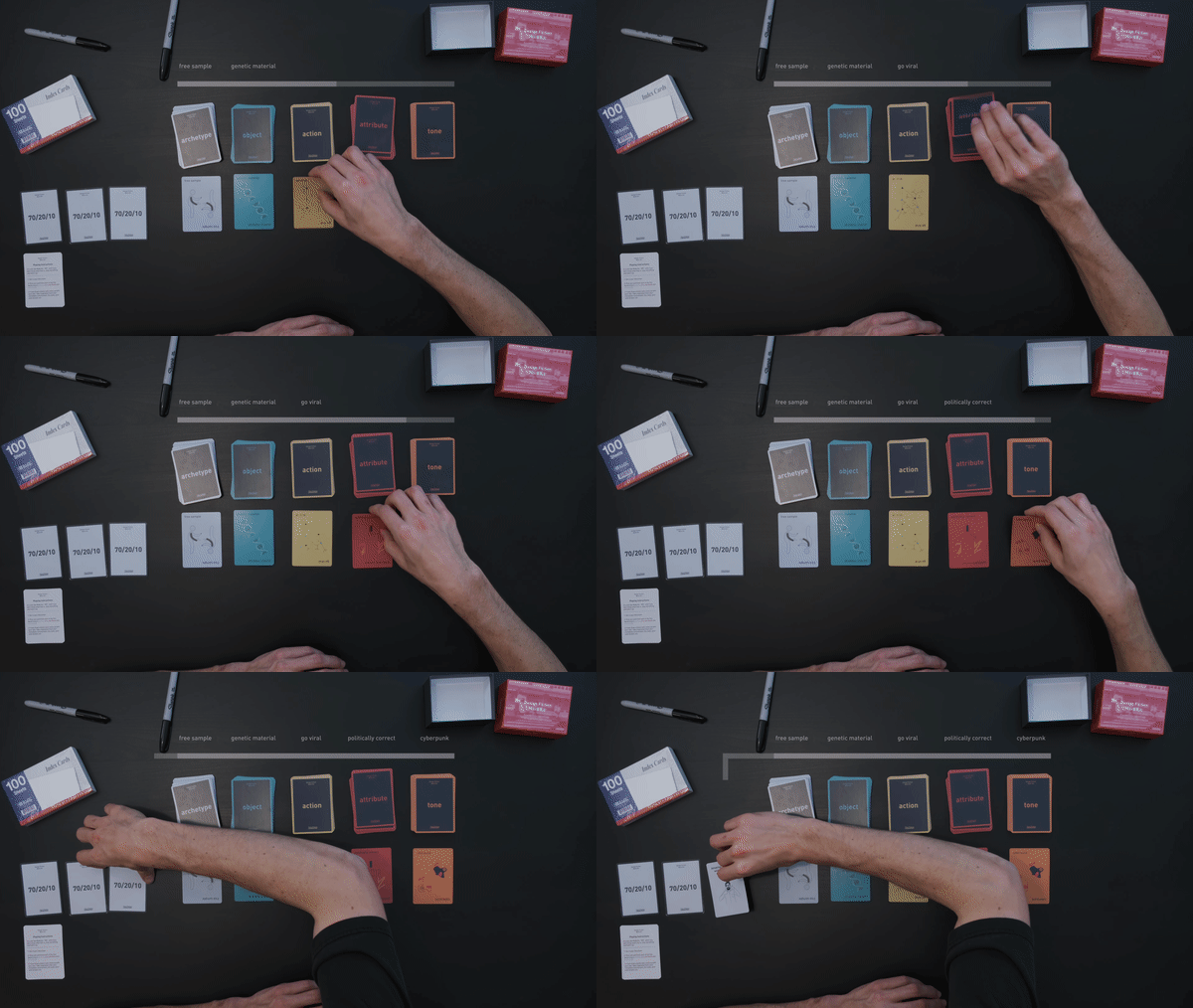
I found this old video that some students made back in the day showing the Work Kit of Design Fiction in action and that got me thinking about the power of open-ended, unframed exploration. No frames, just terrain to explore.

The Work Kit was meant to be simple and playful.

What struck me watching it again is how little structure it actually needs.

The cards give you just enough of a prompt to get going — a hint of order — and then the rest depends on imagination, improvisation, and a willingness to make meaning out of the mess.

Over the years I’ve learned that some people need structure and rules to begin. That’s fine. But the deeper skill — the one that matters most in creative and strategic work — is learning to move comfortably in open-ended space.

Too much structure, too much reliance on frameworks and analytics, dulls that muscle. It narrows one's field of view.

You stop noticing emergence. You stop being surprised.

When you over-index on structure, you start mistaking the map for the terrain.

We build elaborate frameworks to protect ourselves from ambiguity — and in doing so, we lose sensitivity to the unexpected, to the weak signals, to the moments of real breakthrough.

That’s what the Work Kit was designed to help with: to practice the art of embracing ambiguity in a playful, generative way.

Think of it as kettlebells or crossfit for the imagination — a way to strengthen your ability to contend with the unknown.

No Rules of Play.

Short Takes

Fewer Frameworks. More Fragments.

Strategy is an act of imagination

Suppose we shifted from traditional frameworks and consensus-building and moved towards curating encounters with fragments of possibility?

Might that allow multiple futures to emerge in strategic conversations?

Making futures tangible — through a field of fragments, artifacts, stories and prototypes — allows people to feel uncertainty rather than manage it away. It turns strategy into an act of imagination, helping stakeholders dwell within what could be instead of forcing possibility into the narrow shapes of existing frameworks.

Read more →

CODE BASE PAPERCAMP

Out of the Cloud and into a Book

I turned my digital life into printed books

Out of the Cloud and into a Book

You've heard it before — the web is getting more and more enshittified. Platforms rise and fall, ToS change, content disappears, and all the while your digital life scrolls away into oblivion.

This was largely motivated by my desire to preserve my 8+ years of work on OMATA, mostly solo, and the digital traces of that work that existed in Slack channels, Instagram posts, and various other digital artifacts.

What would it take to turn all that digital stuff into something tangible, something real, something you could hold in your hands and put on your bookshelf?

Thus I spent a bewildering, engrossing and occasionally frustrating amount of time (I suppose I could check the commit log, but I'm afraid) building a set of mostly Python tools that can basically transform most digital things into books.

Point it at a directory hierarchy of files, or a Slack or Instagram export, and out comes a print-ready PDF book. I even pointed it at my 7 years of weeknotes that I heaved out of a gigantic Markdown file and made a book out of that. Actually, that became two 600 page volumes.

P.S. That's gif there is every instagram post I made for OMATA from 2015 - 2025, printed into a book. (Videos became a grid of thumbnails.)

P.P.S. I ran it on IG Stories too, which was..interesting..Over 6000 pages to represent all of that. T'would make a mighty tome..or Gagosian gallery installation.

Fork this ▶

Friends of the Lab RECOMMENDED READS & RESOURCES

Partner/Product Name

Jarrett Previews “Design and Visual Communication” by Bruno Munari

Partner/Product Name

Friend of the, like..laboratory Jarrett Fuller reviews Bruno Munari's Design and Visual Communication, newly translated into English. Probably a good read for designers, design fiction practitioners, and anyone interested in the intersections of design, communication, and creativity.

One stand-out pull quote from Jarrett's review:

“For [Munari], design is not a strict set of rules, a specific range of formats, or even discreet professionalized disciplines. Instead, it’s an approach, a way of seeing and making sense of the world—the output of which could take any form.

Read the review →

Save Your Links

linkity-link

A cool, simple and minimalist way to publish interesting links on the web.

Another, other friend of the Laboratory, Brad Barrish shared this repo he created (with Claude) that it super simple to publish links onto a lightweight miniature web page. Like a personal link blog without the 💩 of the enshittifier vibe.

Visit the Github Repo →

From the NFL Community

The Imagination Gap

Back in Office Hours Side Projects Edition N°280, Pawel Halicki shared a thought-provoking reflection on the challenges organizations face in strategic thinking and future planning — and what to do about it.

Pawel reminded us that 96% of senior leaders lack time for straegic thinking, while the feeling is that the future arrives faster than ever — so faster than one can adopt strategy. So if you don't have a structured way to explore the future, you risk being left behind.

Is imagination the missing link? Pawel suggests that cultivating imagination within organizations is key to bridging this gap. By fostering a culture that encourages creative thinking and speculative exploration, organizations can better anticipate and adapt to future challenges.

From the Discord

From the the-dept-of-what? Channel

DEPARTMENT OF YOU JUDGE

This again..

James Padolsey exposes the fragility of using Large Language Models in decision-making, revealing how even minor tweaks in prompts can drastically alter outcomes. His insights into the biases inherent in AI evaluations raise serious concerns about the reliability of these models in critical areas like hiring and law.

From the the-dept-of-what? Channel

DEPARTMENT OF REAL FICTION

Implications of A.I. in storytelling

A.I. is making waves in Hollywood, from 'The Morning Show' to 'Black Mirror,' yet the industry seems oblivious to the ethical quagmire it creates. As labor disputes highlight A.I.'s encroachment on creative jobs, the gap between fiction and reality widens, leaving us to ponder the true cost of this technology.

From the 🖼-art-technology Channel

DEPARTMENT OF NOTE

Visual music system

Visual music transforms the concert experience by synchronizing visuals with melodies so that the musicians become both performers and visual artists. Sound and sight intertwine. Cool.

Join the Near Future Laboratory Discord COMMUNITY IS CREATIVITY

Near Future Laboratory Patreon

Join the Discord, Support Office Hours, the Newsletter and More

Near Future Laboratory Patreon

The Near Future Laboratory is supported by its community and members. Join us on Patreon to support our work, get access to exclusive content, and be part of our vibrant Discord community where we discuss design, technology, creativity, the future and do projects and support each others' work.

I host weekly Office Hours for Patrons — now for 281 weeks and running — every Friday at 0900 (UTC-7 / California). It's a great way to connect, ask questions, and get feedback on your projects.

Each week two people from the community present a project, idea, or challenge and we discuss it together. It's a great way to get feedback, learn from others, and connect with like-minded people.

All of this is done in a friendly, supportive, and welcoming environment. We have people from all over the world, from all walks of life, and with all kinds of interests. It's a great way to meet new people, network, show what you can do, and learn from each other.

In this time of rapid change and uncertainty, it's more important than ever to have a community of people who can support you, challenge you, and help you grow. The Near Future Laboratory is that community.

Join Us →

FOUNNDDD ONLINE

Movie Posters We Never Saw

It's the spooky season

GIF

The statute of limitations on “spoiler alert” for this one has well and truly passed on a 37 year old movie, but sorry anyway..

One of the best most underappreciated horror movies of all time is John Carpenter's They Live (1988). It's a brilliant satire of consumerism, conformity, and the media's role in shaping our perceptions of reality. So rich. So relevant today.

I remember showing it when I taught in the Film School at USC. Sitting in the Ron Howard Theater with a room full of film students who had never heard of the film — and got to see it for the first time. The gasps were priceless.

The first time I saw it was Seattle, grad school, my apartment, on VHS. A friend curated an evening of two movies. I don't recall the first film, but it was scary and a bit intense. Might've been Hellraiser? Then he popped in They Live as a kind of palate cleanser to take the edge off and keep the nightmares at bay. It was hilarious and terrifying all at once.