|
|
|
|
|
The Ontology of Objects
The feature of shipping futures
In Office Hours: The Side Projects Edition N°279, Hala Auf — a design student from IED Barcelona — presented her speculative design thesis.
She asked what happens when we stop seeing everyday things like cups and chairs as objects and start seeing them as verbs.
This isn’t about what these things are, as products.
It’s about what they do, as cultural agents.
Through Object-Oriented Ontology, she showed how a shared mate cup can bind a community, while a mass-manufactured plastic chair can flatten difference. It was poetic and architectural — design as grammar, culture as syntax.
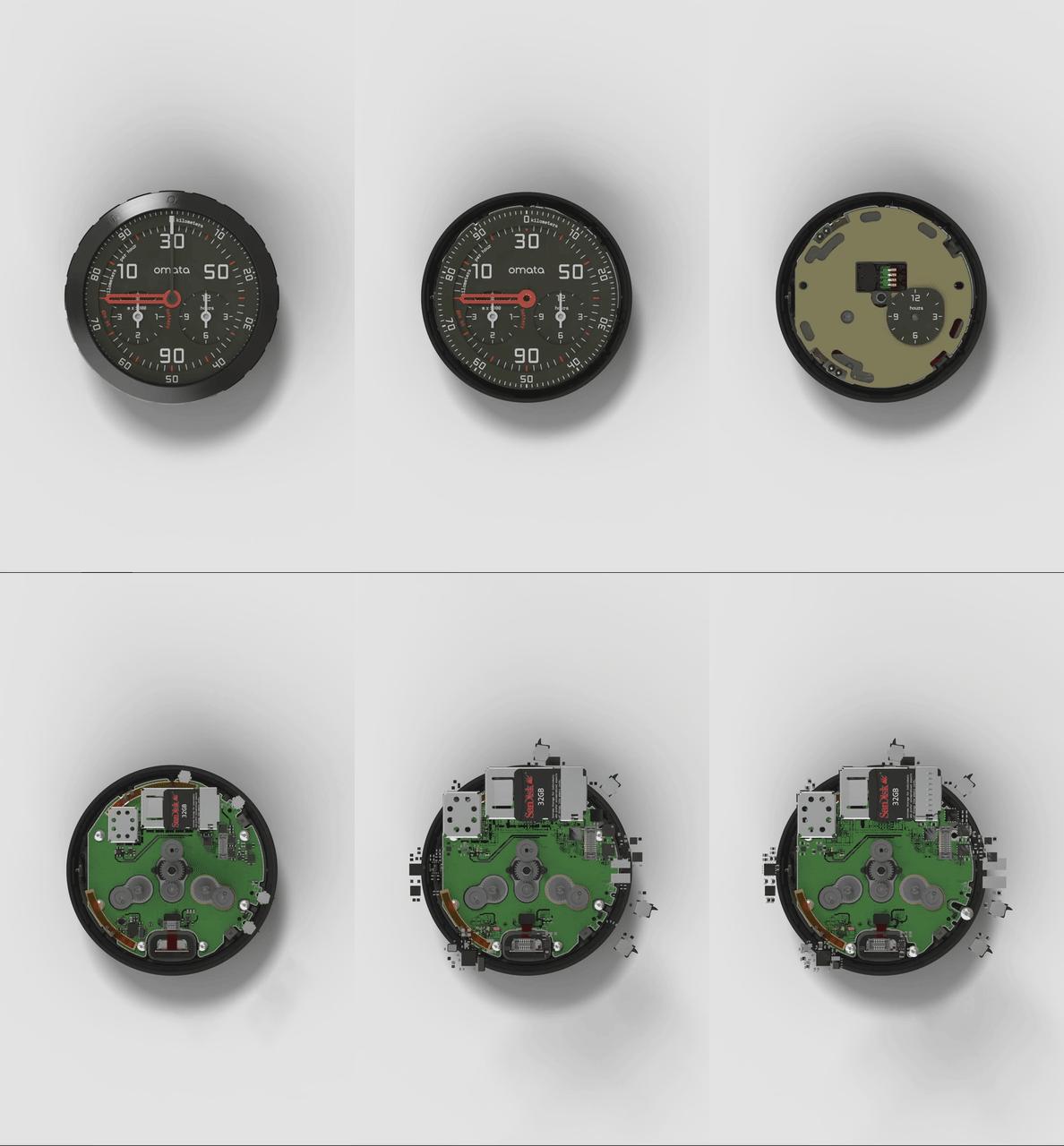
Listening to Hala, I kept thinking about my own decade building OMATA — a speculative idea made real. The question it raised for me was:
What does “what’s next” mean?
After years turning imagination into something tangible, I’ve learned that speculation doesn’t have to stay hypothetical. It can move all the way from idea to industry.
That’s the work I want to keep doing — bringing speculative, world-building practice inside organizations. Building small, hands-on teams that prototype possibilities, that ship possible futures, and make imagination a core capability.
Most companies have R&D for technology.
Few have R&D for culture.
Because the future isn’t something we predict.
It’s something we prototype.
If this resonates — if it makes you think differently about how imagination belongs inside organizations — share it with someone who might feel the same. Or reply. I’d like to hear how you see it from where you are.
Read More ⇒
|
|
|
|
|
It's one thing to talk about the future, but it's another to make it tangible. Once, the internet came in a box. It was a tangible artifact that made a possible future something you could see, touch, and use. There was also a time when jogging itself — yeah, I know! jogging! — did not exist. So Bill Bowerman — co-founder of Nike and legendary track coach — wrote a book called "Jogging" in 1967 to make that future tangible.
Today, organizations need similar artifacts — 'functional fictions' — to navigate the rapidly changing landscape of AI and technology. By building these tangible probes quickly, teams can explore new possibilities and define the future rather than just reacting to it.
Without such practices, organizations risk falling behind in a world where adaptability and foresight are crucial.
What's to be done, then?
Rather than fixating on predictions, organizations should focus on creating 'functional fictions'—tangible artifacts that embody possible futures. These artifacts serve as conversation starters, helping teams explore new possibilities and define the future actively.
By building these tangible probes quickly, in two-week or four-week sprints, teams get a chance to explore and learn hands-on, while the field is still vast and unexplored. This approach complements traditional R&D and design-team concepting, augmenting our capacity to imagine. Holding a piece of the future, even if fictional, helps us start inventing instead of waiting. It helps us rehearse the future instead of merely predicting it. It helps us turn imagination into a competitive advantage. It helps us create a culture of experimentation and exploration.
|
|
|
|
|
|
|
|
|
Office Hours The Side Projects Edition
Sign up to share your side project
Office Hours is my weekly open discussion session, now featuring 'Side Projects Shares'. Up to three people share a side project at whatever stage it may be at. We've had ideas with no deck to refined presentation of thesis projects.
Each share is a tight 10 minutes, followed by 20+ minutes of discussion and reflection, always generative and always generous.
Don't want to share, but just attend? Subscribe to my Luma and get notified when I announce each week's Office Hours.
Read More ⇒
|
|
|
|
|
Tomorrow's News, Today! A Design Fiction Dispatch from a Possible Near Future
|
|
|
|
Largely Languid Models
Esalen Brand Emotionally Supportive Intellectigences
Some describe the Largely Languid Models as the most languid and lackadaisical of all the large language models, and they are not wrong.
Contiguous supportive ESIs from Esalen Institute's Intellectualization Study Group are specifically and personally calibrated to produce gentle flows with prescriptive harmonious narrative styles of output.
Ideally suited for creating soothing or introspective wrap-arounds and immersives and are fully plug-in compatible with most LCE routings meaning all of your home and value-creation chain activities will help you maintain a healthy, well-regulated consciousness that you, your family, and your co-creation collaborators will notice right away.
PRS ESI LLMs backed by the millenial insights and foresighted learnings, gatherings, and teach-ins of Manly P. Hall the noted parapsychologist, parastrategist, prognosticator, predictionator, business alchemist, cryptic cynic, theorist, and mentalization personal trainer whose work continues to bring the teachings of the ancients to millions off-chain.
Read More ⇒
|
|
|
|
|
What's a Design Fiction Dispatch?
|
|
A design fiction dispatch is like receiving a telegram from the future that contains evidence of the world from which it has come. They are like a clue we might find left for us to unpack and interpret — transformations of speculations, prognostications, instincts, intuitions, extrapolations of today's news into a different form, like a music review, a news article, a product review or entry in a product catalog. Each is grounded to current contexts, events, developments, fears, hopes, dreams, dreads, anticipated outcomes whether hopeful or dystopian.
(And sometimes these dispatches may feel speculative to the point of science-fictional or bizarre. Consider that in some sense, science fiction is a form of dispatch from the near future.)
Design Fiction Dispatches contain 'explainers' that put the speculation into context. A bit like backcasting only I start with the speculation and definitely avoid too much structure around the presentation.
I created these as ways to extrapolate today's contingent realities into possible futures, alternative pasts, and adjacent presents. Each dispatch is a speculation on how current events, trends, technologies, social rituals, and cultural phenomena might evolve. Of course, these dispatches are not predictions, but rather explorations of the potential implications and consequences of our current trajectory.
|
|
|
|