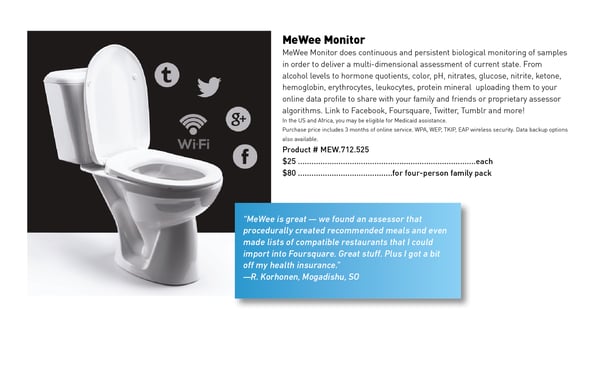
MeWee Monitor does continuous and persistent biological monitoring of samples in order to deliver a multi-dimensional assessment of current state. From alcohol levels to hormone quotients, color, pH, nitrates, glucose, nitrite, ketone, hemoglobin, erythrocytes, leukocytes, protein mineral uploading them to your online data profile to
share with your family and friends or proprietary assessor algorithms.
Link you biometrics to Facebook, Foursquare, Twitter, Tumblr and more!
In the US and Africa, you may be eligible for Medicaid assistance.
Purchase price includes 3 months of online service. WPA, WEP, TKIP, EAP wireless security. Data backup options also available.
About thirteen years ago, I published this
“MeWee Monitor” toilet from some likely future as one of a hundred or so speculative product concepts/prototypes in TBD Catalog, a near-future department store catalog from another timeline. “MeWee Monitor” was a bookmark from the future of sorts — an intimation that toilets would become “smart”. (The
10 year anniversay edition of TBD Catalog updated the “smart” idiom to OpenAI, fwiw.)
Then (and now, but a different register) ”smart” things were trending. Smart homes. Smart chairs. Smart doors. Smart pills. Smart cars. And on
and on. So..it wasn't a stretch to imagine a smart toilet and so we put in this MeWee Monitor to stand in for that inevitability.
To be absolutely clear — MeWee was never meant as prediction; it was an act of Design Fiction — a way of illustrating and representing trends around consumer obsessions with data, optimization, and health. Design Fiction
augments the meaning of analytics — grounding abstractions in a relatable, felt, often provocative fashion. It brings a level of impact that a table or graph — or even written scenario — cannot obtain.
And so now..here we are.
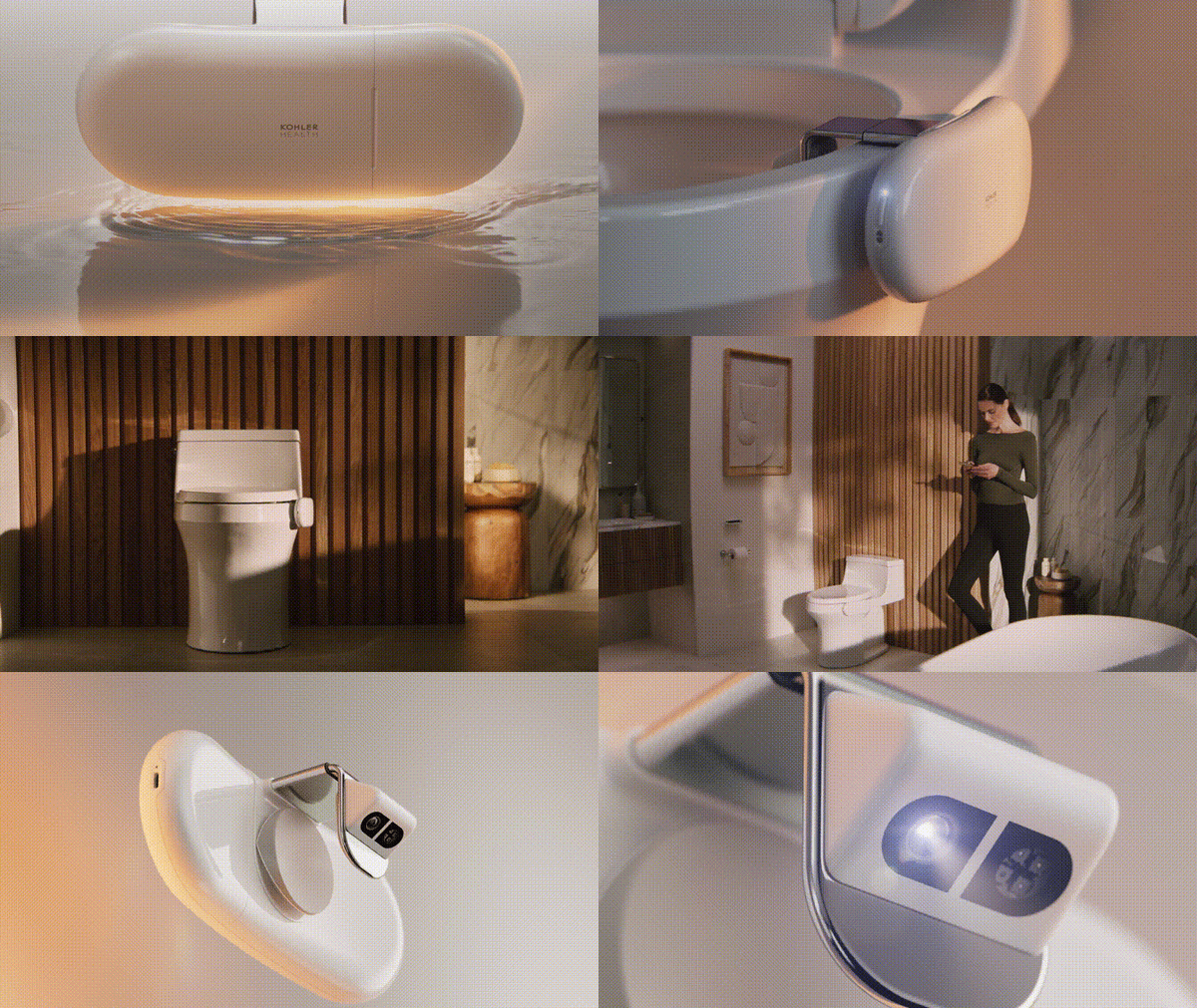
Kohler just announced Dekoda, a toilet equipped with optical sensors(!),
cameras(!!), and machine learning — marketed as a “health platform.” It’s almost word-for-word the same proposition, only minus the irony (unless it is..). Fiction has been kneaded and folded into our odd present.
What’s most interesting (and maybe a little disheartening) about moments like this is that they reveal how Design Fictions don’t so much
foretell the future as instantiate its logics — the trajectories already in play. TBD Catalog’s toilet was not at all prophetic, nor intended as such; it was simply an extrapolation of the overdetermined logics of technological progress and the relentless quantification of the self. Once those logics exist, they almost inevitably express themselves, whether as satire, speculation, or...a shipping product.
There’s something both comforting and sad about that. Comforting, because it suggests the future isn’t chaotic — we can, in fact, trace its directional flow.
It's sad, because it hints at how little room we allow for deviation. It’s as if imagination itself has been automated; the future just
keeps filling in the blanks.
Maybe that’s the real power of Design Fiction — not to predict the future, but to give us a means to practice it. The fact that something like the “smart toilet” can cross from satire to SKU isn’t just evidence of inevitability; it’s proof that
the imagination is a production engine. Fiction leaks into reality all the time.
The question then becomes: whose fiction are we making real? Can we make the futures we might prefer to inhabit real?
So..what's
the point to all of this?
It's to point to this: Design Fiction is a practice and a tool — a deliberate, creative instrument for organizations that want to explore what they can’t yet brief, budget, or build. It lets teams play with trajectories before committing to them, to rehearse the consequences of ideas in material form, and to find the unique,
unseen opportunity hiding just beyond the obvious.
In a world where everyone is optimizing toward the same metrics, chasing the same bit of cheese, Design Fiction restores the capacity to imagine differently — to sketch not just the next product cycle, but the next possible world in which that product might matter. To explore like an expeditionary team
into adjacencies that sit just to the side of the logic of pre-determined futures.
The future isn’t a zero-sum game. It’s an expansive terrain with lots of possibilities to explore, waiting to be mapped by those willing to speculate boldly and prototype imaginatively. That’s not prediction. That’s competitive imagination.
p.s. Want to imagine into your organization's possible near future in a more tangible way than a report? Or augment foresight analysis into something more relatable? That TBD Catalog workshop approach is what you want. Let's talk about how to we can work together! Let's get in touch!


