Near Future Laboratory Blog
Thoughts, Reflections, Updates & Week Notes
Oct 14, 2025 – Nov 15, 2025
w42/w44/w45/w46/w47/ (cc) Metalabel
Nov 15, 2025
This is Metalabel's practical guide for creative people who love making work but struggle with promotion. It offers twelve principles such things as “do it *for* yourself” and “small is beautiful” to things like release windowing, hosting events, and making the next thing. All of this reframes marketing as care, context, and community rather than chasing metrics. It's got examples, anecdotes, and contributions from other creators (me too!), it argues for defining your own version of success, protecting your creative joy, and staying devoted to the long-term practice of making. It seems to still exist as a living/evolving Google doc. When I was promoting The Manual of Design Fiction, I found myself reflecting on the challenges creative people face when it comes to promoting their work. This was particularly acute when my co-authors simply could not do that kind of work. Creatives love to create (obs) and love making things but (strangely) dread the promotional side of things. This...
creative practicepromotionmetalabelprinciples
Nov 15, 2025
My second annual visit to Chapman University for Jillian Warren's course in Chapman's graphic design program. This year, I gave a talk on speculative design and design fiction and we had a fun workshop with Q&A discussing the role of speculation in visual design and communication. One of the consistent questions that has been coming up in these talks is, not surprisingly, is something around “How do you make a living doing speculative design?” or “How do you get paid to do design fiction work?” It's come up so consistently — from the Harvard-Westlake panel on AI last week, to the four hours of fun one-on-one's with Liam Young's students at SCI-Arc yesterday — that I feel like I need to put something together on that point..at some point..
What's The Point of Design Fiction?
Nov 12, 2025
The value of Design Fiction isn’t prediction. It’s a method for making the abstract tangible—a way to embody trends, hopes, and anxieties so they can be discussed, debated, and designed with, not just around. A prototype like MeWee Monitor doesn’t forecast; it makes meaning felt. Using Design Fiction within organizations allows teams to experiment with the future in the present much like the way R&D once explored new technologies before quarterly metrics eclipsed curiosity. It gives companies a safe way to ask what if when the usual tools can only ask what’s next.
aidesign fictiontoiletsensorspurpose
A Panel on AI at Harvard-Westlake School
Nov 06, 2025
Last week I was invited to sit on a panel about AI — surprise — at of all places, a local high school here in Los Angeles called Harvard-Westlake. It was part of an event they called NextGen where they bring in people from various fields to talk about what the future might hold.
event
The function of foresight is to have the intrepid consciousness to notice outloud what others overlook
Nov 04, 2025
Foresight done well isn’t prediction; it’s the discipline of noticing what others overlook, venturing into plausible futures, and returning with tangible proof such as artifacts, images, products, stories that teams can act on before momentum calcifies. This mindset “sees around corners”: it treats weak signals as invitations and turns them into options the organization can actually use. That’s the throughline in my work, from publishing “Hello, Skater Girl” the world's first photobook of woman skateboarders, to building my company OMATA, I treat weak signals as invitations and turn them into options others can actually use. Like Dick Fosbury going over the high bar backwards at the 1968 Mexico City Olympics, this mindset challenges assumptions to unlock new perspectives, show optionality and possibility and hints of what could be. It’s attention, curiosity, and timely action that any organization needs integrated as a matter of its core practice in order to expand the strategic field of view and create practical...
skateboradingphotobookphotographymindsetnoticingforesight
A Design Fiction Dispatch
Oct 29, 2025
As generative AI continues to evolve, new camera technologies are emerging that allow users to capture images from anywhere in the world. Couple that with most everyone's experiences of disruption during the pandemic, the shit-show that airline travel has become, economic and social upheavals, and you can begin to sniff out weak signals of new forms of travel-like experience. Things like virtual travel experiences on Microsoft Flight Simulator, hours-long live streams of walking through cities (with an ASMR-like ambient audio of the bustle of the city streets), and many more. How might these technologies evolve further, enhancing the experiences with photo albums of places “visited”, 3D printed souvenirs, and more? How can the traditional travel industry adapt to these changes? What new forms of “experience” might emerge in this context? How will social norms around travel and destination experiences evolve in response to these technologies? This Design Fiction Dispatch explores the implications of these emerging technologies on the...
aigenerative aitraveltourismfuturesdesign fiction
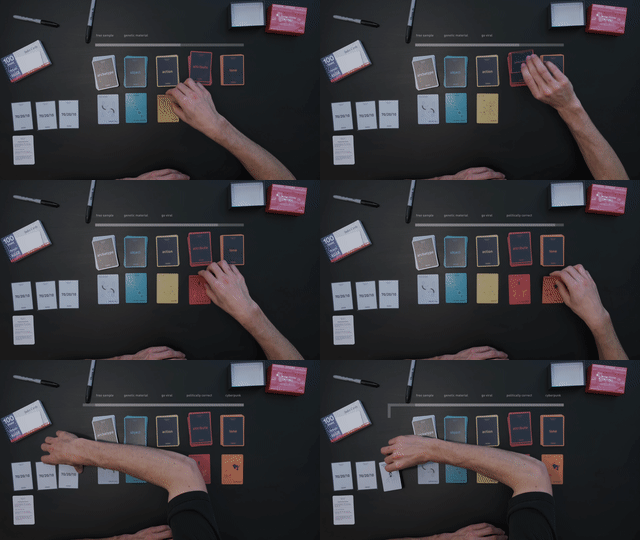
The Work Kit of Design Fiction
Oct 26, 2025
I found an old video that some students made back in the day showing the 2nd edition of the Work Kit of Design Fiction in action. It's fun, simple, and makes good use of a Lazy Susan. The overall sensibility is that there are some basic mechanics to playing with the work kit, but no rules of play. Some people need structure and rules to get going, while a small number of people can just dive in and start playing without any rules at all. My belief is that developing a muscle to contend with open-ended play is vital for bulking up one's ability to deal with ambiguity and uncertainty, vital capabilities for strategic thinking, futuring, and just contending with the complexity and vagaries of life in general. The Work Kit was originally developed for the first TBD Catalog workshop and has gone through I think three editions, and at least one “fork” by Mateusz who made a Swedish edition....
work kit of design fictioncard gameimaginationstructureunknown-unknownsambiguityuncertaintystrategic thinkingfuturing
‘cause I still really want to know
Oct 15, 2025
I once overheard a poet say that “the primary purpose of poetry is to keep the primary vision of childhood alive into adulthood.” What I think this means is that poetry serves to keep the imaginative sense of wonder and possibility alive. Preserve the physical embodied perception of the world that children have before they are taught to see the world in more conventional, adult ways. Poetry, in this sense, is a way of maintaining that imaginative connection to the world and to ourselves. So what's that got to do with AI, anyway? Because, you know — I really want to know. Could it be that it is like this enticing, weird, eery new terrain that we don't yet understand, and poetry is a way of exploring it in a way that is not rational, ordered, or logical? And we need some of that non-rational, non-logical, non-ordred mechanisms for sense-making that revert us to a...
poempoetryaidesignproduct designCultural R&Dexpeditionary teams
Revisiting a Future Vision from the Past
Oct 14, 2025
What is it about camera and the camera image that is so powerful that it keeps getting re-imagined and re-invented? Sascha Pohflepp's "Blind Camera" project from 2006 is a brilliant exploration of this question, and its relevance is more pronounced than ever in today's AI-driven world, particularly in the context of image generation and manipulation. Now today we have a Poetry Camera that prints poems of what it sees, and Matt Webb's Poem/1 delayed Kickstarter project that generates poems that rhyme the the time of day. These projects, like Pohflepp's Blind Camera, are examples of ways of casting our imaginative consciousness into new terrains of possibility — and doing so in a material way that is tangible and experiential. And they are specifically expeditionary because we never expect for these to become commercial products. They are provocations, explorations, and experiments that challenge our conventional understanding of what a camera is, what a poem is, and how we...
camerapoetryproduct designAICultural R&Dexpeditionary teams