Near Future Laboratory Blog
Thoughts, Reflections, Updates & Week Notes
Mar 17, 2006 – Apr 9, 2006
w11/w12/w13/w14/w15/ Apr 09, 2006
The post reflects on the high costs associated with attending the ACM SIGCHI 2006 conference, highlighting the frustrations of researchers like Anne Galloway, who plans to crash the event. The author shares their own disheartening experience from a previous workshop they organized, where despite their efforts, they still faced hefty fees. This commentary raises questions about the fairness of funding in academia and the sacrifices made by those who contribute to the field.
chi2006SIGCHIGeneral
Apr 05, 2006
Nicolas Nova, who will be joining us at the Networked Publics Conference, points to a International Herald Tribute article on user generated content. (Recently, there was an article in the NYT on a similar topic.)
Book Stuff

Apr 02, 2006
I’ve only started doing this blogging bit for a short while, after a few fitful starts. It’s hear because I need a research notebook, and I’m feeling good about making my inscriptions public (if you count the handful of people who skim this a public, why not?).
social networkssocial softwareBook Stuff

Mar 30, 2006
This two-day event will bring together new media scholars and practitioners to exhibit and discuss the roles of audiences, activists, and producers in maturing networked media ecologies. The event is organized by the Networked Publics fellowship program (netpublics.annenberg.edu) at the University of Southern California’s Annenberg Center for Communication.
General
Mar 26, 2006
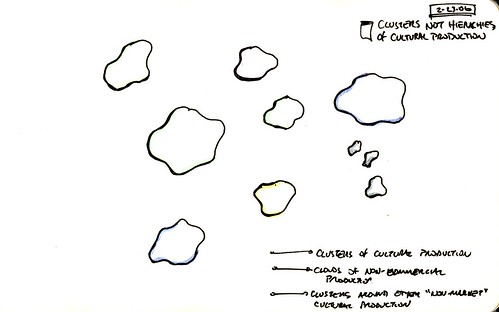
Reflecting on Yochai Benkler's insights, we find ourselves pondering the architecture of culture. The traditional top-down structures no longer serve us; instead, we must embrace a model that celebrates the clusters of creativity and connection among individuals. These clouds of cultural production offer a more nuanced understanding of how meaning circulates, allowing us to envision a future shaped by collective imagination and shared experiences. In this dynamic landscape, everyone has a role in weaving the fabric of culture, crafting a harmonious existence filled with possibility.
theory objectBook Stuff

Mar 26, 2006
I’m liking this Theory Object business more and more.
making things publictheory objectBook StuffDesignDesign as StrategyDesign for ImplicationsTheoryUndesignCraftpractice
Mar 23, 2006
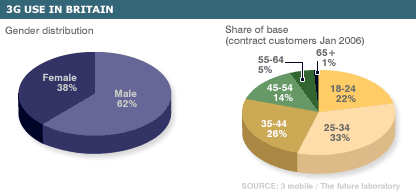
This article was lurking in a Smart Filter in NetNewsWire.
theory objectSocial Practice

Mar 22, 2006
I am just coming back from a round-up quick tour around the South Bay over the last two days. I came up here to San Jose at the invitation of Jyri Salomaa from Nokia, Beijing, who is the Research Manager for Asian Mobile Gaming at Nokia. Jyri invited a few of us out to dinner to discuss the mobile projects going on…
blogjectsspimesSunSpotstheory objectGeneral
Mar 17, 2006
This “Theory Object” business — I’m trying to work out what it might mean through practice, through the activity of making things. As Bruce Sterling said in his wonderfully rabinical talk at SXSW just the other day, “A Theory Object is a kind of Theory Object.” It’s got that geeky recursion, like GNU — GNU is Not Unix.
theory objectBook StuffDesignDesign for ImplicationsTheoryBlogjectsDesign FictionLatour