Near Future Laboratory Blog
Thoughts, Reflections, Updates & Week Notes
Aug 28, 2006 – Sep 19, 2006
w35/w37/w38/ Sep 19, 2006
With the rise of pervasive electronic games, we are entering a realm where gaming transcends traditional boundaries. These games weave themselves into the fabric of our daily lives, transforming mundane spaces into vibrant arenas of interaction. By harnessing mobile devices and location-based technologies, players can experience gameplay that is not confined to a couch or a console. Join me as we explore this exciting frontier, where the real world and virtual adventures collide, creating a new narrative for gaming enthusiasts everywhere.
General
Sep 17, 2006
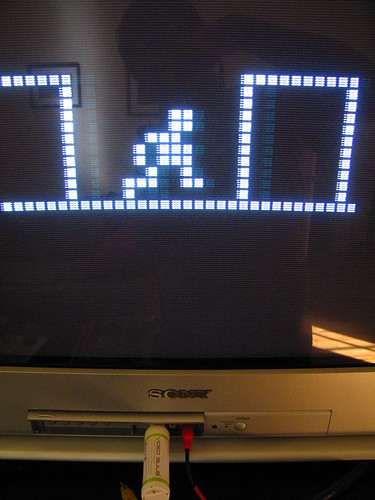
So, anyway. I heard about this gadget a few years ago, but it kind of rolled off my brain. I saw some documentation about it again for this summer’s SIGGRAPH, and then I saw the Device Art article in Intelligent Agent a week or so ago and I decided I should get one — it was resonating with a bunch of stuff. I figure…
device artdigital artArt TechnologyBook StuffDisruptionTheory Object
Sep 17, 2006
John Maeda’s book Simplicity arrived the other day. It’s small, so I sat down to read it over breakfast. I hit a brick wall here, on page i (not page one, page eye, in the preface, I guess):
Uncategorized
Sep 17, 2006
A few notes on Vernor Vinge Paints the Future at Austin Game Conference as they pertain to some topics near and dear. I found the comments as transcribed to be interesting enough to frame a few thoughts around.
networked publicspervasive electronic gamessocial networksubicompBook StuffGeneralTheory
Sep 14, 2006
Should new modes of Leisure & Entertainment be created (or anticipated) that do not vector in on “industrial” entertainment models of production, distribution — even genre? That is, why would we expect that the forms of media apparati that are dominantly understood as “entertainment” or as “leisure” be able to acc…
Uncategorized

Sep 10, 2006
I just read through a short, incisive little essay by Machiko Kushahara called Device Art: A New Form of Media Art from a Japanese Perspective in the v6, n2 issue of intelligent agent.
Uncategorized
Sep 10, 2006
I was deliriously fortunate to have been invited to spend the weekend at Foo Camp a weekend ago and equally fortunate to have met a number of hardware makers and hackers including Nathan Siedel from Spark Fun and Colin Cross, engineer by day and open cell phone developer by night.
InnovationTheory Object
Aug 29, 2006
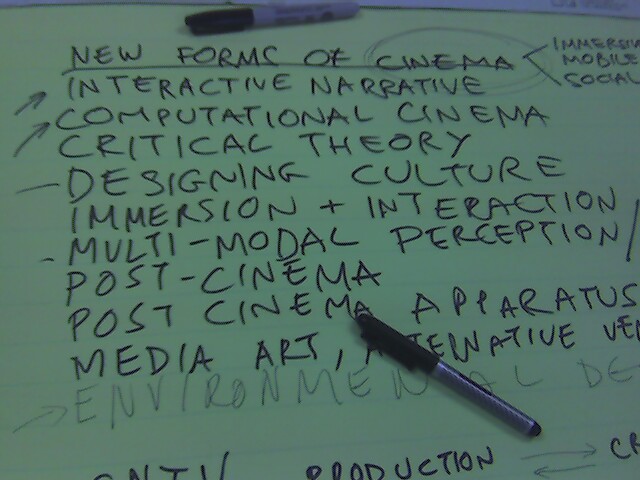
Perry and Andreas came up with this list in our new Collaborative Design Lab. Let’s just call it a to-do list.
UncategorizedTheory Object

Aug 28, 2006
We’ve just posted the 15 accepted papers for the Nordichi workshop on Near Field Interactions. More details at the workshop web page.
Internet of ThingsNFCnordichiRFIDtouchworkshopUncategorized